

Thinking about jumping into the Shopify Affiliate Program? Here’s my take: if you're a content creator who already has an audience in the e-commerce or business world, it's a fantastic opportunity. You get to back a brand that people already know and trust, and the commission potential makes it a really solid way to monetize your work.
What Is the Shopify Affiliate Program?
Think of yourself as a trusted guide for new entrepreneurs. Your job is to show them the best platform for building their dream store. That's pretty much what you do as a partner in the Shopify Affiliate Program.
It's a straightforward partnership: you earn a commission for every new merchant you send to Shopify through your unique affiliate link.
This screenshot from the official Shopify Affiliates page breaks down the simple, three-step process to get started.
As you can see, the focus is on partnering with a world-class brand, getting access to resources, and helping inspire others to start a business—all great perks for any creator.
For those who want a quick rundown, here's a simple summary of what the program offers.
Shopify Affiliate Program at a Glance
| Attribute | Details |
|---|---|
| Commission Rate | $150 per qualified referral |
| Payment Method | PayPal |
| Payout Threshold | $10 minimum balance |
| Cookie Duration | 30 days |
| Affiliate Network | Impact |
| Best For | Bloggers, YouTubers, course creators, and influencers in the e-commerce space |
This table gives you the essentials, but let's dig a little deeper into how this partnership actually works in practice.
How the Partnership Works
You're not just a salesperson; you're more of an educator and an advocate. The whole program is designed as a win-win-win:
- You introduce your audience to a powerful tool that can genuinely help them launch or scale their business.
- Shopify gets a new customer from your trusted recommendation, which is way more effective than a generic ad.
- You earn a nice commission for making that connection, creating a passive income stream from the content you're already making.
The reason this system works so well is because it’s built on trust. Your audience follows you for your expertise. When you genuinely recommend a platform like Shopify, they're much more likely to listen and take action.
This isn't about pushing random products. It’s about matching a genuinely useful service with an audience that actually needs it. Your credibility is your biggest asset here.
Why Promoting a Known Brand Matters
Let's be honest, promoting a household name like Shopify gives you a massive head start.
Unlike trying to sell some obscure, no-name software, Shopify doesn't require a hard sell. Most aspiring entrepreneurs have already heard of it. That immediately lowers the barrier to entry.
Your job isn't to convince someone that a new, unproven tool is worth trying. Instead, you're demonstrating the value of a platform they already recognize, sharing success stories, or creating tutorials that guide them toward making a final decision. This brand recognition makes your affiliate marketing efforts way more efficient and, ultimately, more profitable.
How Shopify Affiliate Commissions Work
Let's get down to the money part, because that’s what really matters in any partnership, right? The Shopify Affiliate Program keeps things refreshingly simple. They don't mess around with confusing percentages or complex revenue-sharing models. Instead, it’s a straightforward, fixed-bounty system.
Think of it this way: you get a one-time payment for every single new merchant you send their way who signs up for a paid Shopify plan using your affiliate link. It’s a flat fee, which makes it incredibly easy to figure out what you might earn. No need to track recurring commissions or do complicated math.
This "Partner, Refer, Earn" model is as clean as it gets.
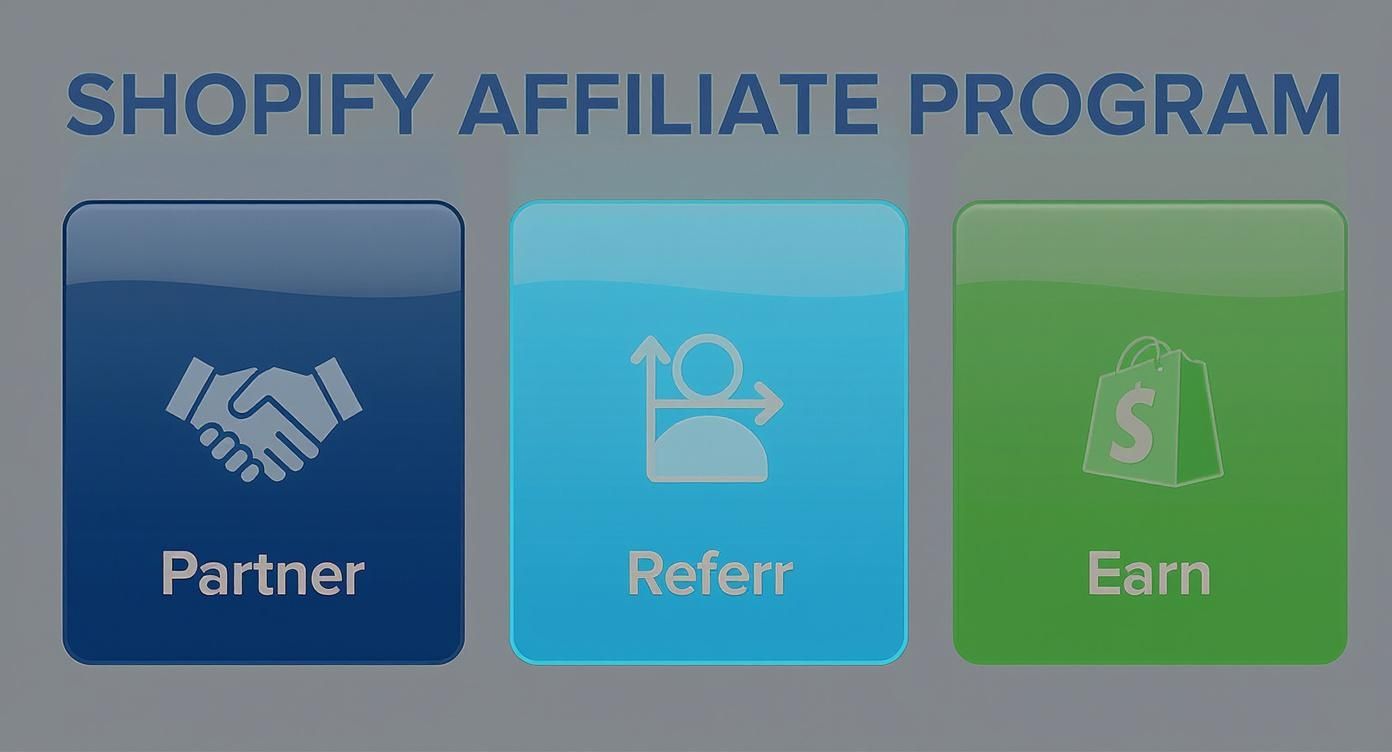
The whole process is designed to be linear and easy to follow. You do the work, you see the reward. Simple.
Breaking Down the Numbers
So, how much are we actually talking about? Shopify pays out a fixed bounty each time one of your referrals moves from a free trial to a full-price plan. The amount you pocket is tied directly to the plan that merchant picks, which is great because it rewards you for sending high-quality leads.
The core idea is simple: the more value your referral brings to Shopify, the bigger your commission. This puts your goals right in line with theirs—helping businesses find the best solution.
For instance, if someone signs up for the standard 'Shopify' plan, you'll get a set commission. But if you manage to land an enterprise-level client for Shopify Plus, that payout jumps significantly. This tiered structure encourages you to go after a mix of entrepreneurs, from small side-hustlers to massive, established companies. It gives you a few different ways to earn, whether you're playing a high-volume game or chasing high-ticket referrals.
Real-World Earning Potential
To put some real figures on this, Shopify affiliates typically earn an average of $58 per referral for users who sign up for paid plans. While the commission structure has changed over time, past data shows earnings could go anywhere from $100 to $500 per referral, all depending on which plan the new merchant chose.
With some affiliates reporting conversion rates around 6-10% for well-targeted audiences, you can see how this could become a pretty solid income stream. You can dig into more affiliate marketing stats over at DesignRush.
Because it's a performance-based model, your success is completely in your hands. The key is to create genuinely useful content that attracts serious entrepreneurs who are ready to build a business.
Here's a quick look at how your potential commission scales with the plans your referrals choose:
- Basic Plan Referral: You earn a solid one-time payment.
- Shopify Plan Referral: The commission gets bigger, reflecting the higher plan value.
- Advanced Plan Referral: Your payout increases again as the merchant invests more.
- Shopify Plus Referral: This is the top tier, offering a massive bounty for landing enterprise-level businesses.
At the end of the day, what you can earn comes down to the audience you build and how well you guide them. By understanding their needs and pointing them to the right Shopify plan, you create a win-win for everyone involved.
Getting Accepted into the Program
So, you're ready to jump into the Shopify Affiliate Program? Awesome. But hold on a second—while the application form is simple enough, getting approved isn't just about filling in boxes. Shopify is pretty selective. They're looking for partners who can bring real value to their world.
Think of it less like signing up for a newsletter and more like pitching a business partnership.
They want to see that you’ve already built something and have a solid plan for how you'll promote them. Just having a website isn't going to cut it. It needs to be an active, professional space that fits right into the ecommerce and entrepreneurship scene. Honestly, understanding what they're looking for in a partner is the most important part of any Shopify affiliate program review.
Key Eligibility Requirements
Shopify has a few core requirements that are absolute must-haves. These are the non-negotiables, the foundation of your application. If you miss even one of these, you're likely looking at an automatic rejection, so pay close attention.
Here's the baseline:
- Own and Run an Active Website: Your site needs to be live, functional, and look the part. A "coming soon" page or a personal blog about your cat probably won't impress them.
- Have an Established Audience: You need to prove you have people listening. This could be solid website traffic, a decent social media following, a YouTube channel, or an email list.
- Create Original Content: Shopify wants to see you're an active creator. Your site should be full of your own original articles, videos, or courses that are genuinely helpful to people interested in ecommerce.
- Experience with Ecommerce: You need to know your way around Shopify or at least another major ecommerce platform. They want partners who can speak from a place of real experience.
Nailing these requirements is just step one. The real challenge is making your application pop among the thousands of others they get.
How to Make Your Application Stand Out
Beyond the official rules, a winning application tells a story. It needs to scream to the Shopify review team why you're the perfect fit. They aren't just looking for affiliates; they're looking for true advocates for their brand.
Your application is your pitch. It needs to clearly communicate your value, your audience's relevance, and your potential to drive high-quality referrals. Don't just list what you have; explain how you'll use it to help entrepreneurs succeed with Shopify.
To really strengthen your case, get specific. Showcase your expertise in a particular niche—maybe it's dropshipping, print-on-demand, or B2B ecommerce. Detail how your content is already helping aspiring merchants solve their biggest problems.
It also helps to understand how different affiliate networks operate, as it gives you a broader perspective. For example, our Commission Factory affiliate network review shows how another major player structures its program.
Finally, frame your audience as Shopify’s ideal customer: ambitious entrepreneurs who are ready to build something real. When you present a clear, strategic plan like that, you dramatically boost your chances of getting that approval email.
The Pros and Cons for Affiliates
Let's be real: no affiliate program is perfect for everyone. This Shopify affiliate program review would be a waste of your time if I didn't give you an honest look at what it's really like to be a partner. You've got to weigh the good against the bad to figure out if it actually fits your business.
So, let's break it down.
On one hand, the program has some major upsides that are tough to beat. The biggest one? You're promoting a brand that everyone already knows and trusts. You don't have to spend your energy convincing people that Shopify is legit—they've already done the heavy lifting for you.
That built-in brand recognition makes your job way easier and leads to better conversions. When you recommend Shopify, you're not pushing some unknown, risky tool. You're pointing entrepreneurs toward an industry giant, which is a much simpler sell.
The Key Advantages
The perks go beyond just having a famous name on your side. Shopify has really structured its program to help its partners win.
Here are the main benefits:
- High Earning Potential: You get a solid fixed-bounty commission for every merchant you bring in. That can add up fast, especially when your referrals sign up for Shopify's higher-end plans.
- Excellent Marketing Resources: Shopify hooks you up with a ton of professionally designed banners, creative assets, and helpful content. This saves you a massive amount of time and effort.
- Strong Conversion Rates: Because Shopify is a household name in ecommerce, the traffic you send is more likely to convert. More conversions mean more commissions in your pocket.
As a whole, affiliate marketing is a proven winner. On average, brands see a return of $15 for every $1 spent on their affiliate programs. That’s a massive ROI, and it shows just how effective it is to promote a trusted product like Shopify. If you want to dive deeper, you can find more insights about Shopify affiliate marketing on afflr.io.
The Potential Challenges
But it’s not all sunshine and rainbows. The program’s popularity creates its own set of hurdles you need to be ready for.
The biggest issue is the competition. It’s fierce. You’ll be up against thousands of other smart creators, all trying to grab the attention of the same audience. To stand out, you need a unique angle, killer content, and a rock-solid strategy. For a look at a different kind of program, you might find our Outrank affiliate program review helpful.
The biggest hurdle isn't getting people to trust Shopify; it's getting them to trust your recommendation over everyone else's. Your unique value proposition is everything.
On top of that, Shopify has pretty strict rules for who gets in. They’re looking for established creators who already have an engaged, relevant audience and a professional online presence. If you're just starting out, getting approved can be a real challenge. This keeps the quality of their affiliates high, but it definitely raises the bar for newcomers.
Here's a quick side-by-side look to help you decide.
Shopify Affiliate Program Pros vs Cons
| Pros (The Advantages) | Cons (The Challenges) |
|---|---|
| Well-known and trusted brand makes for an easier sell. | Extremely high competition from other affiliates. |
| Generous commission structure with high earning potential. | Strict eligibility requirements can be hard for beginners to meet. |
| Access to high-quality marketing materials and resources. | Requires a unique content angle to stand out from the crowd. |
| Strong conversion rates due to brand recognition. | Approval is not guaranteed, even for established creators. |
Ultimately, it comes down to where you are in your affiliate journey. If you're a seasoned creator with an established audience in the business or ecommerce space, the earning potential is massive. But if you're new to the game, the high barrier to entry and intense competition might make it a tough nut to crack right out of the gate.
Strategies to Maximize Your Earnings
Getting accepted as a Shopify affiliate is the easy part. The real work is turning that partnership into a solid income stream, and that takes a bit more than just slapping a link on your website. In a crowded market, you've got to be smart and strategic.
Forget about just pushing a product. The affiliates who really kill it are the ones who act as teachers and guides. Your job is to become the go-to person for anyone thinking about starting an online store. Help them solve their problems, show them the ropes, and naturally, position Shopify as the best tool for the job. Do that, and you'll build the kind of trust that makes people want to click your links.
Focus on High-Value Content Creation
Don’t just tell people Shopify is good; show them. Get your hands dirty and create content that digs into the real problems new entrepreneurs face and demonstrates exactly how the platform fixes them. This is how you go from being just another affiliate to a trusted expert.
Some content ideas that work really well:
- Step-by-Step Tutorials: Literally walk people through setting up their first store, installing a key app, or designing a killer product page.
- In-Depth Case Studies: Find successful Shopify stores and break down exactly what they're doing right. People love seeing real-world proof.
- Niche-Specific Guides: Create guides for hot niches like dropshipping, print-on-demand, or even B2B ecommerce.
This kind of content pulls in an audience that’s already thinking about making a move, which means they're way more likely to sign up. If you want to get really advanced, you can even weave in psychology-backed strategies to get sales on Shopify to make your affiliate content even more powerful.
Target Lucrative Niches and High-Intent Keywords
To really ramp up your earnings, you need the right kind of traffic. That means getting serious about SEO and targeting keywords that scream "I'm ready to buy." Forget broad, generic terms. You want to chase long-tail keywords that people deep in the research phase are typing into Google.
Your ideal visitor isn't just vaguely curious about ecommerce; they're actively looking for the perfect platform to build their business on. Nailing this high-intent traffic is what creates a predictable affiliate income.
The United States is a goldmine for this. It's home to roughly 2.7 million Shopify stores, making it the biggest market by far. This even includes over 26,000 Shopify Plus stores—a huge opportunity for those high-ticket commissions from bigger, enterprise-level clients.
Optimize Your Conversion Funnel
Getting people to your site is one thing, but you still need them to click your link and sign up. You need a smooth, clear path from your content to Shopify's trial page. One of the best ways to nail this is with a dedicated landing page.
A good landing page strips away all the distractions and puts the focus squarely on one thing: getting the visitor to click your link and start a trial. When you tailor the message on that page to match the article or video that brought them there, your conversion rates can go through the roof.
To really get this down, check out our guide on creating killer https://danielproctor.com/affiliate-marketing-landing-pages/. It's this mix of valuable content, targeted traffic, and a slick conversion process that will separate you from the pack and put you on the path to becoming a top-earning Shopify affiliate.
Is the Shopify Affiliate Program a Good Fit for You?
So, should you jump in? The big question really comes down to this: where are you in your own journey as a creator?
This program isn't a one-size-fits-all deal. Think of it like a high-end power tool. In the hands of a seasoned pro—an e-commerce blogger with a steady stream of readers, a business coach with a loyal following, or a marketing agency that lives and breathes this stuff—it can build something incredible. These are the people who already have the audience and trust to make it work.
Who Is the Ideal Candidate?
The program really sings for creators who already have a few key things in place:
- An Existing, Relevant Audience: You're not starting from scratch. You're already talking to entrepreneurs, small business owners, or people dreaming of launching their own online store.
- Proven Content Creation Skills: You're a pro at making high-quality articles, videos, or courses that genuinely solve problems for your audience.
- E-commerce Expertise: You can talk the talk because you've walked the walk. You have real experience building an online business and can speak from a place of authority.
For these folks, the high commission rates and Shopify's rock-solid brand recognition are a killer combination.
But if you're a complete beginner without an established niche or audience? The road is going to be a lot steeper. The program's strict requirements and the sheer amount of competition can feel like hitting a brick wall.
The program rewards established authority. It’s designed for those who have already built a platform of trust, not for those looking to build one from scratch.
Ultimately, you have to be honest about where you're at. A good way to get a feel for whether Shopify aligns with what you can authentically promote is by comparing Shopify with other e-commerce platforms like Weebly. That context will help you make a final call you can feel confident about.
Common Questions Answered
Jumping into a new partnership always brings up a few questions. Let's tackle some of the most common ones that pop up for people considering the Shopify Affiliate Program.
Earning Potential and Getting Accepted
Naturally, the first thing people ask is about the money. How much can you realistically make? Well, it varies wildly. Beginners might pull in a few hundred dollars a month, while top-tier marketers with huge, engaged audiences can clear over $10,000. Your income is a direct result of your traffic, the quality of your content, and how well you can convert readers into sign-ups. There’s no ceiling, but it definitely takes consistent work.
Another big one is about application rejections. Why do some people get turned down? It usually boils down to a few straightforward reasons:
- Your website is brand new or looks abandoned. Shopify wants to see an established presence.
- You don't have any original, quality content that relates to ecommerce or business.
- Your audience just isn't a fit. They're looking for partners who reach entrepreneurs.
- There's no proof you know your way around Shopify or similar platforms.
Think of your application like a business proposal. Shopify needs to see a solid plan and proof that you can deliver value right now—not just an empty site with a promise to add content later.
The Nitty-Gritty: Tracking and Costs
So, how does Shopify even know a referral came from you? The system uses special affiliate links with a 30-day cookie window. When someone clicks your unique link, a small file (a cookie) gets saved on their browser. If they sign up for a paid plan anytime within those 30 days, you get credited with the commission. It works even if they browse other sites in between clicking your link and signing up.
Finally, what about hidden costs? Good news here: there are none. The Shopify Affiliate Program is completely free to join. No application fees, no monthly dues, and no minimum sales quotas. The only thing you invest is your own time and effort to create great content that sends high-quality referrals their way.
Ready to turn your content into a real business? Daniel Proctor provides the mentorship and step-by-step systems you need to succeed with affiliate marketing. Start building your passive income stream today. Learn more at https://danielproctor.com.
