


The short answer? A resounding yes. Especially if your audience is full of creators, coaches, or anyone trying to build an online community. The Skool affiliate program is absolutely worth promoting, and it really comes down to two things: a killer 40% recurring commission and a platform that people genuinely stick around for. That’s the perfect recipe for a reliable passive income stream from a single referral.
Why The Skool Affiliate Program Is A Compelling Opportunity
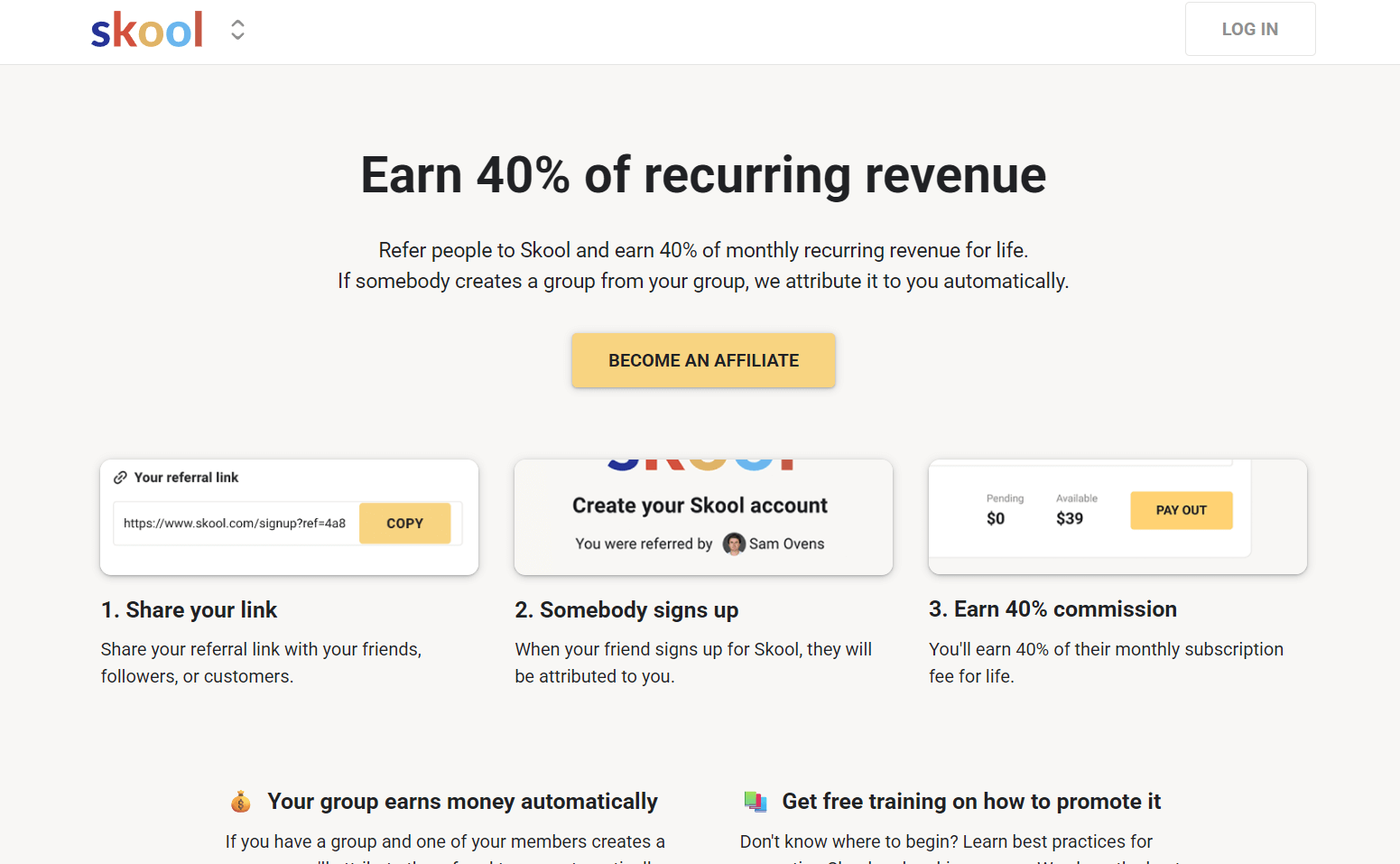
When I’m looking at any affiliate offer, I ask one simple question: does it actually help my audience while paying me fairly for the effort? Skool’s affiliate program nails both, making it a real standout in the crowded world of software products. Unlike a lot of programs that give you a one-time payout, Skool’s entire model is built on long-term, recurring cash flow.
Think of it like this: you’re a landlord for a digital property. You do the work to find a great tenant (your referral) just once. As long as they stick around and keep paying their rent (the subscription), you collect a cut every single month. This shifts your affiliate marketing from a constant hustle for new sales into a compounding asset that grows over time.
Before we dive deeper, here’s a quick look at what the Skool affiliate program offers.
Skool Affiliate Program At A Glance
| Feature | Details | Earning Potential Example (10 Referrals) |
|---|---|---|
| Commission Rate | 40% recurring on all subscriptions | $396 per month |
| Product Cost | $99 per month | $990 in total subscription fees |
| Your Monthly Cut | $39.60 per user | $396 |
| Annual Potential | Varies based on user retention | $4,752 per year |
| Cookie Duration | Lifetime | N/A |
| Payout Method | Tipalti (ACH, Wire, PayPal) | N/A |
This table really shows how quickly your earnings can stack up with just a handful of successful referrals, thanks to that recurring model.
Understanding The Earning Potential
The financial side of this program is straightforward and pretty powerful. You earn a 40% recurring commission on every active referral’s subscription fee. Skool’s main plan is $99 a month, which means you get $39.60 from every single user, every month they stay subscribed.
Get just 10 people to sign up, and you’re looking at nearly $400 a month, or over $4,700 a year. All from that initial push. To see how this stacks up, it’s worth comparing it against other top influencer affiliate programs out there.
This model is way more sustainable than the one-off commission structures you see elsewhere, like the one I covered in our Shopify affiliate program review. Now, platforms like Shopify are great, but their affiliate rewards are usually front-loaded. Skool is all about building that lasting, month-after-month income.
Why The Platform’s Design Benefits Affiliates
Skool’s success as something you can promote is directly tied to how “sticky” it is. The platform is built from the ground up to keep people engaged and subscribed. Here’s why:
- Integrated Community: It pulls courses, event calendars, and community chats all into one spot. This keeps users logged in and active because everything they need is right there.
- Gamification: This is a big one. Features like points, leaderboards, and content that unlocks as you participate make people want to come back every day. It feels less like a course and more like a game, which is huge for cutting down on churn.
- Simplicity: The interface is clean and doesn’t have a million distractions. It’s easy for creators to run and even easier for members to use, which leads to happier customers who are less likely to cancel.
This high user retention is your best friend as an affiliate. It means your referrals will likely stay subscribed for a long, long time, ensuring your recurring commissions just keep rolling in.
How The Skool Affiliate Program Actually Works
The Skool affiliate program is built on a simple idea that most other programs miss: recurring commissions. Instead of a one-time payout for a sale, you get paid month after month for as long as your referral stays subscribed. This is how you build a real, predictable income stream.
Think of it like being a landlord. You do the work once to find a good tenant (refer a user). Then, you collect rent every month (their subscription fee) without having to find a new tenant each time. It’s a model that rewards you for the long-term value you bring, not just a quick sale.
This works so well because Skool is incredibly “sticky.” People join for a course or community and end up staying because of the way it’s all integrated. Less customer turnover for them means more consistent commissions for you.
The Two Main Ways You Get Paid
You’re not locked into just one way of earning, either. Skool gives you a couple of different angles to play, depending on who you’re talking to.
- Promoting the Skool Platform: This is the straightforward route. You use your unique affiliate link to send creators, coaches, and anyone who wants to build a community to Skool’s main $99/month plan. For every person who signs up and sticks around, you get a piece of that subscription.
- Promoting Specific Paid Communities: Here’s where it gets interesting. Any community owner on Skool can launch their own affiliate program for their private group. This lets you promote their specific community directly to an audience that would be a perfect fit.
This dual-path system is super flexible. You can go broad and promote the platform itself, or you can get hyper-specific and recommend a niche community you know your audience will love.
Understanding The Nuts and Bolts
To make this work, you have to trust the tech behind it. Skool’s system is set up to make sure you get credit for every single referral you send their way.
At the heart of any good affiliate program is solid tracking. Skool uses a 60-day cookie window, which is pretty generous. It means if someone clicks your link but takes their time signing up, you still get the commission as long as they purchase within two months.
This is a huge deal. Almost nobody buys on the first click. They’ll see your content, poke around, maybe watch a few more videos, and then come back a week or two later to finally pull the trigger. That 60-day window makes sure you get paid for that initial influence.
Also, keep in mind there’s a $100 minimum payout threshold. This just means your commissions need to add up to at least $100 before you can cash out. It’s a good first goal to hit when you’re just getting started.
The commission rates for individual communities can be a real game-changer, too. Group owners can set their own affiliate rates anywhere from 10% to 50%. If you promote a community that costs $100 a month with a 50% commission, that’s a $50 recurring payment in your pocket for every member you refer. The potential to scale that is massive. You can learn more about how Skool is setting up community affiliates for success by checking out their latest business ideas.
Understanding Commission Rates And Payouts
The real test of any affiliate program boils down to the numbers. How much can you actually make, how often do they pay you, and what are the rules? Let’s get into the nitty-gritty of Skool’s commission structure, which is refreshingly simple and pretty powerful.
At its heart, the program gives you two main ways to earn. The most common route is promoting Skool itself to creators and coaches. For every person you refer who signs up for the standard $99 per month plan, you get a 40% recurring commission. That works out to be $39.60 in your pocket every single month, for as long as that person stays a paying member.
This recurring model is where the magic really happens. It changes the game from a constant scramble for new sales to building a steady, growing income stream. You do the work to get the referral once, and the money keeps coming in. It creates a predictable revenue that stacks up with every new signup.
The Two Commission Structures
While that 40% recurring commission is solid, Skool adds another layer that gives you even more ways to earn.
- Platform Commissions: This is your bread and butter. You promote Skool as the go-to platform for building communities, and you get that 40% recurring fee for every creator who signs on. It’s straightforward, reliable, and you can scale it up big time.
- Individual Community Commissions: This is where things get interesting. Community owners on Skool can set up their own affiliate programs for their groups, with commission rates anywhere from 10% to 50%. This lets you partner directly with creators and promote their specific, high-value communities to a very targeted audience.
This dual-track system means you can go broad and promote the platform, or you can get super specific and recommend a single group. Think about it: promoting a high-ticket community with a 50% commission could easily earn you more per referral than the standard platform rate. That kind of flexibility is a huge plus, especially if you’re already deep in a particular niche. If you want to learn more about earning bigger payouts, check out my guide on what is high-ticket affiliate marketing.
Visualizing The Affiliate Mechanics
To make things even clearer, here’s a quick chart that breaks down the core parts of the Skool affiliate program.
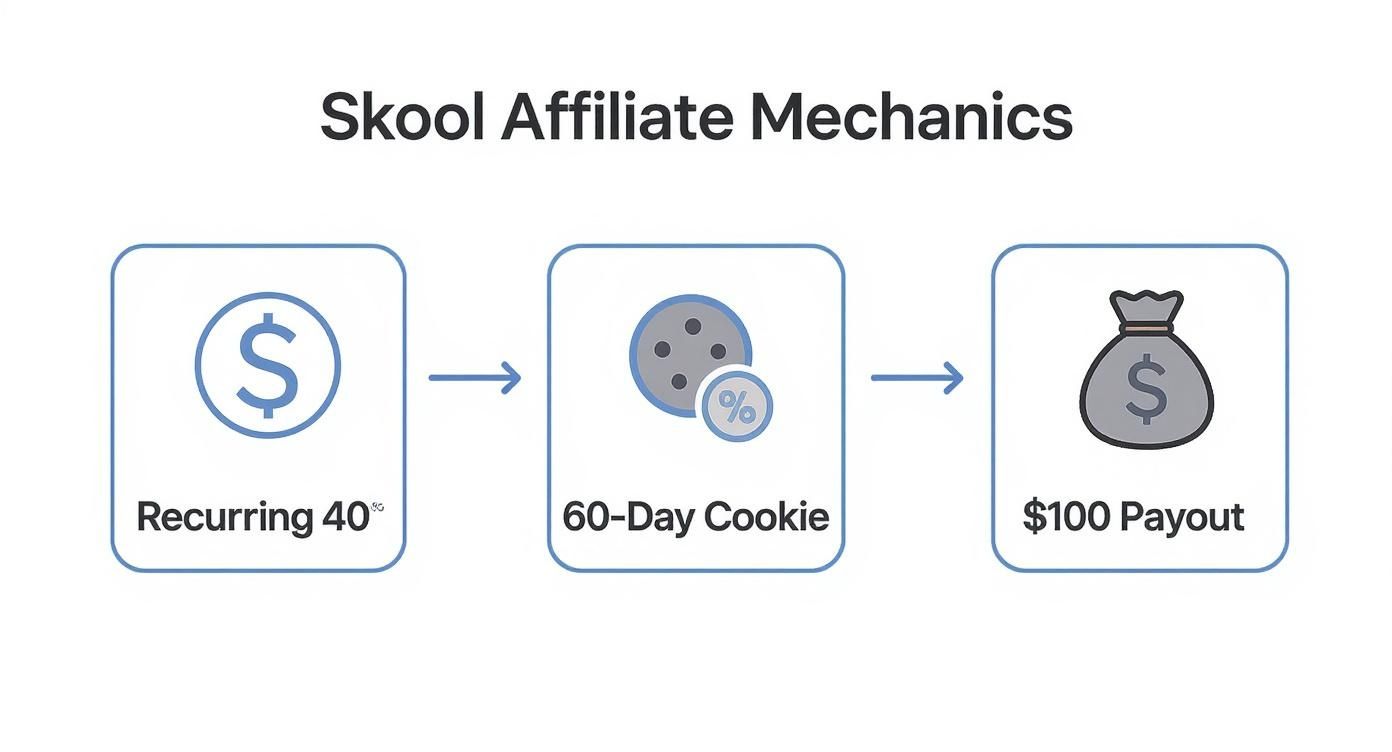
This visual really highlights the generous recurring commission, a fair cookie window that gives your referrals time to decide, and the straightforward payout threshold.
Breaking Down The Payout Logistics
Knowing how and when you get paid is just as critical as the commission rate itself. Skool keeps things clean and reliable here.
All payouts are handled through Wise (which you might know as TransferWise), a super reputable platform for international payments. This means you can get your earnings without a hitch, no matter where in the world you are.
The program has a $100 minimum payout threshold. This just means your commissions need to add up to at least $100 before they get sent over to your Wise account. For new affiliates, it’s a great first target to shoot for.
Once you hit that threshold, payments go out on a monthly schedule. The whole system is automated and designed to be hassle-free, letting you focus on promoting instead of chasing down payments. It’s a clear structure that gives you peace of mind and lets you plan your finances, knowing exactly what to expect from your work with Skool.
Weighing The Pros And Cons Of The Program
Look, no affiliate program is perfect. You’ve got to look at both sides of the coin before jumping in. Skool has some massive strengths that make it super attractive, but it also has a few drawbacks you need to know about. This isn’t about selling you on it; it’s about helping you decide if it genuinely fits your audience and how you like to work.
To really get a handle on the pros and cons, it helps to understand some general affiliate marketing principles. Knowing the basics puts Skool’s specific good and bad points into context, so you can make a smarter call. With that out of the way, let’s break it down.
The Advantages Of Promoting Skool
One of the biggest draws here is the commission structure. Earning a 40% recurring commission is a huge deal, especially when so many other programs just offer a one-time payout. This approach turns every single referral into a long-term asset. You get a stable, predictable income stream for as long as your people stay subscribed.
Another major plus is how “sticky” the platform is. Skool is built from the ground up to keep people engaged with communities, courses, and gamification. That means higher user retention, which is money in your pocket.
- High User Retention: When users are engaged, they don’t cancel. It’s that simple. This gives your recurring commissions a much longer lifespan. A happy Skool customer means a consistent paycheck for you.
- Growing Market Demand: The whole creator economy thing is blowing up. Coaches, course creators, and community builders are all looking for a simple, all-in-one spot to host their stuff. Skool fits that need perfectly, making it a pretty easy sell to the right crowd.
- Simplicity Sells: The platform’s clean design is a massive selling point. It’s dead simple for creators to set up and for their members to use, which cuts down on headaches and helps boost your conversion rates.
When you mix a strong recurring model with a product that people genuinely stick with, you’ve got a solid formula for long-term affiliate success.
The Potential Disadvantages And Challenges
Now for the other side. There are a few challenges to keep in mind. The biggest one is that Skool serves a pretty niche audience. It’s a killer solution for creators and community builders, but if you’re talking to a general crowd, it might not land. If your followers aren’t in that specific market, you could struggle to get any real traction.
Brand recognition can also be a bit of a hurdle. Inside the creator world, Skool is well-known and respected. But it doesn’t have the mainstream name recognition of giants like Teachable or Kajabi. That just means you might have to spend a bit more time explaining to your audience what Skool is and why it’s worth their time.
The platform’s high user engagement is a bit of a double-edged sword for affiliates. It’s great for retention, but the traffic data shows just how focused its user base is. Analytics from October 2025 show Skool pulling in about 24.7 million monthly visits with an average visit lasting over 7 minutes—which is insane and shows people are hooked. But its global rank is around 1,619, proving it’s still a niche player. You can dig into the numbers yourself and check out Skool’s web traffic and user engagement on Similarweb.
Lastly, the $100 minimum payout threshold can be a small roadblock if you’re just starting out. If you only get one or two referrals in your first month, it might take a little while to hit the point where you can actually cash out. It just requires a bit of patience while you build up some momentum.
Skool Affiliate Program Pros vs Cons
To make it even clearer, here’s a quick head-to-head comparison of what you’re getting into with the Skool affiliate program.
| Pros (Advantages) | Cons (Disadvantages) |
|---|---|
| 40% recurring monthly commission | Targets a very specific niche audience |
| High “stickiness” leads to low churn | Lower mainstream brand recognition |
| Simple, easy-to-use platform | $100 minimum payout threshold |
| Strong demand in the growing creator economy | Requires educating your audience on the tool |
Ultimately, the decision comes down to your audience. If you’re talking to course creators, coaches, or anyone trying to build an online community, the pros heavily outweigh the cons. But if your audience is more general, you might find it a tougher sell.
Proven Strategies To Promote Skool Effectively

Alright, so you’re in the program. Now the real fun begins. Let’s be clear: successfully promoting Skool isn’t about blasting your affiliate link across the internet like a firehose. It’s about smart, strategic placement in front of the right people.
Your goal is to show how Skool solves a real, nagging problem for course creators, coaches, and anyone trying to build a genuine community. You’re not just a promoter; you’re a problem-solver. Think about their struggles—scattered tools, dead engagement, the sheer headache of managing everything. You’re here to show them the elegant, all-in-one fix. That’s how you build trust and get conversions that feel earned, not forced.
Content Strategy For Bloggers and SEOs
For those of us who live and breathe SEO, Skool is a goldmine. The creator economy isn’t just growing; it’s exploding. And with that explosion comes a ton of people searching for better solutions. Your job is to meet them right where they are with content that answers their exact questions.
Start with your keyword research, but think beyond the obvious “Skool review.” Dig deeper. What long-tail keywords are your ideal customers typing into Google right now?
- Comparison Posts: Write detailed breakdowns like “Skool vs Mighty Networks” or “Skool vs Kajabi.” These are money keywords. The people searching for them have their wallets out and are ready to make a decision.
- Problem-Solution Articles: Go after the pain points. Think titles like “Best Community Platform for Online Courses” or “How to Stop Members from Leaving Your Community.” You can then naturally position Skool as the answer.
- Tutorials and How-To Guides: Create step-by-step guides that show people how to set up their first Skool community, build a course, or master the gamification features. This delivers a ton of value and instantly establishes you as an authority.
Once your content is up, you need to drive traffic to it. A killer way to do this is with well-designed landing pages. For a full playbook on this, check out our guide on creating high-converting https://danielproctor.com/affiliate-marketing-landing-pages/.
Winning On YouTube And Video Platforms
Video is, without a doubt, the most effective way to show off software. It lets you show, not just tell. For YouTubers, this is your sweet spot. You can create content that literally walks people through the Skool experience and showcases just how clean and intuitive it is.
Try some of these proven video formats:
- The In-Depth Skool Review: Go deep. Give an honest, comprehensive tour of the platform—the UI, the classroom, the gamification, pricing, and who it’s truly built for.
- The “Watch Me Build” Tutorial: Do a screen-share video where you build a brand new Skool community from scratch. This takes the mystery out of the setup and gives viewers the confidence to try it themselves.
- A “Day in the Life” Video: Give a behind-the-scenes look at how you (or a client) actually use Skool to run a community day-to-day. Authenticity like this is incredibly persuasive.
And don’t forget the basics: pop your affiliate link and relevant keywords right at the top of your video description.
Leveraging Social Media For Referrals
Social media—especially visual platforms like Instagram and X (formerly Twitter)—is perfect for quick, punchy promotions. You don’t need a 20-minute video here. You need to grab attention and get the point across fast.
On social media, it’s all about visual appeal and quick wins. A short video clip showing Skool’s slick design or a gamified leaderboard can be a massive scroll-stopper.
Focus on creating short-form videos like Reels, TikToks, or Shorts that highlight one specific feature at a time. For instance, a 15-second clip can show off the leaderboard in action or how easy it is to switch from the community feed to the classroom. It’s way more effective than trying to cram everything into one post.
So, Who Is This Skool Affiliate Program Actually For?
Alright, after digging into the commissions, strategies, and the odd pitfall, it comes down to one simple question: is this affiliate program a good fit for you?
Let’s be real, not every program works for every creator. A good partnership all comes down to audience alignment. And while the Skool affiliate program is a seriously powerful tool, it’s only going to work if you put it in the right hands.
The perfect Skool affiliate is someone whose audience is already looking for ways to build, manage, or cash in on an online community. Your content needs to naturally bump into the problems that Skool was built to solve.
The secret sauce here is just being authentic. You’ll get the best results not by shoving a product down people’s throats, but by offering a solution to a problem they’re actually struggling with. If they’re fed up with dead engagement on other platforms, Skool becomes an easy, honest recommendation.
This program is pretty much a perfect match for a few specific types of creators.
The Ideal Affiliate Profiles
If you’re in one of these camps, you should definitely have the Skool affiliate program on your radar:
- Business Coaches and Consultants: Your clients are probably trying to scale their business and build a tribe around what they know. Recommending Skool isn’t just a pitch; it’s a genuine value-add to the services you already offer.
- Online Course Creators: You know the pain of terrible completion rates and students who just ghost after buying. You can authentically promote Skool as the answer to that headache by merging courses with a lively community.
- Community Managers: You’re already a pro at getting people to talk and engage. You can create content showing how Skool’s features—like its gamification and leaderboards—make your job way easier and more effective.
- SaaS Review Bloggers and YouTubers: If your whole thing is reviewing tools for entrepreneurs and creators, Skool is a must-have in your content calendar. Comparison posts like “Skool vs. Kajabi” or “Skool vs. Teachable” are pure SEO gold and pull in people who are ready to buy.
How Skool Stacks Up Against the Alternatives
It’s super important to know where Skool fits in. Platforms like Kajabi and Teachable are great, but they’re often complex, all-in-one marketing machines. They throw in landing pages, email marketing, and complicated funnels, which can be total overkill for creators who just want a simple, slick platform for their community and courses.
Skool’s magic trick is its laser focus on simplicity and community engagement. It cuts out all the extra fluff to give you a clean, intuitive experience that does one thing exceptionally well: keeping your members hooked and subscribed.
This difference is your biggest selling point as an affiliate. You’re not just flogging another course platform; you’re offering a streamlined, specialized tool built for today’s creator economy. For audiences tired of clunky software and juggling a dozen different tools, Skool is a breath of fresh air.
So, the final call really hinges on this: if your audience values simplicity and real engagement more than a kitchen-sink feature list, then becoming a Skool affiliate is a smart—and potentially very profitable—move.
Frequently Asked Questions
Jumping into a new affiliate program always brings up a few questions. I’ll break down the most common ones I hear about the Skool program to give you the clarity you need to get started.
How Much Can You Realistically Earn?
This is where things get interesting. Your earning potential with Skool is all about recurring revenue, which is a game-changer for building a stable income.
You get a 40% recurring commission on every $99 monthly subscription. That means for every single person you refer who stays subscribed, you pocket $39.60 per month.
Let’s look at what that actually means in your bank account:
- 10 Referrals: That’s $396 per month, or $4,752 a year. A pretty solid goal to aim for when you’re starting out.
- 25 Referrals: Now you’re at $990 per month, which adds up to $11,880 annually.
- 50 Referrals: This is where it scales nicely to $1,980 per month, giving you $23,760 in yearly recurring revenue.
Because Skool is built to keep users engaged, people tend to stick around. A single referral can keep paying you for months, sometimes even years. This is how you build a predictable income stream, not just one-off paydays.
What Is The Cookie Duration For The Skool Affiliate Link?
Skool gives you a 60-day cookie duration, and this is a bigger deal than it sounds.
Think of it like this: when someone clicks your link, a little digital timer starts. For the next 60 days, if that person signs up for Skool, you get the commission. Simple as that.
This 60-day window is a huge advantage. Most people don’t buy on the first click. They need time to think, watch a few more videos, and decide if it’s the right fit. This generous cookie length makes sure you still get paid for doing the initial legwork, even if they take a few weeks to make up their mind.
It’s a policy that actually understands how people make decisions online, giving you a fair shot at earning what you deserve.
Do I Need To Be A Paying Skool Customer?
Nope. You don’t need to be a paying customer to join the affiliate program. It’s 100% free to sign up, with no strings attached or sneaky requirements to buy anything yourself.
That said, I’d strongly recommend using the platform. It’s tough to sell something you’ve never touched.
When you’re an active user, your content just hits different. Your reviews, tutorials, and walkthroughs will have that genuine feel because you actually know what you’re talking about. It’s not a requirement, but trust me, your conversion rates will thank you for it.
Ready to build a recurring income stream by promoting a platform creators love? Join the Daniel Proctor community to get the mentorship and strategies needed to succeed. Start your journey with our free masterclass on affiliate marketing.
