

So, is the Uber Eats affiliate program actually worth your time? The short answer is yes, but only for a certain kind of creator. It’s a fantastic fit if you can consistently drive brand-new users to the platform, because the entire commission structure is built around that first-time order.
Is the Uber Eats Affiliate Program Worth Your Time
When you start digging into the Uber Eats affiliate program, the first thing that jumps out is its massive brand recognition. This isn’t some obscure app you have to sell your audience on. Everyone knows Uber Eats. That built-in trust makes your job a whole lot easier and seriously lowers the friction to getting a click and a conversion.
It’s a really natural promotion for anyone in the food, local travel, or deals space. If you’re a food blogger, you can drop links into restaurant reviews. Running a city guide? It slides perfectly into a “best delivery options in downtown” article. Coupon and discount sites are another obvious win.
But here’s the catch—it’s not for everyone. The program is laser-focused on one thing: new customers.
Key Takeaway: The Uber Eats affiliate model pays you a commission only when a new user places their first order. That’s it. You don’t get recurring revenue from loyal customers you send their way, which is a major difference from programs with broader catalogs, like the one I covered in my Walmart affiliate program review.
This “one-and-done” payment model means it’s probably not the best choice if you’re looking for long-term passive income from a single referral. Instead, it’s designed to reward creators who have a constant flow of new traffic—people who are likely trying a food delivery app for the first time. Think blogs for college students, city relocation guides, or resources for digital nomads. These are audiences always on the move and looking for convenience.
To help you figure out if it fits your strategy, I’ve put together a quick summary of the key details.
Uber Eats Affiliate Program Key Details at a Glance
This table breaks down the essentials of the program so you can see if it aligns with your audience and goals at a quick glance.
| Feature | Details | Best For |
|---|---|---|
| Commission Model | Fixed fee per new customer’s first order. | Affiliates with a steady stream of new audience members. |
| Brand Recognition | Extremely high; a globally recognized household name. | Creators who want to promote a trusted, high-conversion service. |
| Cookie Duration | Typically 30 days, managed via partner networks. | Driving immediate action with timely promotions and discounts. |
| Ideal Affiliate | Food bloggers, city guides, deal sites, and local influencers. | Niche creators whose content naturally involves food and local discovery. |
Ultimately, it comes down to whether your audience is constantly refreshing with new people who haven’t yet signed up for Uber Eats. If so, this program could be a solid earner for you.
How the Uber Eats Affiliate Program Actually Works
So, how do you actually go from sharing a link to getting paid? It’s simpler than you might think.
The Uber Eats affiliate program boils down to one thing: you earn a commission for bringing in new customers who place their first-ever order. Your unique affiliate link is like a digital referral card that gives you credit for sending business their way.
But here’s something you need to know right away: you don’t sign up on the Uber Eats website itself. Instead, Uber partners with big-name affiliate networks like Impact to run the show. This is where you’ll apply, get your links, and track everything.
The Affiliate Journey from Signup to Commission
Once you’re approved, you’ll get access to a dashboard inside the affiliate network. Think of this as your command center.
Here, you’ll generate your personalized tracking links. These aren’t just regular links; they have a special code baked in that ties any clicks and sales directly back to your account.
You then drop these links into your content—maybe a blog post reviewing local takeout spots, in your YouTube description, or on a “deals” page on your website. When a reader clicks that link, a small tracking file called a cookie gets stored on their browser.
This cookie is your marker. For Uber Eats, it typically lasts for 30 days. If the person who clicked your link signs up and makes their first purchase within that 30-day window, the cookie tells the system to give you credit for the sale. Boom—a commission pops up in your affiliate dashboard.
This simple infographic breaks down the process visually. It’s all about finding your audience, signing up, and then earning from the traffic you send.
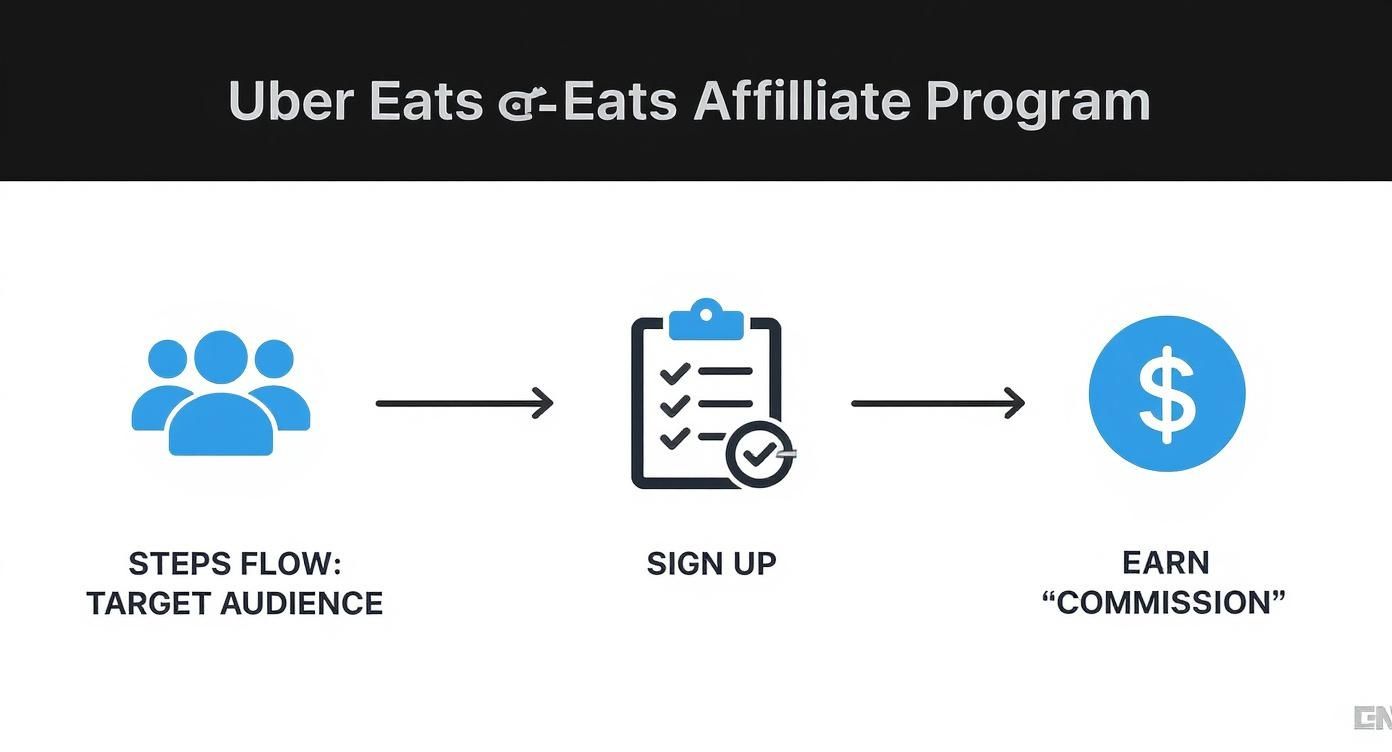
The main takeaway here is that the whole system is automated. The partner network handles all the messy tracking and payment details so you don’t have to.
The Role of the Affiliate Network
Working through a network like Impact is what makes this whole thing legitimate and reliable. It acts as the middleman, managing the entire relationship.
- Application and Approval: The network is your front door. You submit your application through them, and they handle the screening for Uber Eats.
- Link Generation: This is where you create your standard affiliate links. You can also create “deep links” that point to specific restaurant menus or offers, which can seriously boost conversions.
- Performance Tracking: Your dashboard is your lifeline. It gives you real-time data on clicks, conversions, and how much you’ve earned. This is absolutely critical for figuring out what’s working and what’s not.
- Payment Processing: The network gathers up all your earnings and pays you out on a regular schedule, usually once a month.
Using a major, reputable network adds a layer of trust and transparency you wouldn’t get otherwise. If you’re new to these platforms, it’s worth understanding how they operate. Our Impact affiliate network review dives deep into whether it’s the right fit for your goals.
At the end of the day, the program is a straightforward, performance-based deal. Your job is to create good content that connects with people who might be interested in trying Uber Eats. The affiliate network takes care of the technical side, making sure you get paid for every new customer you bring in. It’s not some mysterious black box—it’s a clear, trackable system designed to reward you for your results.
Your Realistic Earning Potential with Uber Eats

Alright, let’s talk money. Partnering with a huge brand like Uber Eats sounds great, but your success really boils down to understanding how you get paid. This isn’t one of those programs where you earn a tiny percentage of every order someone makes for life. It’s a different game entirely.
The whole thing is built on one simple idea: you earn a fixed fee for each new customer’s first order. You have to get this part. You’re basically a bounty hunter for new sign-ups, not a partner earning recurring cash from one referral.
The upside? This makes figuring out your income dead simple. If the commission is $5 per new user and you convince 100 people to place their first order in a month, you just made $500. That kind of clarity is a huge win for setting goals you can actually hit.
Deconstructing Your Payouts
All your earnings are handled through the affiliate network you sign up with, like Impact. These platforms take care of the tracking, the reports, and—most importantly—getting the money into your bank account.
Here’s the typical flow of how payments work:
- Payment Schedule: Most networks pay monthly, but there’s usually a “locking” period. This means commissions you earn in January might get finalized in February and actually paid out in March. Standard stuff.
- Minimum Threshold: You’ll need to hit a minimum amount before you can cash out, often around $50 or $100. If you don’t hit it one month, your balance just rolls over to the next. No big deal.
- Payment Methods: Getting paid is usually flexible. Options like direct deposit (ACH), PayPal, or even a wire transfer are typically available right inside the network’s dashboard.
Getting these mechanics down is key. For some real-world context on what top affiliates are earning in different spaces, check out our guide on how much affiliate marketers actually make. The Uber Eats program fits right in as a high-volume, fixed-fee opportunity.
Factors That Define Your Success
Just dropping an affiliate link and hoping for the best won’t get you far. Your real earning potential comes down to a few key things that are completely in your control. Success isn’t about luck; it’s about having a smart strategy that speaks directly to your audience.
Your earning potential is not just about traffic volume—it’s about traffic relevance. Driving 10,000 uninterested visitors to a link will earn you less than 100 highly motivated visitors who have never tried Uber Eats before.
Let’s break down the three factors that will make or break your results:
- Audience Demographics: Are your followers living in one of the 11,000+ cities where Uber Eats actually operates? Are they college students or young professionals who are likely new to food delivery apps? If your audience doesn’t match geographically and demographically, you’re dead in the water. It’s non-negotiable.
- Content and Context: Your promotion has to feel natural. If you’re a food blogger reviewing a cool new local spot, it’s a no-brainer to suggest getting it delivered via Uber Eats. A travel creator making a guide to a new city? Suggesting the app for easy meals is a perfect fit. The more organic the recommendation, the more people will actually click and buy.
- Audience Engagement and Trust: This is your biggest asset. If you’ve built a real connection with your followers, they’re way more likely to act when you recommend something. That trust is earned over time by consistently creating content that’s actually valuable and authentic.
And there’s another layer here. Your work contributes to a bigger picture. The Uber Eats platform has become a lifeline for small businesses, helping 53% of its SMB partners stay afloat. Promoting the service can also mean you’re indirectly supporting those local restaurants. You can read the full merchant impact report to see the data for yourself.
By focusing on these core factors, you can stop just hoping for clicks and start strategically building a reliable income stream.
Proven Strategies to Promote Uber Eats and Earn More
Making real money with the Uber Eats affiliate program is about more than just dropping a link and hoping for the best. It takes a bit of strategy. Think of your affiliate link less like a billboard and more like a helpful tip from a friend who knows all the best food spots.
The real trick is to weave your promotions into content that people are already finding useful. When your audience sees the Uber Eats offer as the perfect solution to their problem—like getting those amazing local tacos delivered right now—they’re way more likely to click and order.
This means you’ve got to ditch the generic “click here” approach. Instead, build compelling content that makes signing up for Uber Eats feel like the obvious next step.
Content Marketing for Food Bloggers and Reviewers
If you’re already writing about food, you’re basically sitting on a goldmine. The key is to slide your affiliate links into places where they feel natural and genuinely helpful. This kind of contextual placement is what gets you the clicks.
Your audience already trusts your taste in food. Now, you’re just extending that trust to a super convenient way to get it.
- Restaurant Reviews: Just wrote a killer review for a local pizza joint? Tack on a line like, “Good news! You can get their amazing wood-fired pizza delivered straight to your door. Get $10 off your first Uber Eats order here.” It’s direct, useful, and perfectly timed.
- “Best Of” Lists: Articles like “The 10 Best Burger Joints in Austin” or “Top 5 Vegan Restaurants in Brooklyn” are perfect. Inside each recommendation, pop in your affiliate link as an easy way for readers to try your picks without ever leaving their couch.
- Recipe Posts: Let’s say you post a recipe that’s a little complicated. Offer a shortcut. Something like, “Don’t have time to make Pad Thai from scratch tonight? Order an authentic version from my favorite local Thai spot on Uber Eats and get a discount on your first order.”
Leveraging Social Media and Local Influence
For influencers with a solid local following, social media is your playground. Platforms like Instagram and TikTok are built for creating visual, in-the-moment promotions that get people to act fast. And the temporary nature of Stories? It creates a perfect sense of urgency.
Your authenticity is your biggest advantage. Promote Uber Eats in a way that feels like you. Share your own order, highlight a local black-owned restaurant, or offer a discount code that genuinely helps your followers out.
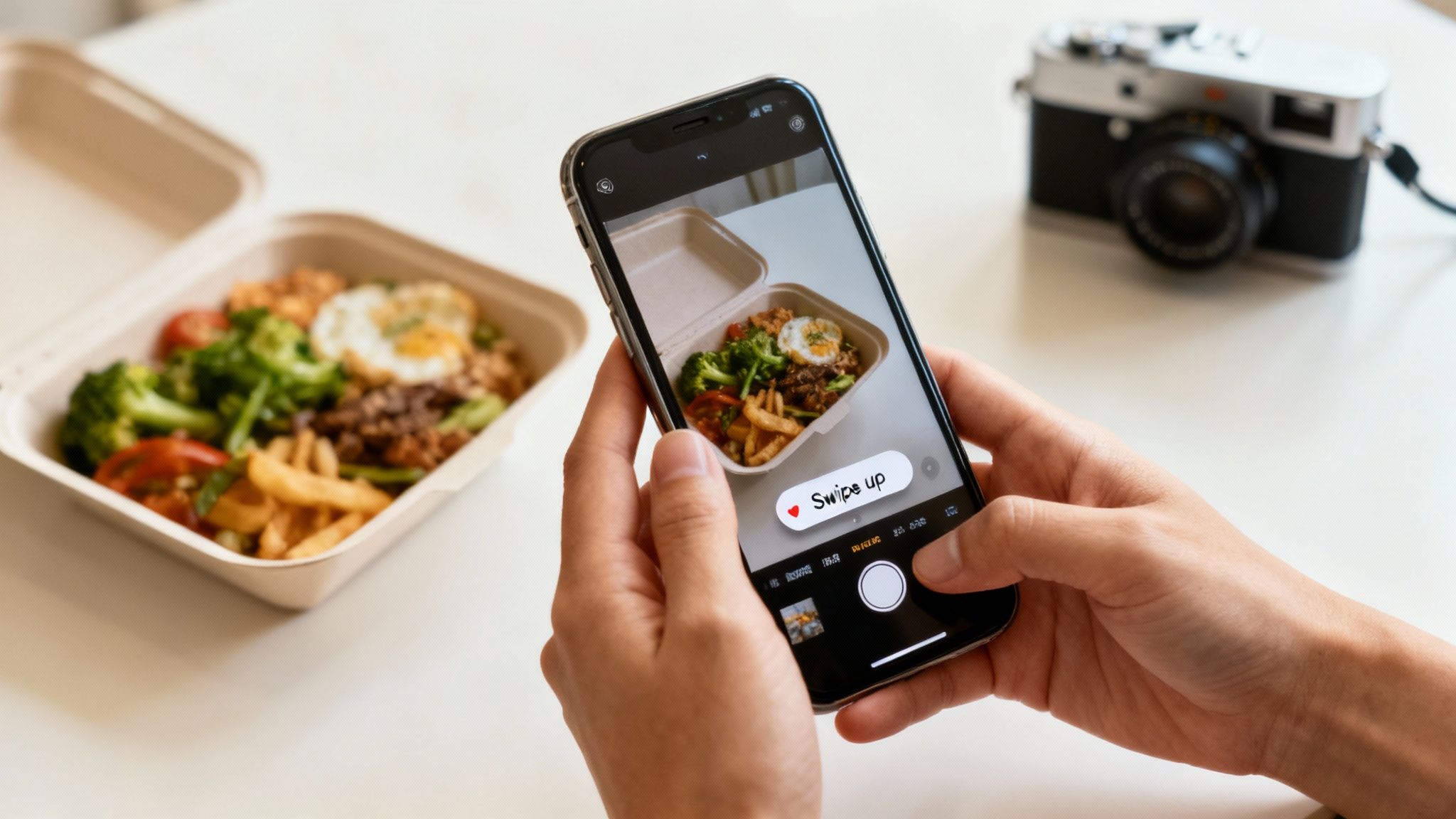
A simple but effective Instagram strategy is using the “link in bio” or a swipe-up feature in your Stories to push a special first-order discount. You could film a quick story of yourself ordering from a favorite local spot, talk about how easy it was, and then point your followers to your link to grab their own discount.
SEO and Targeting High-Intent Keywords
If you want to pull in a steady stream of new users, you need to think like someone who’s actively searching for a food delivery service. This is where SEO (search engine optimization) becomes your best friend. By targeting specific long-tail keywords, you can catch people right when they’re ready to sign up.
Focus on phrases that scream “I’m ready to order!”:
- “uber eats promo for first order”
- “best food delivery service in downtown chicago”
- “how to get free food delivery”
- “doordash vs uber eats for new users”
Creating content that answers these questions directly puts you in the driver’s seat. A detailed blog post comparing delivery services or a landing page dedicated to the latest Uber Eats promo codes can turn into a consistent moneymaker, pulling in new customer referrals day after day.
For affiliates wanting to connect with a wider audience, learning about making an effective email marketing campaign can be a game-changer. An email list gives you a direct line to your audience, letting you send out exclusive deals and timely offers that are hard to ignore.
Weighing the Pros and Cons of the Program
Look, no affiliate program is perfect for everyone, and this one is no exception. Before you jump in, it’s worth taking an honest look at both sides of the coin—where the Uber Eats program really shines and where it might just fall flat for you.
At the end of the day, it’s a simple deal: you send new customers their way, and they pay you for it. But the details are what matter, and that’s what will decide if this is a good fit for your business or just a waste of your time.
Let’s break down the good, the bad, and the ugly.
The Clear Advantages of Partnership
The biggest plus here is staring you right in the face: the Uber Eats brand. You’re not trying to convince your audience to try some random, unheard-of app. You’re promoting a household name that millions of people already know, use, and trust. That built-in recognition does half the work for you and makes getting conversions so much easier.
This leads right into the next big win: a super simple offer with high conversion potential. The pitch is dead easy for your audience to grab—”sign up and get money off your first order.” It’s an impulse-friendly deal that solves an immediate craving, which usually means more clicks and sign-ups compared to promoting more complex or expensive products.
Finally, fitting it into your content is a breeze. It doesn’t feel forced or overly salesy, which is a huge relief.
- Food Bloggers: An obvious add-on to any restaurant review.
- Travel Creators: A genuinely helpful tip for people exploring a new city.
- Deal Sites: An easy win for an audience looking for quick discounts.
- Local Guides: A perfect fit for content about what’s good in the neighborhood.
The Not-So-Hidden Drawbacks
Now for the biggest catch, and it’s a dealbreaker for some: the “first-order only” commission model. You get paid only when a new user places their very first order. After that one meal, your earning potential from that person is gone. Forever. This model puts a hard ceiling on your income and kills any chance of earning recurring revenue from loyal customers you refer.
This structure makes it a tough sell for affiliates who want to build a stable, long-term passive income stream. To keep the money coming in, you have to be on a constant hunt for brand-new users who have never tried the service before.
The other thing to consider is the fierce competition. Sure, Uber Eats is a giant, but it’s not the only food delivery app on the block. It holds around 23-25% of the U.S. market, which puts it behind DoorDash. While its global reach is massive—over 95 million users by 2024 and 1.2 million restaurant partners—you’re still fighting for new users who might already be happy with another service. You can dig deeper into Uber Eats’ market performance on appsrhino.com for more context.
The Big Picture: This program is built for affiliates who are absolute machines at acquiring new customers. If your strength is building a loyal community that generates recurring income, this “one and done” model is probably going to feel pretty limiting.
Weighing the Uber Eats Affiliate Program
To make it even clearer, let’s lay it all out side-by-side. Deciding if this program is right for you really comes down to weighing the massive brand power against the single-payout commission structure.
| Pros (Advantages) | Cons (Disadvantages) |
|---|---|
| Massive Brand Recognition | First-Order Commission Only |
| Instantly trusted household name. | No recurring income from loyal referrals. |
| High Conversion Potential | Highly Competitive Market |
| Simple, low-commitment offer. | Vying for new users against services like DoorDash. |
| Simple Promotional Angle | Requires Constant New Traffic |
| Fits naturally into many content niches. | Earnings depend on a steady flow of fresh leads. |
| Global Service Availability | Potentially Short Cookie Duration |
| Operates in over 11,000 cities worldwide. | The standard 30-day window requires timely action. |
Ultimately, succeeding with the Uber Eats affiliate program is a volume game. Your success will hinge entirely on your ability to consistently reach a fresh audience of people who haven’t hit that “order now” button yet.
How Does Uber Eats Stack Up Against the Competition?
While the Uber Eats affiliate program has massive brand recognition, it’s not the only game in town. A smart affiliate strategy isn’t about picking one winner; it’s about knowing the field. Promoting alternatives isn’t just a backup plan—it’s how you diversify your income and find the perfect match for your audience.
For most creators in the food delivery space, the other two big names that immediately come to mind are DoorDash and Grubhub. Each one has a serious slice of the market and runs its own affiliate program with different rules. Looking at them side-by-side with Uber Eats shows you where the real money-making opportunities are.
Think of it like investing. You could put all your cash into one big, famous stock, or you could spread it around to minimize risk and hit different parts of the market. Same idea here.
DoorDash Affiliate Program
DoorDash is without a doubt Uber Eats’ biggest rival, especially in the US. You’ll usually find their affiliate program on networks like Impact, and it’s a solid alternative for most creators.
- Commission Structure: Just like Uber Eats, DoorDash pays a set bounty for a new customer’s first order. The exact amount can change, so you’ll want to log into your affiliate network to see the current rate.
- Brand Power: DoorDash is a household name in North America. That kind of trust means less work for you and potentially higher conversion rates, since you don’t have to sell people on the brand itself.
Grubhub Affiliate Program
Grubhub has been around for a while and is another major player. Their affiliate program has a slightly different angle that might work better for certain types of content.
- Commission Model: Grubhub sometimes pays on a per-lead or per-signup basis. This can be a game-changer because getting someone to sign up is often easier than getting them to complete a full order.
- Regional Strength: While Grubhub is a national brand, it’s an absolute beast in certain cities. If a chunk of your audience lives in a Grubhub-dominated area, you could see much better results promoting them.
When you’re weighing these options, don’t just stare at the commission rate. Look at the whole picture: cookie duration, how well the brand fits your audience, and what kind of promo materials they give you. A slightly smaller commission from a brand your followers already love will almost always outperform a higher payout from one they don’t.
Even with strong competitors, Uber Eats has a few aces up its sleeve. The platform’s global growth is just staggering—it went from 80,000 restaurant partners in 2017 to over 1 million by 2024. That explosion gives you a ridiculously huge and varied list of restaurants to promote in thousands of cities all over the world. You can dig into the data on Uber Eats’ rapid restaurant expansion to see just how big their footprint is.
At the end of the day, the smartest move might not be to choose one program over the others, but to promote them all. By giving your audience options, you earn a commission no matter which delivery app they end up using. It turns a competitive market into a win-win for you.
Common Questions About the Uber Eats Program
Whenever you’re looking into a new affiliate program, a few last-minute questions always pop up. It’s totally normal. To make sure this Uber Eats affiliate program review is truly complete, let’s run through some of the most common things potential partners ask. Getting these details ironed out will give you the clarity you need to jump in with confidence.
First up, the big question: what’s it going to cost you? Good news here. Joining the Uber Eats affiliate program is completely free. There are no hidden fees or signup costs to worry about. The only thing you’ll invest is the time and effort it takes to create solid content that gets people clicking.
Getting Paid and Global Reach
Okay, so how do you actually get your hands on the money? Payouts are handled by the affiliate network you sign up through, like Impact. They typically send out payments monthly after a quick check to make sure all the sales are legit.
Most networks have a minimum amount you need to earn before they’ll send a payment, usually around $50 or $100. If you don’t hit that threshold one month, no sweat—your balance just rolls over to the next until you do.
As for who can join, the program is pretty much open in most countries where Uber Eats operates. That said, the specific rules can change depending on which affiliate network is running the show. It’s always a good idea to double-check the terms and conditions on the network’s site to confirm your region is good to go before you apply.
Key Insight: Even though Uber Eats is a massive global brand, your affiliate success is all about thinking local. Your commissions come from getting new customers to sign up in the specific cities and neighborhoods where the service is already active and popular.
Practical Program Details
Here are a few more quick-fire answers to common sticking points that come up. Nailing these down from the start can help you sidestep simple mistakes and get you on the right track from day one.
- Is a website required? A website or blog is definitely the most common route, but it’s not always a deal-breaker. Social media influencers with a big, engaged following might get the green light, but having your own established platform is a huge advantage.
- Can I promote other delivery services? Absolutely. There’s no exclusivity clause stopping you from promoting competitors like DoorDash or Grubhub. In fact, reviewing and comparing different services can be a great way to build trust and boost your overall earnings.
- Are there promotional restrictions? Yep. You can’t run paid search ads on branded keywords (like “Uber Eats” or “UberEats coupon”). And, as always, you have to follow FTC guidelines by clearly disclosing that you’re using affiliate links.
Ready to stop guessing and start building a real, profitable affiliate marketing business? At Daniel Proctor, I provide the step-by-step mentorship and proven systems you need to succeed. Join my free masterclass to learn the six passive income methods you can start today.
