


Let's get straight to it: The SiteGround affiliate program is a solid choice, but only if you have the right audience. If you’re a creator in the tech, marketing, or business space with an established following, this program can be a real winner. The high commissions, great brand reputation, and weekly payouts make it a top contender—assuming you can send them quality traffic.
A Practical Verdict on the SiteGround Affiliate Program
For most people, the big question is simple: can you actually make money with the SiteGround affiliate program? The short answer is yes, absolutely. But it’s not for everyone.
Think of it like a high-end power tool. In the hands of a pro, it works wonders. But for a beginner, it might be overkill. The program is best for affiliates who genuinely understand and can explain the value of premium web hosting.
This isn’t a get-rich-quick deal. Your success hinges on trust and proving you know what you’re talking about. SiteGround’s plans cost more than the cheap, budget hosts, so your audience needs a good reason to make that investment. That’s where your authority and expertise come into play.
Before we dive deeper, here's a quick look at the program's key features.
SiteGround Affiliate Program At a Glance
| Feature | Details |
|---|---|
| Commission Rate | $50 – $100+ per sale, based on volume |
| Cookie Duration | 60 days |
| Payment Frequency | Weekly payouts |
| Minimum Payout | $50 (after the first sale) |
| Payment Method | PayPal |
| Best For | Tech bloggers, web developers, marketing agencies, YouTubers |
This table gives you a snapshot, but the real story is in how you leverage these features to your advantage.
Who Benefits Most from Promoting SiteGround?
To really succeed, your content needs to solve the same problems SiteGround does. Here’s a breakdown of who I’ve seen get the best results:
- Tech Bloggers and SEO Experts: These are the people who can really geek out on the details. If you can write in-depth tutorials, create compelling case studies, or publish detailed comparison posts that highlight SiteGround's speed and security, you'll attract readers who are ready to buy. They’re already looking for a solution, and your content can be the final push.
- Marketing Agencies and Web Developers: This is a no-brainer. If you're building sites for clients, recommending SiteGround is a natural fit. You can bundle their hosting into your service packages, which gives your clients a reliable product and earns you a nice, steady commission stream on the side.
- YouTube Content Creators: Video is incredibly powerful for this. A tutorial showing someone how to set up a WordPress site on SiteGround, or a walkthrough of their performance tools, can convert like crazy. Seeing is believing, and a visual guide builds the trust needed for someone to click your link and make a purchase.
Ultimately, the best way to know if SiteGround is right for you is to see how it stacks up against the best hosting sites for blogging platforms. The affiliate marketing industry is massive—it’s expected to hit $11.99 billion in the U.S. alone by 2025. By promoting a quality product like SiteGround, with its 99.99% uptime and premium features, you can definitely carve out a piece of that pie.
If this sounds like it aligns with your brand and audience, it's easily one of the best web hosting affiliate programs you can join today.
How You Actually Make Money with SiteGround
Alright, let's get to the part everyone cares about: how you get paid. With SiteGround, your earnings are directly tied to your performance through a tiered commission structure. It’s a pretty smart system, honestly. They reward affiliates who bring in a steady stream of new customers, which can make this a really profitable partnership if you can deliver.
Think of it like leveling up in a game. You start out on the standard tier, pocketing a solid commission for every sale. But the real magic happens when you start referring more people each month. As you do, you unlock higher commission rates, which can seriously boost your income.
This performance-based model is what keeps you motivated. It lays out a clear path to making more money without having to go back and renegotiate anything. Your success is completely in your own hands—it all comes down to the quality of traffic you can send their way.
Breaking Down the Commission Tiers
SiteGround’s commission structure is refreshingly simple and really encourages growth. They don't splash the exact rates for the top tiers all over their site, but the path forward is easy to understand.
- Standard Tier (1-5 sales/month): This is where everyone begins. For 2024, the starting rate is a cool $50 per sale.
- Performance Tier 1 (6-10 sales/month): Once you start hitting this range consistently, your commission for each sale gets a nice bump.
- Performance Tier 2 (11-20 sales/month): Keep the referrals coming, and you'll slide into an even higher bracket. This means more cash for every single sale you make.
- Custom Tiers (21+ sales/month): For the heavy hitters. If you're sending this much business their way, you can negotiate custom commission rates. At this point, you're not just earning more per sale; you're building a pretty significant income stream.
Let's say you refer 12 sales in a month. Instead of the base $50, you might now be earning $75 per sale. That one small jump in performance turns a $600 month into a $900 month. See how powerful that tiered system can be?
This infographic breaks down the types of creators who are in the best position to climb these tiers.
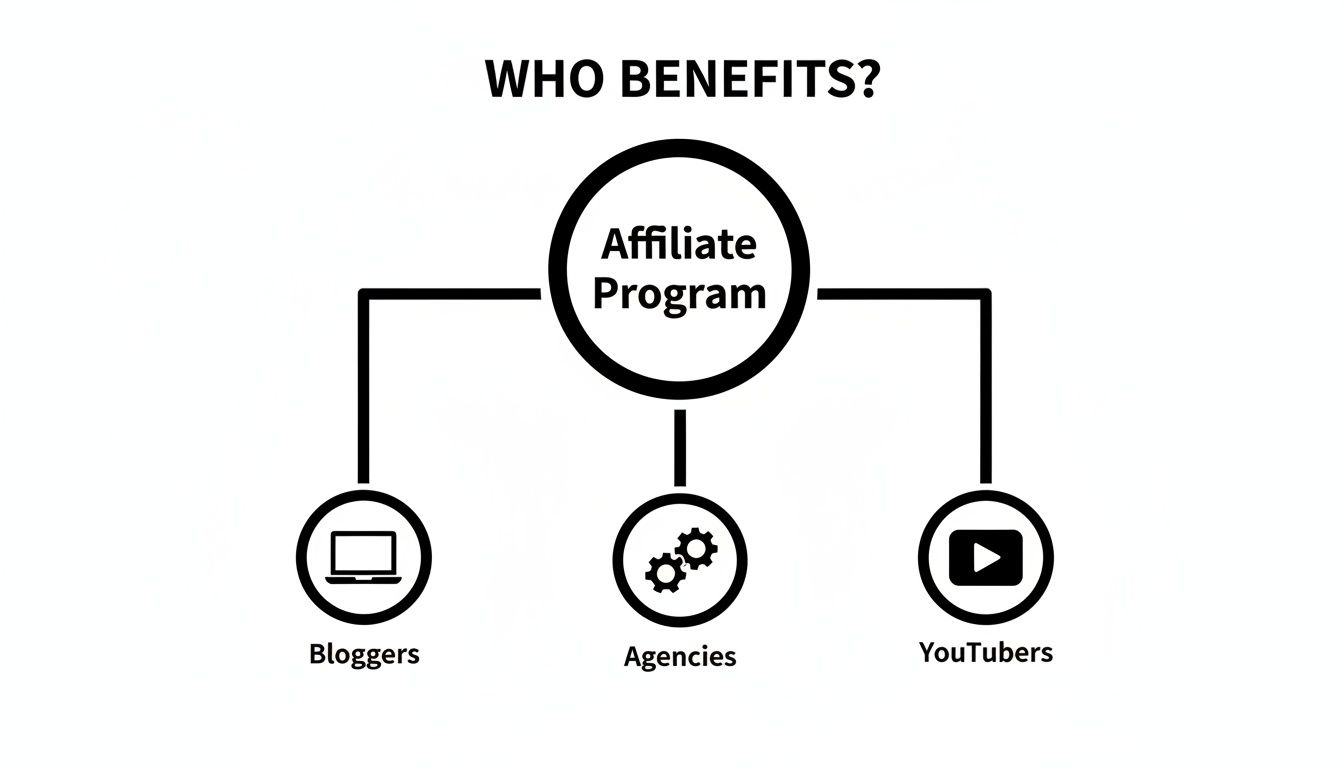
As you can see, bloggers, agencies, and YouTubers have a natural advantage. Their content is perfect for showing people why premium hosting is worth the investment.
The Fine Print on Payouts
Making sales is great, but getting that money into your bank account is what really matters. SiteGround's process is clear, but there are a few key details you need to know.
First off, there's a 30-day holding period on all your commissions. This is pretty standard stuff in the affiliate world. It’s just to cover any customer cancellations or refunds. If someone you refer cancels within that first month, that commission gets reversed. No big deal.
Second, SiteGround pays out weekly. Once a commission clears that 30-day hold, it’s good to go for the next weekly payout. You’ll need to hit a $50 minimum to get paid, which you'll easily clear with your first sale. All payments are sent through PayPal, so double-check that your account info is correct in your dashboard.
If you're curious about what top affiliates are pulling in across the board, my guide on https://danielproctor.com/how-much-do-affiliates-make/ gives you some solid industry benchmarks.
To really maximize your income, it helps to look beyond just one program. Understanding diverse content monetization strategies can make a huge difference. Pairing a high-paying program like SiteGround's with other methods is how you build a more stable and scalable online business.
Getting Your Affiliate Application Approved
Applying for the SiteGround affiliate program is pretty simple, but getting approved isn't a rubber-stamp deal. Unlike some programs that let anyone in, SiteGround actually has real people reviewing applications to find partners who are a good fit. They’re looking for affiliates who already have a platform and a solid plan for how they'll actually promote SiteGround.
First up, you'll need to head over to the affiliate section on their main website to find the signup page. You'll fill out a form asking for the usual stuff—contact details, payout info (they use PayPal), and, most importantly, how you plan to promote them. Don't just breeze through this part; it’s your first impression.
What SiteGround Looks for in an Affiliate
Think of your application as your pitch. You've got to convince them you're worth partnering with. While they don't have a public checklist, I've seen enough approvals and rejections to know what they're looking for.
- An Active, Professional Website: Your site needs to be live, look decent, and have quality content that’s relevant to SiteGround's audience. A brand-new blog with a single "hello world" post is a fast track to rejection.
- Relevant Content and Audience: Your content should make sense for a hosting promotion. Things like web design, SEO, digital marketing, or guides for small business owners are a perfect match.
- A Clear Promotional Plan: The application asks how you’ll promote them. Be specific. Don't just say "social media." Instead, try something like, "I'll create YouTube tutorials showing how to set up WordPress on SiteGround" or "I'll write in-depth comparison posts targeting freelancers looking for reliable hosting."
Your website is basically your resume for this application. An affiliate manager will probably spend less than a minute on it, so make that time count. Make sure it looks professional and shows you're serious.
The Application and Approval Timeline
Once you hit submit, the waiting game begins. SiteGround says many applications get approved almost instantly, but in my experience, it's pretty common for a manual review to take up to 2-3 business days. This is especially true if you've got a newer site or your promotional methods aren't just standard blogging.
During this time, their team is actually checking out your platform. They're looking at your content quality, seeing if your audience is a good fit, and making sure your ideas align with their brand. It’s super important that all the info you provided is accurate and detailed—it really does make a difference.
If you don't hear back within a few days, don't sweat it. You can always follow up with their support, but a little patience goes a long way. A solid, well-thought-out application is the best way to get a yes, whether it's for this program or any other one you'll read about in a site ground affiliate program review. Getting this right from the start lays the groundwork for a profitable partnership.
Using the Affiliate Dashboard to Your Advantage
Once you get that approval email, the SiteGround affiliate dashboard becomes your new command center. It's easy to dismiss it as just a bunch of numbers, but honestly, this is where you can see what’s working and what’s bombing in real-time. Learning your way around this dashboard is what separates the affiliates making pocket change from those earning a serious income.
At first glance, it might just look like data. But every number tells a piece of the story. Clicks tell you if your content is grabbing attention. Conversions tell you if that attention is turning into actual money. Think of it as your direct feedback loop.
Navigating Your Key Performance Metrics
When you log in, the first thing you'll see is a snapshot of your activity: clicks, unique visitors, and sales. It's tempting to stare at the sales number, but the other stats are your early warning system. Low clicks could mean your links are buried, while lots of clicks but no sales might point to a disconnect between what you're promising and what the reader needs.
Here's a quick rundown of what I personally keep an eye on:
- Clicks vs. Unique Visitors: This tells you if the same people are clicking your link more than once. A high number of clicks from fewer unique visitors isn't a bad thing; it often means someone is coming back to your content a few times before they're ready to buy.
- Conversion Rate: This is the big one. It's calculated as (Sales / Unique Visitors) x 100, and it shows you how good you are at turning your traffic into cash. A respectable affiliate conversion rate hovers around 1-2%, so if you're hitting higher than that, you're on the right track.
- Earnings Per Click (EPC): This metric breaks down how much you make, on average, every single time someone clicks your affiliate link. It's a fantastic way to quickly compare which blog posts or campaigns are actually the most profitable.
And here’s a peek at the dashboard itself. As you can see, it’s clean, simple, and gets straight to the point without a ton of clutter.

This setup makes it incredibly easy to see your commissions, traffic, and conversion stats at a glance. It’s built to give you quick insights so you can make adjustments without getting lost in data.
Finding Your Links and Marketing Assets
The dashboard is also where you'll find your most important tool: your unique affiliate link. SiteGround gives you a standard link, but the real power comes from creating deep links that send people to specific pages, like their WordPress hosting or WooCommerce plans.
For example, if you write a tutorial on setting up an e-commerce store, linking directly to the WooCommerce hosting page is way more effective than just dumping them on the homepage. You'll find these tools under the "Marketing Tools" section. They also have a bunch of banners and logos you can use to add some visual pop to your site or emails.
Your goal isn't just to get clicks; it's to get the right clicks. Use deep links to guide your audience to the most relevant solution, and your conversion rate will thank you for it.
Understanding Payouts and Cookie Tracking
Finally, let’s talk about getting paid. Your dashboard clearly shows which commissions are pending and which have been approved. Just remember, there's a 30-day holding period on all commissions to cover any customer refunds. After that 30-day window, the commission is cleared for payout.
SiteGround pays out weekly via PayPal once you hit a $50 minimum threshold, which you'll usually clear with your very first sale. Another huge plus is the 60-day cookie duration. This means if someone clicks your link, you get credit for the sale as long as they sign up within two months. That generous window is a massive advantage, giving your readers plenty of time to think things over. Any solid site ground affiliate program review has to mention these affiliate-friendly policies because they genuinely make a difference.
An Honest Look at The Pros and Cons
Let's be real—no affiliate program is perfect. To figure out if promoting SiteGround is the right move for you, you need the full picture, warts and all. It’s not just about the big commission checks; it's about understanding the good, the bad, and the genuinely challenging parts.
So, let's break down exactly what you're getting into.
The Advantages of Promoting SiteGround
First off, SiteGround has a stellar brand reputation. You’re not trying to sell some unknown, fly-by-night hosting company. People in the know recognize SiteGround for its premium performance, top-notch customer support, and solid security. That brand trust does a lot of the heavy lifting for you and is a big reason why conversion rates are so high.
The commission structure and payout reliability are also huge wins. The tiered system genuinely rewards your hard work, starting you off at $50 per sale and letting you climb higher as you bring in more customers.
Honestly, the weekly payouts via PayPal are a game-changer. So many programs make you wait 30 or even 60 days to see your money. SiteGround’s consistent weekly schedule gives you predictable cash flow, which is incredibly valuable when you're running a business.
Finally, the 60-day cookie duration is a massive plus. This gives your audience a two-month window to make a decision after clicking your link, and you still get the credit. It lets people do their research without you losing out on the commission.
Here’s a quick rundown of the best parts:
- Strong Brand Reputation: SiteGround is a trusted name, making it an easier sell to an audience that values quality.
- Generous Commissions: The performance-based tiers give you a clear path to earning more per sale.
- Reliable Weekly Payouts: Forget waiting months; you get paid consistently and predictably.
- Long Cookie Duration: The 60-day window is a safety net that helps you capture more sales.
The Challenges and Downsides to Consider
Now for the not-so-great stuff. The biggest hurdle is SiteGround's premium price tag. Their plans cost more than budget hosts like Hostinger or Bluehost. This makes it a tougher sell for total beginners or anyone on a shoestring budget. Your content has to work harder to justify why it's worth the extra cash.
The web hosting niche is also brutally competitive. You're up against thousands of other affiliates, including huge publications with massive domain authority. A generic "SiteGround review" post is just going to get lost in the noise. You need to create hyper-detailed, genuinely helpful content that targets a specific slice of the market to even stand a chance.
On top of that, SiteGround is extremely strict about paid advertising. You are strictly forbidden from bidding on branded keywords like "SiteGround" or "SiteGround hosting" on Google Ads or anywhere else. Break this rule, and you'll get kicked out of the program and lose your commissions. You have to lean on organic strategies like SEO, YouTube, and email marketing.
Lastly, the lack of recurring commissions is a definite downside. While that initial payout is nice, many SaaS and hosting programs pay you a percentage every time the customer renews. With SiteGround, it's a one-and-done deal. That means you're always on the hamster wheel, needing to find new customers just to keep your income steady.
SiteGround Affiliate Program vs Key Competitors
To give you a clearer picture, I've put together a quick comparison table showing how SiteGround stacks up against a couple of other big players in the hosting affiliate space.
| Feature | SiteGround | Bluehost | Hostinger |
|---|---|---|---|
| Commission | $50 – $100+ (Tiered) | $65+ (Flat Rate) | 60% of Sale (One-Time) |
| Cookie Duration | 60 Days | 90 Days | 30 Days |
| Payouts | Weekly | Monthly (Net 45-60) | Monthly (Net 45) |
| Recurring? | No | No | No |
| Best For | Quality-focused content | Beginner-focused content | Budget-conscious audiences |
As you can see, each program has its own strengths. SiteGround shines with its weekly payouts and appeal to a quality-conscious audience, while Bluehost offers a longer cookie and Hostinger targets the budget market. The right choice really comes down to your audience and your promotion strategy.
Proven Strategies for Promoting SiteGround

Getting approved is the easy part. Now, the real work begins: actually making some money. Just throwing your affiliate link around on social media isn't going to get you very far. The web hosting space is crowded, so you need a solid game plan to stand out.
Forget about just dropping links and hoping for the best. The secret is to create genuinely useful content that solves a real problem for your audience. When SiteGround is the natural solution to that problem, the sale happens almost on its own. Help people first, and they'll trust your recommendation.
Create High-Ranking Comparison Posts
One of the best ways to get in front of people ready to buy is with detailed, SEO-driven comparison posts. Think about it: your potential customers are already weighing their options. Your job is to meet them right at that critical moment of decision.
Don't just write a generic "SiteGround Review." You have to get more specific and target the long-tail keywords that signal someone is ready to pull out their credit card.
- SiteGround vs. Bluehost for Small Business: This hits a specific audience (small business owners) and pits two giants against each other. You'll attract readers who are deep in the research phase.
- SiteGround vs. Hostinger for WordPress Speed: Here, you’re focusing on a major pain point—a slow website. This allows you to frame SiteGround as the premium choice for anyone who cares about performance.
- Best Managed WordPress Hosting for Freelancers: In a roundup post like this, you can review several hosts but highlight why SiteGround’s specific features make it the clear winner for that professional group.
The trick is to be brutally honest. Acknowledge where a competitor might have an edge, like on price. But then, clearly show where SiteGround delivers superior value—like its 99.99% uptime, killer security features, or top-notch support. This kind of balanced take builds trust and makes your final recommendation feel earned, not forced.
Produce Problem-Solving YouTube Tutorials
Video is an incredibly effective way to show, not just tell. A well-made YouTube tutorial can walk someone through a technical process, making the idea of paying for quality hosting feel tangible and a lot less scary. Your videos should always be about solving a problem.
For instance, a tutorial titled "How to Speed Up Your Slow WordPress Site" can show viewers the common culprits behind poor performance. As you walk them through the fixes, you can casually explain how SiteGround’s built-in caching and optimization tools handle all of this automatically. From there, it's a natural transition to your affiliate link in the description.
Think of your content as a bridge. On one side, you have your audience with a problem (a slow site, security worries). On the other is the solution (fast, secure hosting). Your content is the bridge that connects them, and your affiliate link is the final on-ramp.
Build a Simple and Effective Email Funnel
Your email list is your most valuable asset as an affiliate. It’s a direct line to your audience, letting you build a real relationship over time. A simple email funnel can turn subscribers into SiteGround customers without feeling pushy at all.
- Offer a Valuable Freebie: Create a lead magnet that solves a relevant problem. Think a "Website Security Checklist" or a "New Website Launch Guide." Give people a great reason to hand over their email.
- Deliver Value First: Your first few emails should be packed with helpful tips related to your freebie. This establishes you as an expert and builds that all-important trust.
- Introduce SiteGround as the Solution: Once you've earned their attention, you can make the case for why solid hosting is the bedrock of any successful website. Position SiteGround as the obvious choice.
This approach works because it’s not a hard sell. For anyone looking to go deeper on this, our complete guide on email marketing for affiliates breaks down more advanced strategies. The best site ground affiliate program review strategies always put genuine value first.
Common Questions About the SiteGround Affiliate Program
Alright, let's wrap this up by tackling some of the questions I get asked all the time about SiteGround's affiliate program. Getting these things cleared up from the start helps you know exactly what you're getting into.
Can I Promote SiteGround Without a Website?
Yes, but it's a much harder road. SiteGround's application definitely favors affiliates with an established website, but they do approve people who are big on other platforms, like YouTube. If you have a decent YouTube channel with relevant videos and a clear plan for how you'll promote them, you've got a shot.
That said, having even a simple, professional-looking website massively boosts your chances of getting approved. It just signals to the affiliate managers that you're serious and have a home base for your content.
Are There Any Promotional Restrictions I Should Know?
Absolutely, and you need to pay close attention here. SiteGround is serious about protecting its brand. The biggest rule is you are strictly forbidden from bidding on branded keywords on platforms like Google Ads. That means no ads targeting "SiteGround," "SiteGround hosting," or anything similar.
You also can't offer weird cash-back deals, make misleading claims, or use any spammy tactics. The goal is to provide real value and stick to their rules to keep your account safe. Breaking these rules is a fast way to get terminated and lose any commissions you've earned.
It's pretty simple, really: promote SiteGround based on its actual strengths and your honest experience. Don't try to game the system. That's a surefire way to get your affiliate account shut down for good.
How Long Does It Take to Get Paid?
SiteGround is actually pretty solid with its payout schedule. All your commissions go through a 30-day holding period, which is standard practice to cover any customer refunds. Once a sale is past that 30-day mark, it's cleared and ready for payout.
They process payments every single week through PayPal, as long as you've hit the $50 minimum. Honestly, that low threshold combined with weekly payments is a huge plus. A lot of other programs make you wait a whole month.
Is There a Cap on How Much I Can Earn?
Nope, there's absolutely no limit on what you can make. The sky's the limit. Their commission structure is built to reward affiliates who bring in a lot of sales. Thanks to the tiered system, the more you sell, the more you earn on each sale.
I know plenty of top affiliates pulling in thousands of dollars every single month just by consistently sending new customers their way. Your income is directly tied to the quality of your content and the trust you build with your audience. A successful site ground affiliate program review strategy hinges on understanding these details.
Ready to turn your content into a reliable income stream? At Daniel Proctor, we provide the mentorship and step-by-step frameworks to help you build a profitable affiliate marketing business from the ground up. Learn more and get started today.
