


So, you’re looking for a high-ticket affiliate partnership and landed on Cloudways. Is it any good?
Short answer: Yes, it’s an excellent opportunity. But it’s not for everyone. This program is best suited for affiliates whose audience actually cares about performance over finding the cheapest possible hosting deal. It’s built for pros, with a solid commission structure, a long cookie window, and the choice between big upfront payments or steady recurring income.
Why the Cloudways Affiliate Program Is a Top-Tier Choice
If you’re a blogger, agency owner, or content creator who speaks to developers, growing businesses, or serious online entrepreneurs, then the Cloudways affiliate program should be on your radar.
Unlike the affiliate programs for cheap, shared hosting, Cloudways targets a smarter market. These are people willing to pay a little more for speed, reliability, and the power to scale. That alignment makes your job easier because you’re not just pushing a discount—you’re recommending a real solution to performance problems.
You’re also not just selling a service; you’re recommending a platform that’s built on the credibility of giants like DigitalOcean, AWS, and Google Cloud. That built-in trust does a lot of the heavy lifting for you.
High Trust and Engaged Traffic
A good sign of a strong affiliate program is the company’s own brand reputation and traffic quality. Cloudways.com pulls in over 1.2 million visits every month, and people stick around for an average of 6.8 minutes. That’s a long time in the online world.
With a low bounce rate of just 31%, it’s clear that visitors find what they’re looking for. This high engagement is a great signal for affiliates—it means your referrals are more likely to convert. You can discover more insights about their traffic profile and see how they measure up.
To give you a quick snapshot of what’s on offer, here’s a simple breakdown of the program’s key features.
Cloudways Affiliate Program At a Glance
The table below summarizes the core components of the Cloudways affiliate program, making it easy to see the value proposition at a glance.
| Feature | Details |
|---|---|
| Commission Model | Slab (up to $125/sale) or Hybrid ($30 + 7% recurring) |
| Cookie Duration | 90 days |
| Minimum Payout | $250 via PayPal |
| Best For | Affiliates targeting developers, agencies, and businesses |
| Key Advantage | High-ticket commissions and recurring revenue potential |
As you can see, the program is designed to be flexible and rewarding, especially for affiliates who can drive quality, long-term customers.
And the earning potential isn’t just theoretical. Cloudways proudly showcases what their top affiliates are making each month right on their official page.
These numbers show that with the right strategy, you can build a serious, consistent income stream. When you combine a strong brand, flexible payout models, and a genuinely high-quality product, you get an affiliate program that’s absolutely worth considering.
Understanding Your Earning Potential with Cloudways
Jumping into any affiliate program really boils down to one big question: How do I actually get paid? With Cloudways, the answer isn’t a simple one-size-fits-all deal. Instead, they offer two different commission models, each built for a different kind of affiliate strategy.
Think of it like choosing between being a sprinter or a marathon runner. One is all about a powerful, high-reward burst of speed upfront. The other is about building steady, long-distance endurance. Your choice here will shape your entire affiliate income strategy.
The Slab Model: Sprinting For High Upfront Commissions
The Slab model is built for pure speed and volume. It’s a performance-based structure, meaning the more customers you refer in a single month, the higher your commission gets for each sale. This model is a fantastic fit if you can drive a lot of sign-ups in a short time, like during a big promotion or a new launch.
Here’s how the tiers break down:
- 1-5 Sales/Month: You earn $50 per sale.
- 6-20 Sales/Month: Your rate jumps to $75 per sale.
- 21-45 Sales/Month: Things get serious at $100 per sale.
- 46+ Sales/Month: Hit the top tier and you’re earning a massive $125 per sale.
So, if you send 10 new customers their way in one month, that’s $750 ($75 x 10) in your pocket. But if you can really push it and get 25 customers, that month’s income skyrockets to $2,500 ($100 x 25). It’s an awesome option if you’ve got a high-traffic site and want to see big, immediate cash flow.
The Hybrid Model: Running The Passive Income Marathon
On the flip side, the Hybrid model is all about the long game. It combines a smaller payment upfront with a recurring commission that lasts for the entire life of the customer. This is the perfect choice for anyone focused on building a stable, predictable monthly income that just keeps growing.
Here’s the structure:
- An upfront bonus of $30 per sale.
- A 7% recurring commission for as long as that customer sticks with Cloudways.
Let’s say you refer a customer who spends $50 a month on hosting. You get the initial $30, plus an extra $3.50 every single month they stay active. That might not sound like much at first, but imagine referring 100 of those customers over a year. You’d have a passive income stream of $350 every month, on top of the $3,000 in bonuses you already pocketed.
This recurring revenue is where the real power is. It compounds. Every new referral adds to your monthly baseline, creating a snowball effect that can lead to some serious long-term earnings, especially with a low customer churn rate of just 3%.
Slab vs Hybrid Commission Models Compared
To help you decide, let’s put these two models side-by-side. Your choice really depends on whether you value immediate cash or long-term, compounding growth.
| Commission Model | Best For | Earning Potential (Example: 10 Sales/Month) | Long-Term Value |
|---|---|---|---|
| Slab | High-traffic affiliates, promotional campaigns, quick cash flow. | $750 ($75 per sale) | Value is front-loaded; earnings reset each month. |
| Hybrid | Content creators, bloggers, SEOs focused on building sustainable income. | $300 upfront + growing monthly recurring revenue. | High. Creates a compounding, passive income stream over time. |
Ultimately, the Slab model is for affiliates who can consistently drive high volume month after month, while the Hybrid model is for those who prefer to build a reliable, hands-off income stream.
And you’ll be promoting to a very engaged audience. Just take a look at Cloudways’ traffic overview.
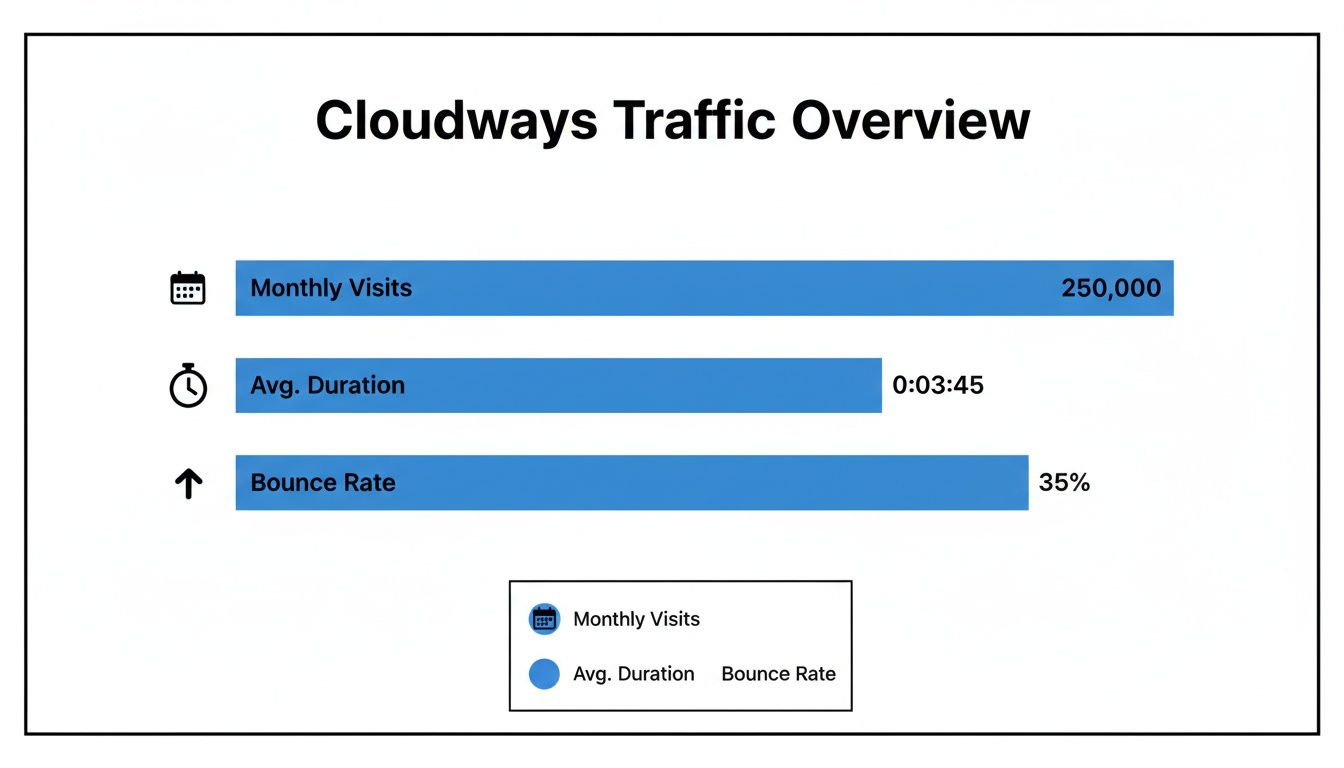
Those metrics tell a story: people who land on Cloudways tend to stick around, which is great news for getting conversions and keeping customers long-term. This isn’t just luck. After being acquired by DigitalOcean in 2022, the company’s valuation exploded, hitting an estimated $350 million by 2025. They’ve become a powerhouse by making cloud hosting from giants like AWS and Google Cloud simple for everyone.
Choosing The Right Path For You
To really know which model is best and what’s working, you have to track everything. Getting good at mastering Google Analytics UTM parameters is non-negotiable; it’ll show you exactly which campaigns are driving your best customers.
The best choice really comes down to your business and your audience. If you want a deeper look at what top affiliates are actually earning, check out my detailed guide on how much affiliates make on average.
Getting Started with the Affiliate Dashboard
Jumping into the Cloudways affiliate program is refreshingly simple. They’ve clearly designed the whole process to get you from sign-up to grabbing your first affiliate link as fast as possible. Let’s walk through exactly how it works.

One of the best parts? You don’t have to be a paying customer. Unlike some programs that make you buy a plan first, Cloudways lets you apply even if you just have a free trial account. It’s a low barrier to entry, which is great for new affiliates.
The Simple Sign-Up and Approval Process
First up, you’ll need a free Cloudways account. You can sign up the old-fashioned way with an email or connect a Google, LinkedIn, or GitHub account to make it even quicker. Once your email is verified, you can apply for the affiliate program straight from your main dashboard.
Head over to the “Affiliate” section, and you’ll find a straightforward profile form. This is where you’ll give them the details they need to understand how you’ll be promoting them.
- Your Information: The usual stuff—contact details and what you do.
- Payout Method: You’ll set up how you want to get paid. PayPal is the default option.
- Promotion Plan: A quick rundown of how you plan to send them traffic.
My tip for getting approved quickly: be specific here. Don’t just say “blogging.” Tell them your blog’s niche, mention your YouTube channel’s theme, or describe the paid ad strategy you’re considering. It shows you’re serious and makes you a much more appealing partner.
After you hit submit, the review process starts. Cloudways says it can take up to 24 hours, but honestly, most people I know got approved much faster than that. You won’t be left waiting around for ages before you can start earning.
Navigating Your Affiliate Command Center
Once you’re approved, you get access to the affiliate panel. Think of this as your mission control for everything promotion-related. It’s clean, easy to navigate, and has everything you need to track your performance and get the tools to drive referrals.
Here’s a quick tour of what you’ll find inside:
- Your Unique Affiliate Link: This is your golden ticket. It’s right there on the dashboard, front and center. This is the link you’ll share to make sure every single referral gets credited back to you.
- Performance Reports: This is where you see the numbers—clicks, sign-ups, and conversions. Keeping an eye on these metrics is crucial for figuring out what’s working and what’s not.
- Promotional Materials: Cloudways gives you a bunch of ready-made banners and co-branded landing pages. These look professional and can seriously help boost your conversion rates.
- Campaign Tracking: For those who like to get a bit more granular, you can create custom tracking links. This is super useful for seeing whether your traffic is coming from a blog post, a YouTube video, or an email campaign.
The dashboard really gives you all the data you need at a glance, from the first click all the way to a pending commission. That kind of transparency is exactly what you want when you’re trying to fine-tune your strategy. Master this dashboard, and you’ll be well on your way to turning your efforts into a solid income stream.
Proven Strategies to Promote Cloudways
Let’s be real: successfully promoting Cloudways isn’t about just dropping a few affiliate links here and there and hoping for the best. You’re talking to a much smarter crowd—developers, agencies, and business owners who care deeply about performance. Your strategy has to be built on showing genuine value, not just chasing a quick click.
Think of it like this: your audience has a problem (maybe a painfully slow website or unreliable hosting). They’re on one side of a canyon. The solution (a slick, high-performance Cloudways server) is on the other. Your job is to build a bridge of trust between them, and you do that with content that’s packed with proof, expertise, and real help.

This “value-first” approach does more than just build your credibility. It brings in higher-quality referrals—the kind of clients who actually stick around. This is exactly what makes the Hybrid commission model so profitable in the long run.
For Bloggers and SEO Specialists
If you’re good with words, your goal is to create content that climbs the search engine rankings and becomes a go-to resource for anyone considering Cloudways. Generic “best hosting” listicles are a dime a dozen and won’t move the needle here. You’ve got to dig deeper and provide cold, hard proof.
Here are a few content ideas that actually work:
- In-Depth Performance Benchmarks: Run detailed speed tests comparing Cloudways against a popular shared host or another managed cloud provider. Use tools like GTmetrix or PageSpeed Insights to show real data on load times and server response. Numbers don’t lie, and this kind of evidence-based content is gold for a technical audience.
- Detailed Migration Tutorials: A lot of people stay with bad hosting because they’re terrified of the migration process. Break it down for them. Create a super-detailed, step-by-step guide showing exactly how to move a WordPress site to Cloudways, complete with screenshots. You’ll be the hero who demystifies the whole thing.
- Client Case Studies: If you’re an agency or developer, this is your secret weapon. Showcase a project where you moved a client to Cloudways and saw tangible results. Detail the problem, the solution, and the outcome—like a 50% cut in load time or how the site handled a massive traffic spike without breaking a sweat.
The name of the game is to show, not just tell. Instead of saying Cloudways is fast, publish a performance report that proves it. This builds serious authority and makes your affiliate link the obvious next click for the reader.
For YouTube and Video Creators
Video is an incredibly powerful way to bring the Cloudways platform to life. For a hands-on product like this, a walkthrough can be way more compelling than just reading about it.
Consider these video formats:
- Live Site Speed Teardown: Find a volunteer with a slow site and migrate it to Cloudways live on camera. Record the “before” and “after” speed tests. This is raw, authentic, and incredibly persuasive because it shows the platform’s impact in real-time.
- Complete Dashboard Walkthrough: Do a “first impressions” style video where you explore the entire Cloudways dashboard. Show people how to spin up a server, install WordPress, manage backups, and play with the staging environment. This lowers the barrier to entry for people who are intimidated by cloud hosting.
- Project-Based Tutorials: Instead of a generic review, create a tutorial around a specific goal, like “How to Launch a High-Performance WooCommerce Store on Cloudways.” This attracts a super-motivated audience that is actively looking for a solution right now.
Building a High-Converting Content Funnel
No matter which platform you choose, your goal is to build a content funnel that guides people from curious to convinced. This isn’t about one piece of content; it’s a system.
For example, a blog post comparing different hosting providers (top of the funnel) can lead people to a deep-dive Cloudways review (middle of the funnel). From there, an email opt-in could deliver a migration guide or a special offer. A newsletter is a fantastic way to keep the conversation going. If you want to go deeper on this, you can find some great resources covering effective https://danielproctor.com/email-marketing-for-affiliates/ that show you how to build that relationship and drive sales.
Your content should answer questions at every step of the journey. By consistently solving problems, your affiliate links stop being ads and start being trusted recommendations. That’s the key to crushing it with any high-ticket affiliate program.
Weighing the Pros and Cons
Look, no affiliate program is perfect. To give you a real, honest-to-goodness Cloudways affiliate program review, we need to look at both sides of the coin—the good and the not-so-good. Figuring out where the program shines and where it might trip you up is the key to deciding if it’s the right move for you.

So, let’s break it all down. No fluff, just the straight facts on what to expect if you partner up with Cloudways.
The Major Upsides of Promoting Cloudways
First off, the program is clearly built to reward affiliates who can bring in serious business. It’s got a versatile structure that can work for quick cash flow or for building a long-term passive income stream, which is a level of flexibility you don’t see everywhere.
Here’s what really stands out:
- Huge Commission Potential: With the Slab model, you can pull in up to $125 per sale. That’s a high-ticket commission that puts it in the top tier of hosting affiliate programs. If you can drive consistent sign-ups, the earnings add up fast.
- Flexible Payout Models: You’re not stuck with one way to earn. You get to choose between the Slab model for those big upfront paydays or the Hybrid model for $30 upfront + a 7% recurring lifetime commission. This lets you match your earnings strategy to your business goals.
- A Generous 90-Day Cookie Window: This is a big deal. A 90-day cookie gives your audience a full three months to think things over after clicking your link. You still get credit even if they don’t buy on day one, which is huge for a considered purchase like hosting.
- Strong Brand Reputation: You’re not just promoting some random company. Cloudways is backed by DigitalOcean, a massive name in the cloud infrastructure world. That name alone brings a ton of credibility and trust to your recommendations.
The combination of high commissions and a long cookie window is a powerful one. It means that even if a referral takes weeks to research and finally sign up, you’re still rewarded for your initial marketing effort.
These upsides make the Cloudways program a really solid choice for serious marketers who know how to reach the right people. But it’s not all smooth sailing.
Potential Hurdles to Keep in Mind
While the earning potential is massive, there are a couple of things you need to be aware of before jumping in, especially if you’re new to the game. The challenges really boil down to getting paid and the type of person you need to attract.
- High Payout Threshold: The $250 minimum payout via PayPal can feel like a mountain to climb for new affiliates. If you’re only making a sale or two a month, it could take a while before you actually see any of that cash.
- It’s a Premium, Niche Product: Cloudways isn’t your average cheap shared hosting. It’s a high-performance managed cloud solution built for developers, agencies, and businesses that are serious about speed. That means your marketing has to be a lot smarter and more educational.
- Requires a More Technical Audience: To really succeed here, you need to be talking to people who get (or want to get) the value of managed cloud hosting. A generic “how to start a blog” article probably won’t cut it. You’ll see much better results with in-depth performance shootouts or detailed migration guides.
Basically, the program’s greatest strength—its top-tier product—is also its biggest challenge. You can’t just slap a banner ad on your sidebar and hope for the best. Success demands a content strategy built on genuine expertise and solving real technical problems for a smart audience. This makes it a fantastic fit for established tech bloggers and agencies, but a pretty steep hill to climb for total beginners in the affiliate world.
How Cloudways Compares to Other Hosting Affiliate Programs
Picking an affiliate program isn’t just about grabbing the one with the biggest commission. It’s really about finding a match for your audience and the way you create content. The web hosting affiliate space is seriously crowded, so figuring out where Cloudways fits in is crucial. It sits in a really interesting spot—somewhere between the ultra-premium hosts and the mass-market shared hosting guys.
Let’s use a car analogy. Think of shared hosting as a reliable, budget-friendly sedan. It gets the job done and is super popular. On the other end, you have the luxury sports cars—exclusive, powerful, and pricey. Cloudways is more like a high-performance sports sedan; it offers serious power and scalability but doesn’t have that absolute top-tier price tag. This positioning totally shapes how you’d promote it.
Cloudways vs Kinsta: A Premium Rivalry
Kinsta is another big name in the premium managed WordPress space. Just like Cloudways, they’re going after developers, agencies, and high-traffic sites that can’t afford slow performance. Both of them get the value of a long-term relationship, which is why they both offer recurring commissions.
Here’s a quick breakdown of how they stack up:
- Kinsta: Gives you a pretty generous $50 to $500 upfront commission depending on the plan, plus a 10% monthly recurring commission.
- Cloudways (Hybrid Model): Offers a $30 upfront bonus and a 7% lifetime recurring commission.
On the surface, Kinsta’s numbers might catch your eye more. But, Cloudways’ slightly lower price point can make it an easier sell to businesses that are watching their budget but still need top-notch performance. The choice really comes down to your audience. Are they the type to go for the absolute best-in-class service (Kinsta), or do they prefer a powerful, more cost-effective alternative (Cloudways)?
Cloudways vs SiteGround: The Audience Divide
SiteGround is an absolute giant in the shared hosting world, and it’s a go-to for beginners and small businesses. Their affiliate program is built for that mass-market approach, focusing on high volume with a tiered, one-time payout that’s a lot like Cloudways’ Slab model.
The real difference is the person you’re talking to. Promoting SiteGround is often about convincing someone to start their very first blog. Promoting Cloudways is about showing an established website owner how to fix a performance problem. They’re completely different conversations.
SiteGround can pay out commissions of $100+ per sale if you send a lot of traffic their way, but they don’t have a recurring commission option. This makes it fantastic for earning quick cash upfront but not so great if you’re trying to build a sustainable, passive income stream. Cloudways’ Hybrid model, on the other hand, is designed for affiliates who want to keep earning from their referrals for years.
Ultimately, the best program for you is… well, up to you. To find the right fit, it pays to look at a bunch of different options. You can dive deeper by checking out our guide to the https://danielproctor.com/best-web-hosting-affiliate-programs/ available today. For an even broader perspective, looking at a list of the 23 best influencer affiliate programs can give you a good sense of where hosting programs fit into the bigger affiliate marketing picture.
Got Questions About the Cloudways Program?
Jumping into any new affiliate program always brings up a few last-minute questions. Let’s clear up some of the common ones so you can figure out if Cloudways is the right move for you.
What’s the Cookie Duration and Why Should I Care?
Cloudways gives you a 90-day cookie duration. Think of it like this: when someone clicks your affiliate link, a little timer starts. If they buy hosting anytime in the next three months, you get credit for the sale. Simple as that.
This is actually a pretty big deal. High-quality hosting isn’t an impulse buy. People need time to think, compare features, and maybe even get their boss to approve the budget. That 90-day window means you still get paid for doing the work upfront, even if your referral takes a while to pull the trigger.
How Do Payouts Actually Work?
Getting paid is pretty straightforward, but there are a few things to keep in mind, especially the minimum payout amount.
- PayPal: You need to hit $250 in commissions to cash out.
- Wire Transfer: For the bigger earners, the minimum is $1,000.
Payments go out monthly. But here’s the catch: a commission only becomes “payable” after your referral pays at least two of their hosting bills. This is just Cloudways making sure you’re sending them real, long-term customers, not just tire-kickers.
Can I Use My Own Link to Get a Commission?
Nope. This is a hard and fast rule with pretty much every affiliate program out there. The whole point is to refer new customers, not to get a discount on your own stuff. Trying to sign up through your own link is a quick way to get your commissions voided and potentially kicked out of the program. Just don’t do it.
Is This a Good Program for Beginners?
It can be, but you have to be the right kind of beginner. If you’re serious about building a real audience—say, a blog or a YouTube channel focused on web development, WordPress, or online business—then yes, you can do well here.
But if you’re just looking for a quick buck without putting in the work to build trust and authority first, you’re going to struggle. Cloudways is a premium product, and that $250 payout threshold can feel like a long way off when you’re just starting out.
Ready to build a real affiliate business with expert guidance? At Daniel Proctor, we provide the mentorship, tools, and step-by-step training to help you succeed. Learn how to build your profitable affiliate marketing business today.
