

Absolutely. Not only is affiliate marketing without a website possible, it’s actually one of the fastest ways to start earning money online. By tapping into social media platforms and email lists you already use, you can connect directly with your audience and generate income without the headaches of building and maintaining a website.
Why You Don’t Need a Website to Succeed
The old-school approach to affiliate marketing meant building a blog, fighting to master SEO, and then waiting patiently for Google to send you trickles of traffic. That model isn’t dead, but it’s slow and requires a serious upfront investment in time and technical know-how.
Things have completely changed.
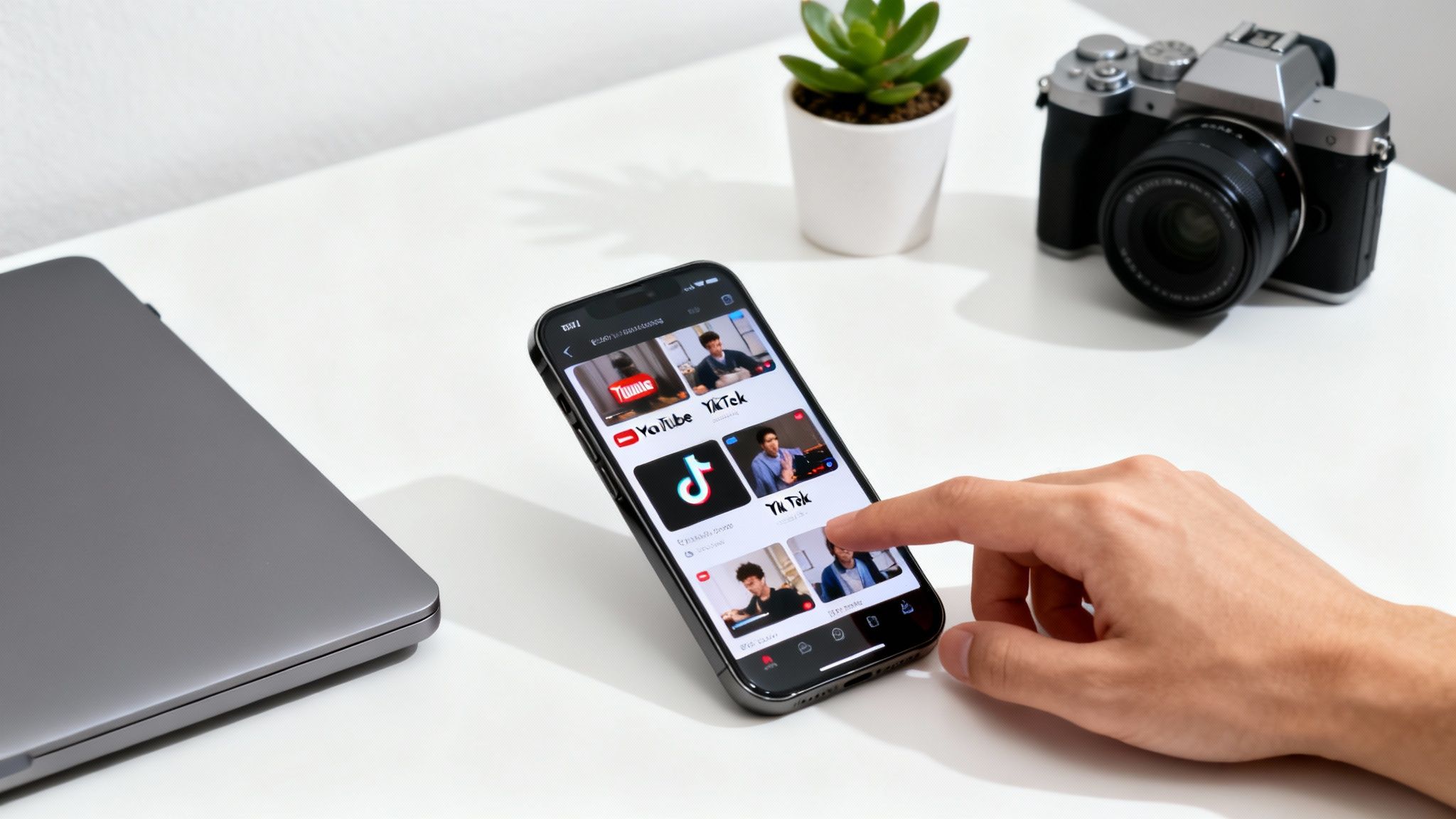
Creators are now building legitimate, profitable affiliate businesses on platforms where their audience already hangs out every single day. Think about it: your potential customers are scrolling YouTube, TikTok, and Instagram, and checking their email constantly. Instead of trying to drag them over to a new website, you just meet them where they are. This approach cuts out the friction and can seriously speed up how quickly you start earning commissions.
The Power of Social Platforms
The numbers don’t lie. Social media now drives a massive 67.32% of affiliate traffic, making it the undisputed king of affiliate channels, leaving traditional blogging behind. And with mobile devices accounting for up to 62% of all affiliate traffic, platforms designed for your phone are where the real action is.
This shift means your smartphone is a more powerful affiliate tool than a complicated website ever was. If you take a look at the latest affiliate marketing statistics, you’ll see exactly why this strategy is crushing it.
This modern, website-free approach boils down to three simple ideas:
- Build a Community: You gather a loyal following around a topic you genuinely care about.
- Deliver Real Value: You share content, reviews, and tutorials that actually help people solve a problem.
- Recommend Authentically: You seamlessly weave in affiliate products as the natural solution to your audience’s needs.
The goal isn’t to be another faceless publisher. It’s to become a trusted source. When you build that trust, your followers will buy through your links because they value your opinion, not just because you’re pushing a product.
Choosing Your Channel
The best part about this strategy is the flexibility. You don’t need to be everywhere at once. Just pick the platform that fits your style and the niche you want to serve. Whether you’re a natural on camera, a great writer, or have an eye for visuals, there’s a channel that will work for you.
To help you figure out where to start, here’s a quick rundown of the most effective channels for affiliate marketing when you don’t have a website.
Comparing Top Website-Free Affiliate Marketing Channels
Deciding where to focus your energy first can feel overwhelming. This table breaks down the pros and cons of the most popular platforms to help you choose a starting point that plays to your strengths.
| Channel | Best For | Effort Level | Income Potential |
|---|---|---|---|
| YouTube | In-depth reviews, tutorials, visual demonstrations | High | High to Very High |
| TikTok | Short-form video, trending products, quick tips | Medium | Medium to High |
| Lifestyle, visual products, influencer marketing | Medium | Medium to High | |
| Email List | Direct promotions, building relationships, high-ticket items | High | Very High |
| Facebook Groups | Niche communities, problem-solving, targeted advice | Medium | Low to Medium |
Each channel offers a unique way to connect with an audience. Don’t feel pressured to master them all—pick one, get good at it, and then expand from there.
Finding Your Niche and High-Converting Offers
Before you make a single dollar, your success in affiliate marketing without a website really boils down to two things: the niche you pick and the offers you promote.
Get these right, and you’re building on solid ground. Get them wrong, and you’ll feel like you’re shouting into an empty room.
A niche isn’t just a topic; it’s a specific group of people with a shared problem or obsession. Your goal isn’t to sell to everyone. It’s to become the trusted resource for a specific crowd, whether that’s home baristas trying to nail their latte art, busy parents desperate for healthy meal prep ideas, or gamers looking for the best gear on a budget.
How to Identify a Profitable Niche
Your sweet spot is where three things overlap: your genuine passion, audience demand, and real potential to make money. Passion is the fuel; if you don’t actually care about the topic, your content will feel forced, and you’ll burn out. Trust me on that one.
To figure out if there’s real demand, you need to do a little detective work:
- Active Communities: Look for busy Facebook Groups, subreddits, or popular TikTok hashtags on the topic. Big, chatty groups are a dead giveaway that you’ve found a hungry audience.
- YouTube Search Volume: Just start typing keywords related to your niche into the YouTube search bar. The autocomplete suggestions are pure gold—they show you exactly what people are searching for right now.
- Affiliate Product Availability: Are there already products out there solving problems in this niche? A quick search on networks like ShareASale or ClickBank will tell you if companies are already paying people like you to reach this audience.
For a deeper dive into market research, our guide on finding profitable affiliate marketing niches breaks down the exact framework I use. It’s a crucial step to make sure your idea has legs before you go all in.
Don’t mistake a broad topic for a niche. “Fitness” is a topic. “Postpartum fitness for new moms using at-home equipment” is a niche. Getting specific is what attracts a loyal following and makes it way easier to promote stuff they’ll actually want to buy.
Uncovering High-Converting Affiliate Offers
Once you’ve nailed down your niche, it’s time to hunt for offers that actually convert. A great offer isn’t just about a high commission percentage; it’s a product that genuinely helps your audience and has a proven history of selling well.
Start your search on the big, established affiliate marketplaces. These platforms are basically giant malls for affiliates, connecting you with thousands of brands.
- ShareASale: This is my go-to for physical products and well-known brands. You’ll find everything from home goods and fashion to tech and software.
- ClickBank: A powerhouse for digital products—think ebooks, online courses, and software. They’re known for having some seriously high commission rates, sometimes even 50-75%.
- Amazon Associates: This is the ultimate starting point for beginners. The commissions are on the lower side, but the sheer number of products and the fact that everyone trusts Amazon makes it easy to land your first few sales.
When you’re looking for affiliate opportunities that don’t need a website, browsing directories that list these kinds of programs can be a massive shortcut to finding offers that click with your audience.
Vetting Products Like a Pro
Never, ever promote a product just because the commission looks good. Your reputation and the trust you build with your audience are your most valuable assets.
Before you even think about sharing a link, run every potential offer through this quick checklist.
- Does it genuinely solve a problem? The product needs to offer real, tangible value. It has to be a direct solution to a pain point your audience feels. Vague promises don’t sell.
- What’s the product’s reputation? Go look for real customer reviews away from the product’s own website. Check out what people are saying on Reddit, Trustpilot, or in YouTube comments. You want the unfiltered truth.
- What’s the commission and cookie duration? A fat commission is great, but don’t overlook the cookie duration. A longer window (think 30-90 days) gives people more time to buy after clicking your link, and you still get credit for the sale.
- Can you try it yourself? Honestly, the best promotions come from personal experience. If you can get your hands on the product, you can create authentic content showing how it works in the real world—warts and all. That kind of honesty is your superpower, especially when you don’t have a website.
Mastering Social Media for Affiliate Commissions

Social media is more than just a place to catch up with friends; it’s a beast of an engine for affiliate sales, especially when you don’t have a website. The trick is to pick the right platform for your niche and create content that genuinely helps your audience first and sells second. You’re building a trusted presence, so when you recommend something, people actually listen.
Each platform has its own vibe and unwritten rules. What kills it on YouTube will die a slow death on TikTok. A great post in a niche Facebook Group will feel totally weird on Instagram. You have to master the specific plays that work for your chosen channel.
Dominate with YouTube Reviews and Tutorials
For in-depth affiliate promos, YouTube is the undisputed king. It’s perfect for anything that needs a visual demo—think software walkthroughs, gadget unboxings, or showing how a tool works in a real-world setting. Your job is to create videos that solve a specific problem for the viewer.
Don’t just talk about a product; show it in action. If you’re promoting a camera lens, show off the incredible photos you took with it. If it’s software, do a screen recording and walk people through the exact steps to get a result.
The video description is your money-maker. This is where your affiliate links live. Make a habit of mentioning in the video that you’ve linked everything below—it’s a simple verbal cue that gets people to click.
For instance, a video on “How to Brew the Perfect Espresso at Home” could easily link out to:
- The exact espresso machine you’re using
- Your favorite brand of coffee beans
- A grinder you’d recommend for a beginner
- The digital scale you use for weighing shots
This gives your viewers a ton of value and creates multiple commission opportunities from one video.
Convert Followers on Instagram and TikTok
With platforms like Instagram and TikTok, you’re dealing with short attention spans and lightning-fast content. Success here is all about grabbing attention immediately and driving action through visual formats like Reels and Stories. This is prime territory for lifestyle, fashion, beauty, and trending gadget niches.
Your “link-in-bio” is your most valuable asset. Since you can’t drop clickable links in most posts, you have to train your audience to check your bio. Tools like Linktree or Beacons let you build a simple landing page that holds all your key affiliate links in one spot.
To get people there, your content needs a crystal-clear call to action.
- For a Reel: Film a short, snappy video showing off a cool kitchen gadget. End it with on-screen text that says, “Find this amazing chopper in my bio!”
- For a Story: Use the built-in “link” sticker to send people directly to a product page. You could run a poll asking, “Struggling with frizzy hair?” and follow it up with a Story recommending your go-to serum, complete with a direct affiliate link.
Authenticity and consistency are everything. If you want to get more advanced and turn your profile into a real sales funnel, learning how to properly monetize Instagram is a total game-changer. It’s all about building a brand that sells naturally.
On these visual platforms, remember that people are buying into the lifestyle or the result you’re showing. Your content needs to feel less like an ad and more like a genuine tip from a friend. That’s the real secret.
Engage and Recommend in Online Communities
Places like Facebook Groups and Reddit can be absolute goldmines for affiliate marketing, but they demand a totally different playbook. These are communities built on trust and shared interests. If you just show up and start dropping links, you’ll get banned fast.
The entire strategy here is to become a genuinely helpful, recognized member of the community first.
This means you need to:
- Provide Real Value, Consistently: Jump into discussions, answer questions, and share your own experiences without mentioning any products or links.
- Wait for the Right Moment: Only share an affiliate link when it’s the perfect, natural solution to a problem someone has posted about.
- Frame It as a Helpful Suggestion: Instead of saying, “Buy this,” try something more like, “I had the same problem, and this is the tool that finally solved it for me. I can grab the link if you think it’d be helpful.”
Real-World Scenario: A Reddit Community
Let’s say you’re in a subreddit for home networking geeks. A user posts, “My WiFi is terrible in my upstairs office. What can I do?”
- Spammy Approach: “Buy this WiFi extender [affiliate link].” (Gets you downvoted or banned.)
- Value-First Approach: “I had the exact same issue in my two-story house. I tried moving the router and even a cheap extender, but nothing worked. What finally fixed it was switching to a mesh WiFi system. I ended up getting the [Product Name] and it covers my whole house perfectly now. The setup was also way easier than I expected.”
You’d only share your affiliate link if someone asks for it, and even then, it’s often best to do it in a private message to avoid breaking any community rules. This builds your reputation as an expert, not a spammer, which makes your recommendations a hundred times more effective.
Building Your Most Valuable Asset: An Email List
Relying entirely on social media platforms is a risky game. It’s like building your dream house on rented land—one algorithm change and you could lose everything overnight. This is precisely why an email list is the ultimate asset in affiliate marketing without a website. It’s the one direct line to your audience that you actually own and control.
An engaged email list isn’t affected by those unpredictable platform shifts. It’s where you can build real relationships, share targeted advice, and promote offers in a personal way that just converts better. Think of it as your own private community where people see you as a trusted guide, not just another face in a crowded feed.
Creating a Lead Magnet People Actually Want
To get someone’s email address, you need to give them something valuable first. This is your lead magnet. Forget those generic, fluff-filled ebooks. Your lead magnet should be a quick, powerful fix for a very specific problem your audience is struggling with right now.
Here are a few simple ideas you could whip up in an afternoon:
- A One-Page Checklist: Think simple and actionable. Something like “The 10-Point Checklist for a Perfect At-Home Manicure” or “The Pre-Travel Tech Checklist” is incredibly useful.
- A Curated Resource List: Share your expertise by compiling your top 5 favorite tools or apps. For example, “My 5 Must-Have Apps for Editing Viral TikTok Videos.”
- A Short Video Tutorial: Record a quick 5-minute private video solving one tiny, annoying problem. You can host it on YouTube as an “unlisted” video and just share the link with new subscribers.
The whole point is to deliver an immediate win. When your free stuff provides real value, your subscribers will naturally trust that your paid recommendations are worth their time, too.
Capturing Emails Without a Website
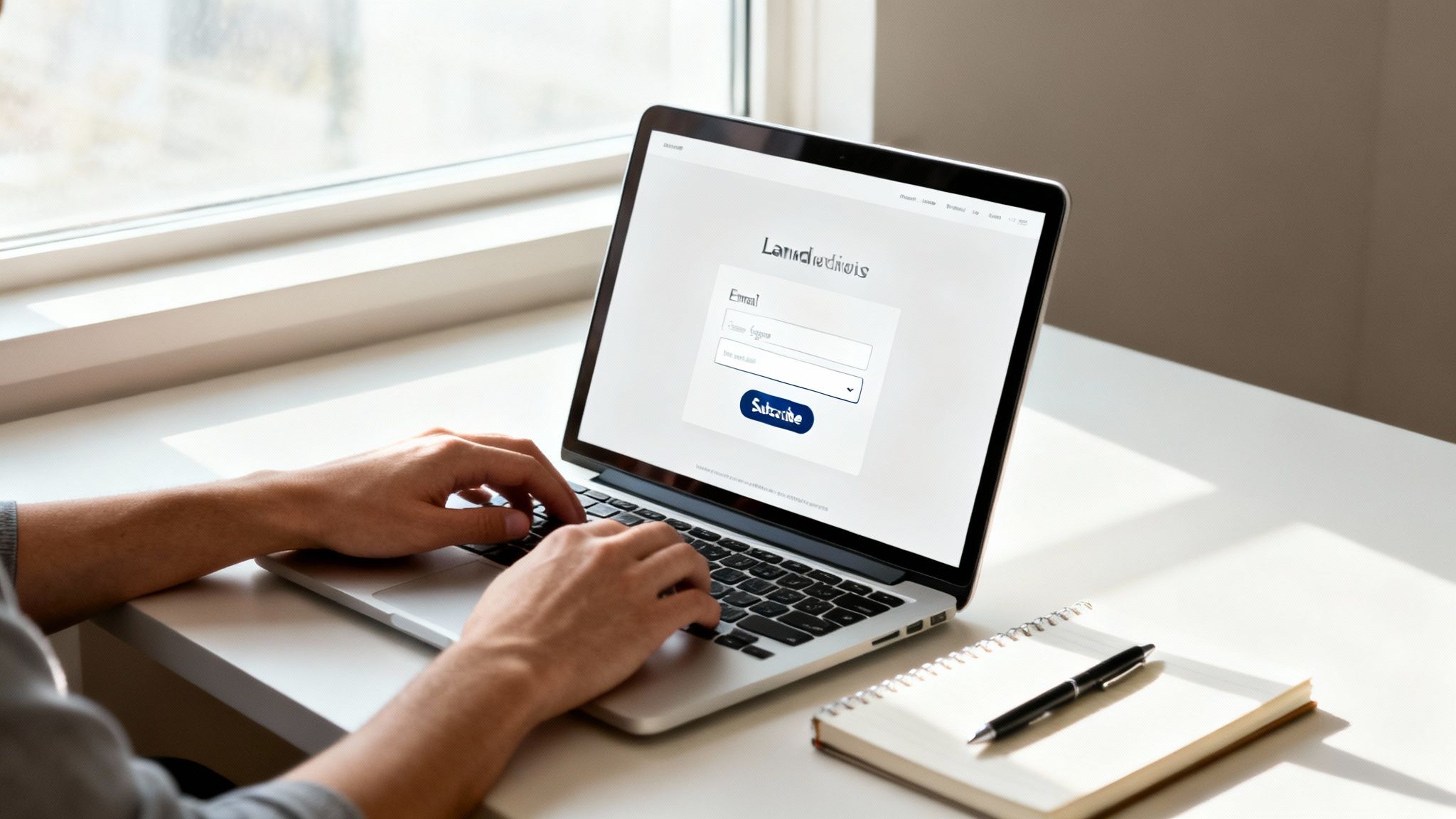
You don’t need a massive website to start collecting emails. There are simple, dedicated landing page builders made for exactly this. Tools like Leadpages or ConvertKit let you create clean, high-converting pages in just a few minutes.
Once you have your page, share the link everywhere you can:
- In your social media bios (that all-important “link-in-bio”).
- At the end of your YouTube video descriptions.
- As a pinned comment in a Facebook Group you run.
Your landing page has one job: clearly explain the benefit of your lead magnet and make it dead simple for someone to sign up. No distractions.
The best email lists are built, not bought. Always focus on quality over quantity. An engaged list of 100 true fans who actually open and click your emails is worth infinitely more than 10,000 subscribers who couldn’t care less.
Nurturing Your List and Promoting Offers
Okay, so you’ve got a new subscriber. Now what? The real work begins. Your first goal is to build a relationship, not just bombard them with affiliate links. A simple “welcome sequence” of 3-5 automated emails is the perfect way to do this. For a really deep dive on how to craft these, checking out a solid guide on email marketing for affiliates can give you a great starting point.
Here’s a basic welcome sequence you could model:
- Email 1 (Immediate): Deliver the lead magnet and give a warm welcome. Briefly reintroduce yourself and tell them what to expect.
- Email 2 (Day 2): Share a useful tip or a personal story related to your niche. Give value with zero strings attached.
- Email 3 (Day 4): Gently bring up a common problem and position an affiliate product as the solution. Frame it as something you genuinely recommend.
After that initial sequence, try to email your list at least once a week, mixing pure value with the occasional promotion. To really level up your list-building game, it’s worth digging into some proven email list building strategies. By consistently showing up with helpful content, you earn the right to sell.
Staying Compliant and Building Trust
Doing affiliate marketing without a website doesn’t mean you get to skip the rules. In fact, it’s the opposite. When your entire business is built on a direct, personal connection with an audience, trust is everything. Getting this right isn’t just about staying out of trouble; it’s about building a business that actually lasts.
Ignoring the legal stuff, like affiliate disclosures, is probably the fastest way to burn the trust you’ve worked so hard to build. The Federal Trade Commission (FTC) has some pretty clear guidelines to protect consumers, and they don’t care if you’re on YouTube, TikTok, or sending an email—they apply to you. Your audience deserves to know when you might earn a buck from your recommendations.
Mastering Affiliate Disclosures on Every Platform
The main rule here is simple: your disclosure needs to be clear and conspicuous. That just means people should see it without having to go on a treasure hunt. Burying it in a giant block of text at the very bottom of a YouTube description or using a light grey font just won’t fly.
Here’s how I handle this on different channels:
- On YouTube: The easiest way is to add a simple tag like (paid link), #ad, or #commissionsearned right next to the affiliate link in your description. For total transparency, mentioning it out loud in the video itself is even better. People appreciate the honesty.
- On Instagram & TikTok: For any posts in your feed or for Reels, pop
#ador#affiliatelinkhigh up in the caption. You want it visible before someone has to tap “more.” For Stories, the built-in “Paid Partnership” label is perfect, or just add a clear text overlay. - In Emails: A simple sentence at the start or end of your email does the trick. I usually go with something like, “Just so you know, this email may contain affiliate links, which means I might earn a small commission if you buy something—at no extra cost to you.”
The whole point of a disclosure isn’t just to check a legal box. It’s about being straight with your audience. When people see you’re upfront, it actually strengthens their trust in what you recommend, making them more likely to buy.
Beyond Disclosures: The Unwritten Rules of Trust
Legal compliance is just the starting line. The affiliates who really kill it operate with a code of ethics that puts their audience first, which, surprise surprise, leads to more sales in the long run.
The most important rule? Only promote products you have actually used and genuinely believe in.
Your followers are coming to you for real advice. If you push some junk product just to make a quick commission, they’ll figure it out. That one sale might cost you a loyal follower forever, along with all the future purchases they might have made. This is a long game.
Link Management and Tracking Your Success
Once you start sharing links across a bunch of different platforms, things can get messy—fast. Using a link management tool is a game-changer. These tools let you create clean, short links that are easy to share and, more importantly, track.
You might look into a standalone service like Geniuslink. If you ever decide to set up a simple blog down the road, a tool like ThirstyAffiliates is great, too.
These tools give you priceless data, showing you exactly which links are getting clicked. This info is gold. It tells you what your audience is actually interested in, so you can double down on what’s working and stop wasting time on what isn’t. This data-driven approach is how you fine-tune your strategy and grow your income way faster.
Launching and Scaling Your Affiliate Income
Okay, this is where all the pieces come together. It’s time to turn those sporadic clicks into a reliable income stream. Your first mission, should you choose to accept it, is simple: get your first commission within 30 days.
Seriously, that’s the goal. This isn’t about hitting a four-figure month right out of the gate. It’s about taking focused action to prove the concept and build some real momentum.
Your first few weeks are all about consistent output on your chosen platform. Maybe that’s two in-depth YouTube reviews, five genuinely helpful TikToks, or a welcome sequence for your brand-new email list. The key is just to show up and deliver value.
While you’re creating, keep a close eye on your affiliate dashboards, whether it’s ShareASale or Amazon Associates. Don’t just look for sales. Pay attention to the clicks. That click data is gold—it tells you exactly what your audience is curious about, long before they ever pull out their credit card.
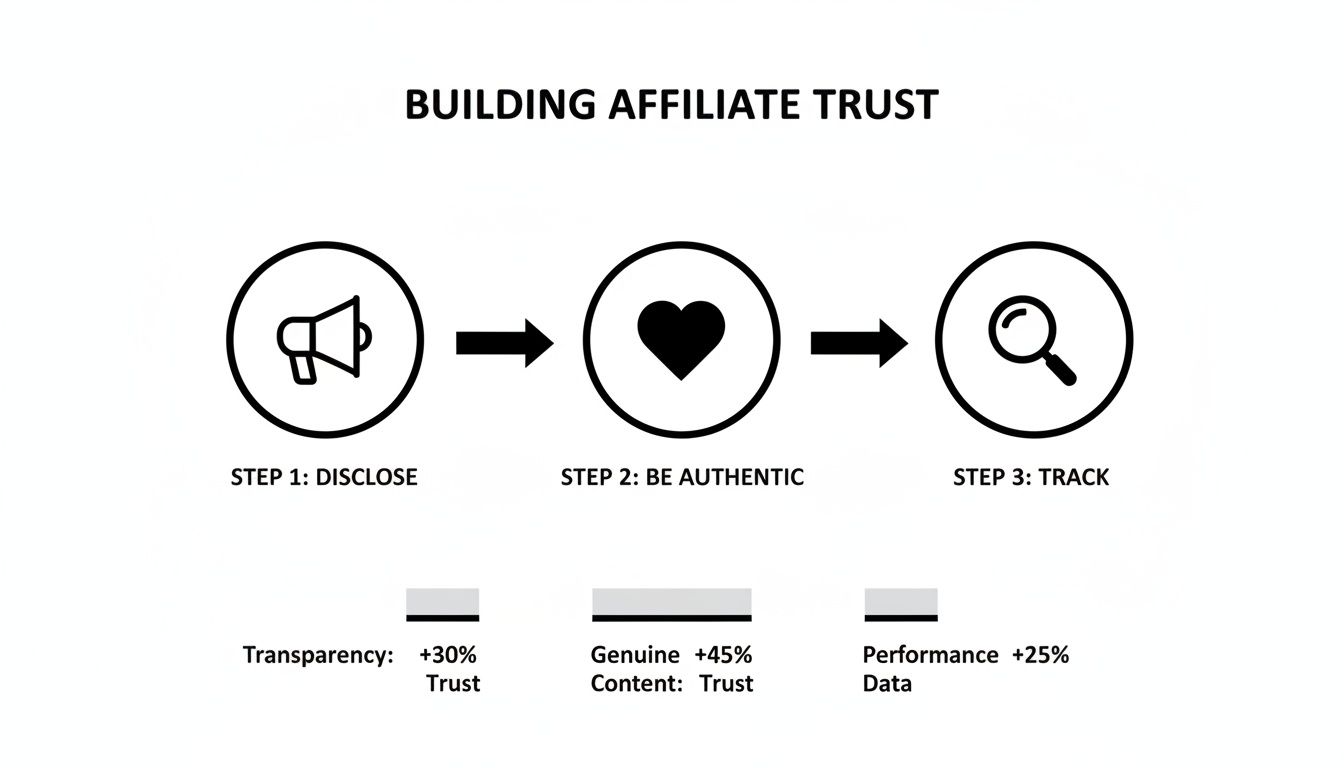
This whole process boils down to building trust. You have to be transparent (disclosure), you have to be yourself (authenticity), and you have to know your numbers (tracking). That’s the foundation for everything that comes next.
From First Commission to Consistent Growth
Once you see which links are getting traction or—even better—generating your first few sales, you’ve found your starting point. This is the moment you shift from throwing things at the wall to see what sticks, to executing a proven strategy.
Growth comes from doubling down on what’s already working. Simple as that.
The secret to scaling your affiliate marketing without a website is data-driven replication. Find the winning formula in your content—the format, the offer, the platform—and systematically create more of it.
This isn’t random guesswork. It’s a clear process:
- Find Your Top Performers: Look at your data and pinpoint the one piece of content or offer that drove the most clicks or sales. Just one.
- Create Variations: Now, brainstorm five new content ideas that orbit that same successful topic. For instance, if your “best budget microphone review” on YouTube took off, you could follow it up with a “microphone setup tutorial for beginners” or a “common mistakes people make with this mic” video.
- Expand Vertically: Start introducing complementary products. If you sold a bunch of coffee grinders, the logical next step is to recommend specific coffee beans, a high-quality digital scale, or even a beginner-friendly espresso machine.
This approach gives you a repeatable system. Instead of waking up and wondering what to post, you let your audience’s actions dictate your content calendar. And that’s how you build a consistent, scalable affiliate income.
Your Top Questions About Website-Free Affiliate Marketing
A lot of people interested in affiliate marketing get tripped up by the same few questions right at the start. Let’s tackle some of the biggest hang-ups so you can get moving.
Can You Really Make Good Money Without a Website?
Yes, you absolutely can. Some of the most successful affiliates I know—especially top-tier influencers and creators—are pulling in six figures without ever touching a traditional website. They’ve built their entire business on platforms like YouTube, Instagram, and TikTok.
Think of a website as just one tool in the toolbox. It’s useful, but it’s not the only one. Your real earning potential comes down to the audience you build and the trust you earn, not whether or not you own a domain name.
How Do I Post Links Without Looking Like a Spammer?
This one’s simple: always lead with value. The goal is to make the product feel like a natural, genuinely helpful part of your content. Never, ever just dump a raw link and run.
Instead, frame it as a solution.
- On YouTube: After demonstrating something, just say “I’ve linked everything I used in the description below.” It’s helpful, not salesy.
- On social media: Weave the link into a caption that shares a personal story or a useful tip.
- Always be upfront: A simple #ad or (paid link) shows you’re being honest. It builds trust, which is everything in this game.
People don’t mind you getting a commission when they feel like you’ve genuinely helped them. A good recommendation should feel like a tip from a trusted friend, not a hard sell from a stranger.
Which Affiliate Networks Are Best if I’m Just Starting Out?
You don’t need a fancy website to get approved by many of the best networks. Honestly, the best place for most beginners is Amazon Associates. Why? Everyone already trusts Amazon, their product range is massive, and that familiarity makes it much easier to get your first sale.
Beyond Amazon, networks like ShareASale and ClickBank are great options. They have thousands of merchants, and many will happily approve you as long as you can show you have an active social media profile or a growing email list.
Ready to stop guessing and start building? At Daniel Proctor, we provide the exact playbooks and 1-on-1 mentorship to help you build a profitable affiliate business, with or without a website. Start your journey with our free masterclass.
