


Starting an affiliate marketing business is exciting, but your success hinges on the platform you build it on. The right website builder isn't just a tool to publish content; it's the engine that powers your SEO, conversion rates, and long-term scalability. A poor choice can lead to frustrating technical headaches, slow page speeds that hurt your rankings, and ultimately, missed revenue opportunities. This guide moves beyond generic feature lists to provide a practical, in-depth analysis of the 12 best website builders for affiliate marketing.
We will examine each platform through the specific lens of an affiliate marketer. Our focus is on the features that directly impact your bottom line:
- Content Management: How easily can you create, optimize, and manage review articles, comparison tables, and blog posts?
- SEO Capabilities: What tools are available for on-page SEO, schema markup, and site speed optimization?
- Link Management: Can the platform handle link cloaking, nofollow attributes, and tracking with ease?
- Monetization Flexibility: How well does it integrate with affiliate networks, advertising platforms, and other income streams?
Whether you're building a niche review blog from scratch, a visually-driven comparison site, or a series of high-converting landing pages, this breakdown will help you choose the perfect foundation for your affiliate business. We've included detailed reviews, screenshots, and direct links for each option to simplify your decision-making process. Let's find the right builder to turn your content into a consistent source of passive income.
1. Wix
Wix is a dominant force in the website-building space, making it one of the best website builders for affiliate marketing for those prioritizing speed and ease of use. Its highly intuitive drag-and-drop editor and extensive library of over 900 professionally designed templates allow beginners to create a visually appealing, content-rich affiliate site in hours, not days. This rapid deployment is a key advantage for marketers eager to start publishing reviews and product comparisons.
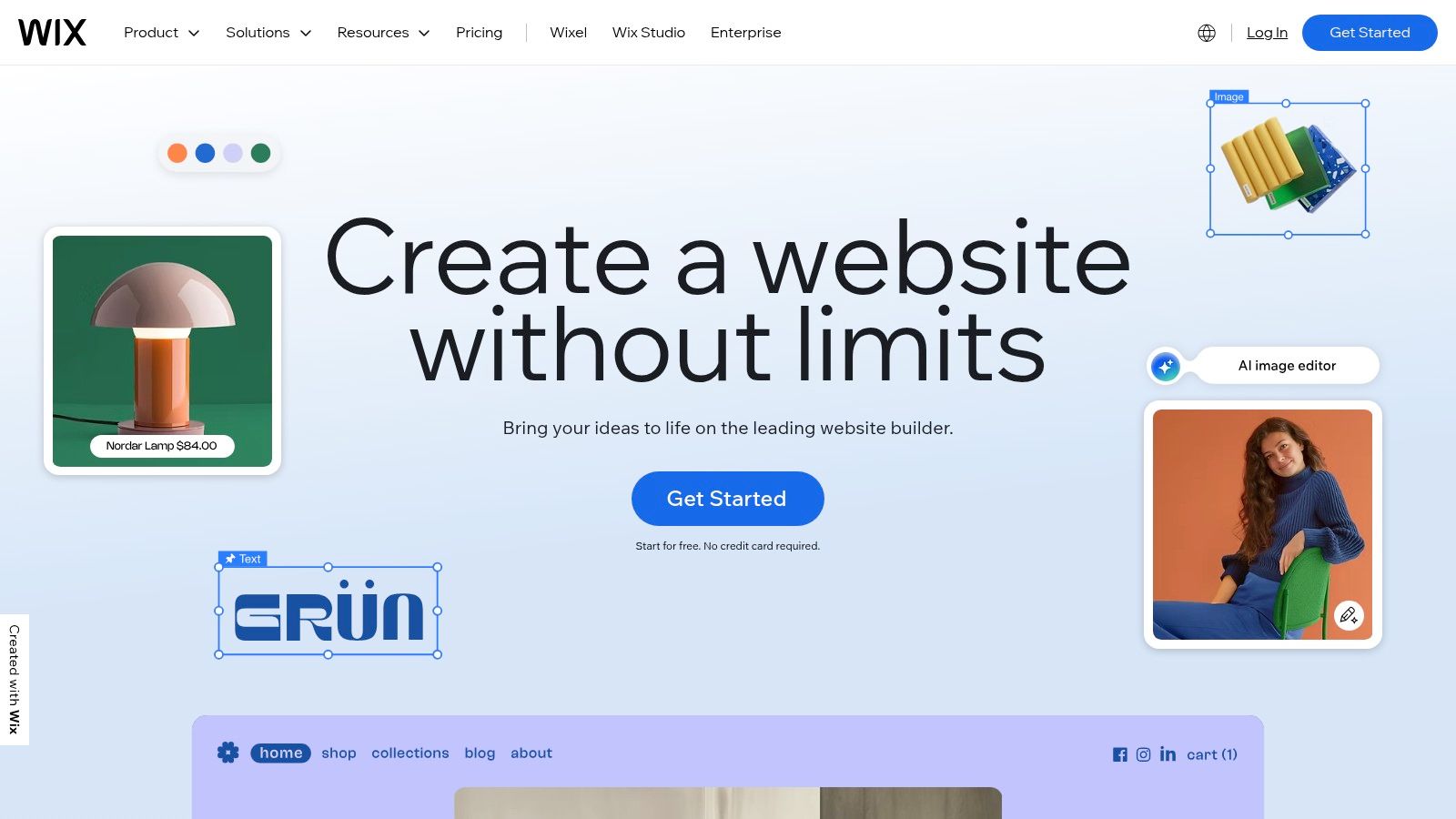
The platform’s strength lies in its simplicity for content-based affiliate marketing. Adding affiliate links is straightforward: you can embed them in text, buttons, and images with just a few clicks. The built-in blogging tools and basic SEO features (like the SEO Wiz setup guide) provide a solid foundation for new sites aiming to attract organic traffic.
Implementation and Key Features
Wix’s App Market is where its functionality truly expands. For affiliates who also want to run their own program, apps like GoAffPro or Simple Affiliate integrate directly, transforming a standard content site into a merchant platform. This ecosystem is a major differentiator, offering flexibility as your marketing strategy evolves.
- Ease of Use: The visual editor is extremely beginner-friendly.
- App Ecosystem: Access hundreds of third-party apps for SEO, analytics, and affiliate program management.
- Affiliate Link Integration: Clear and simple process for adding links to any element.
- Pricing: A limited free plan is available for testing. Paid plans start at around $17/month to connect a custom domain and remove Wix ads.
Pros and Cons
While Wix excels at getting users online quickly, it's important to consider the trade-offs.
| Pros | Cons |
|---|---|
| Extremely beginner-friendly | Advanced features often require costly third-party apps |
| Massive template and app library | Not as scalable for complex, high-traffic e-commerce affiliate sites |
| Fast to launch a new site | Can't switch templates after your site is live |
Its user-friendly interface makes it an excellent choice for newcomers, especially those promoting products in niches like web hosting; for more information, you can explore top web hosting affiliate programs.
Best For: Beginners and content creators who need a visually impressive affiliate blog or review site launched quickly with minimal technical knowledge.
2. Squarespace
Squarespace is a design-centric, all-in-one platform, making it one of the best website builders for affiliate marketing for creatives and bloggers who value aesthetics. Its award-winning templates provide a sophisticated and professional starting point for affiliate review sites, portfolios, and blogs. The platform's emphasis on clean design ensures that your affiliate content is presented in an engaging, trustworthy format that encourages clicks.
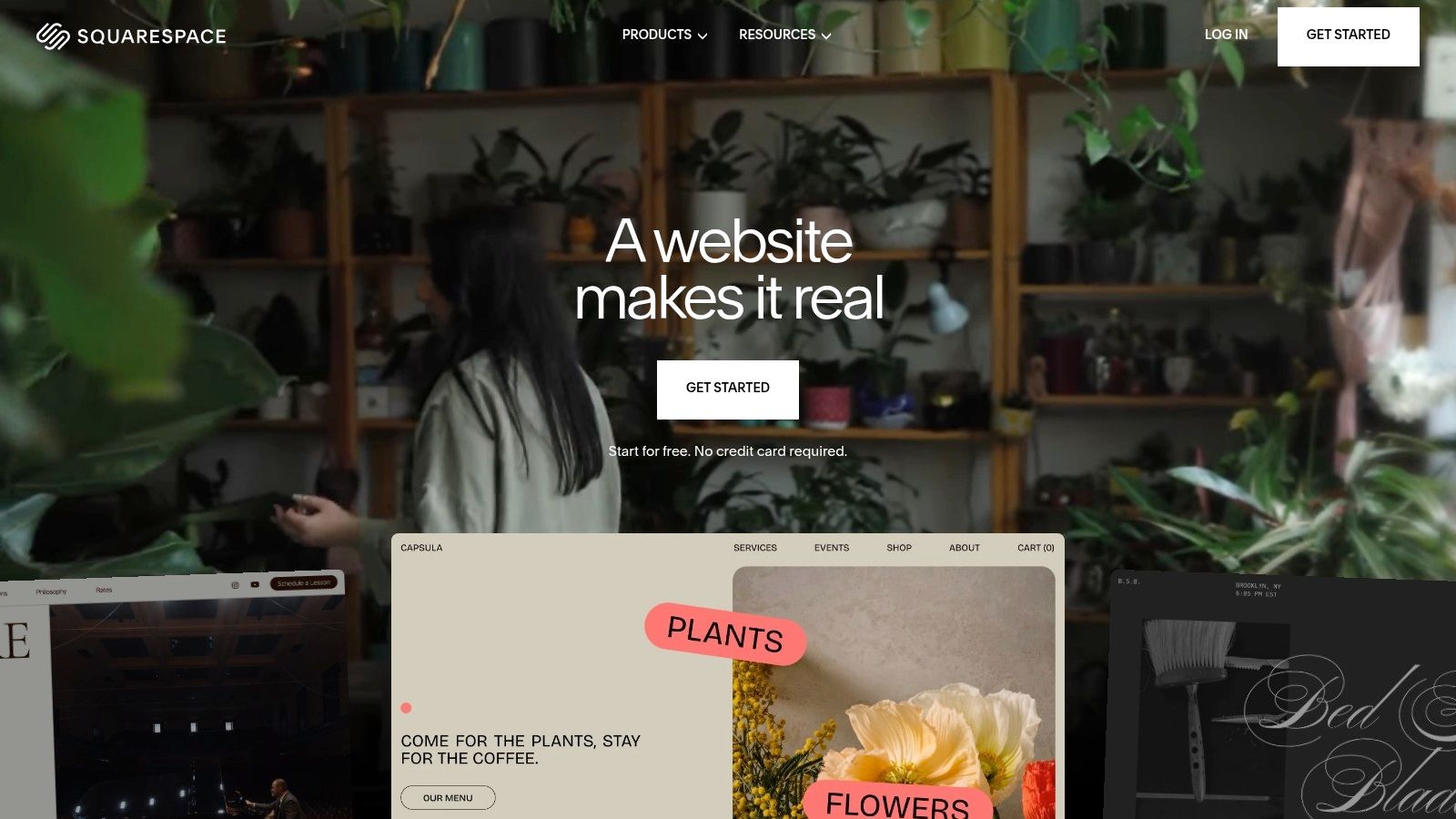
The platform shines with its polished and powerful blogging user experience, allowing for seamless integration of text, images, and affiliate links. Built-in tools for SEO, analytics, and even e-commerce provide a comprehensive ecosystem, eliminating the need for many third-party plugins. For affiliates looking to diversify, Squarespace's integrated membership and digital product features offer additional monetization streams beyond simple links.
Implementation and Key Features
Squarespace’s strength is its unified, all-in-one nature. Everything from hosting and SSL certificates to analytics is included out of the box, simplifying the technical side of running an affiliate site. Its AI-powered tools, like Squarespace Blueprint, can help you generate a unique site design framework in minutes, which is ideal for marketers managing multiple niche sites. Adding affiliate links to text or buttons is an intuitive part of the editing process.
- Design Quality: Industry-leading templates that are mobile-responsive and visually stunning.
- All-in-One Platform: Includes hosting, analytics, and robust blogging tools.
- Monetization Flexibility: Built-in support for memberships, e-commerce, and digital products.
- Pricing: Plans start at around $16/month (billed annually). There is no permanent free plan, but a 14-day free trial is available.
Pros and Cons
While Squarespace offers a beautiful and integrated experience, its curated system has certain limitations.
| Pros | Cons |
|---|---|
| Great designs and clean blogging experience | No permanent free plan available for long-term testing |
| Comprehensive platform with everything included | Less extensible than platforms with large app marketplaces |
| Excellent for visual-heavy content niches | Transaction fees apply on lower-tier commerce plans |
Squarespace’s polished environment makes it a top choice for affiliate marketers who want a premium-looking site without touching a line of code.
Best For: Bloggers, creators, and marketers in visual niches (like travel, food, or design) who prioritize a professional aesthetic and an all-in-one solution.
3. WordPress.com
WordPress.com is the managed hosting solution for the world's most popular CMS, making it one of the best website builders for affiliate marketing, especially for those with a long-term, SEO-focused strategy. It combines the power of WordPress's best-in-class blogging features with a simplified site builder experience. This platform is built for content, offering robust tools like categories, tags, and RSS feeds right out of the box, which are essential for organizing and distributing product reviews.
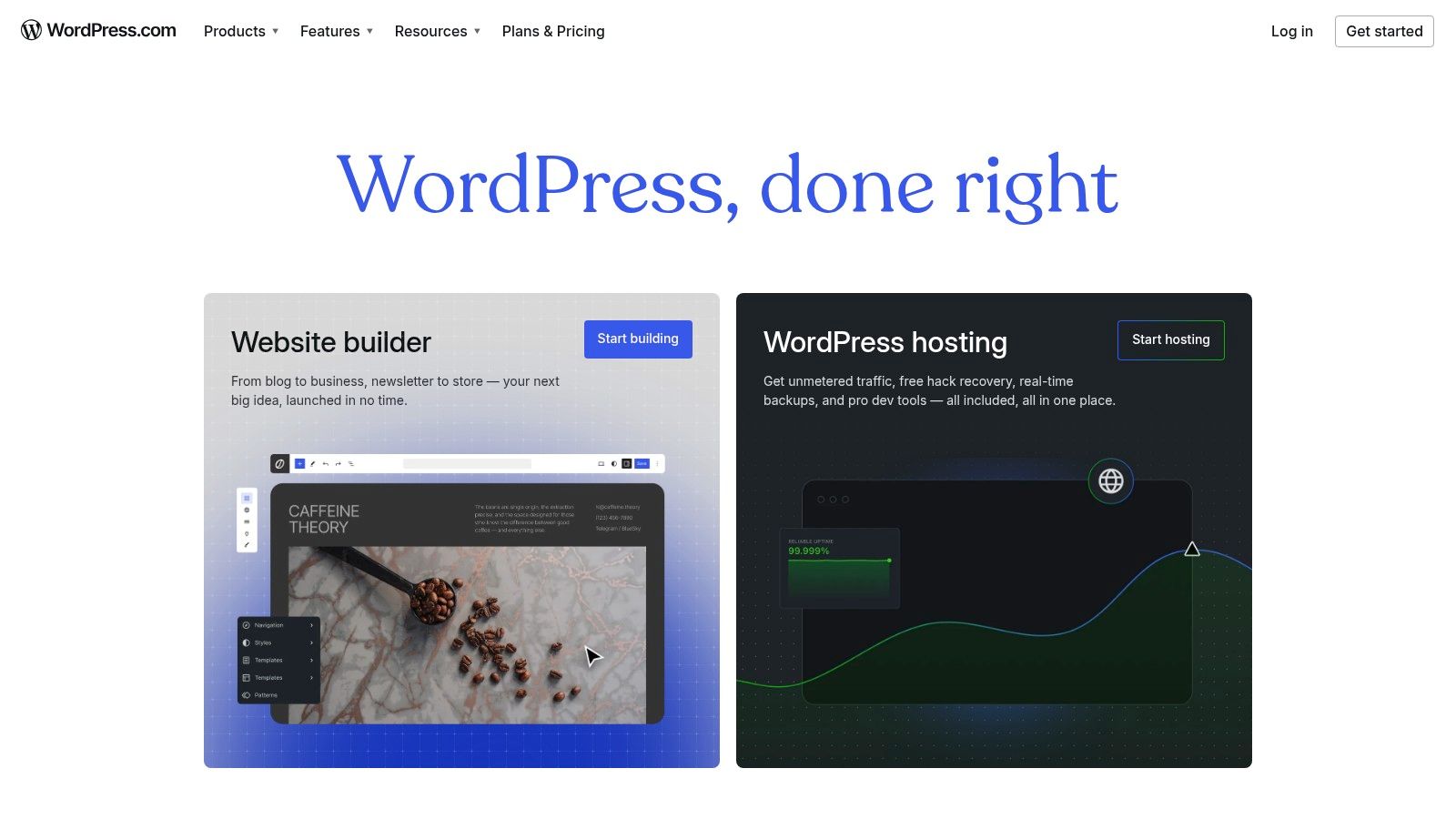
The platform scales effectively with your ambitions. While lower-tier plans are great for getting started, higher-paid plans unlock the full potential of WordPress by granting access to its vast ecosystem of plugins and themes. This allows affiliates to add advanced functionality for SEO, link management, and analytics as their site grows. The recent addition of an AI site builder also helps accelerate the initial setup process for new users.
Implementation and Key Features
WordPress.com provides a guided path into the powerful WordPress ecosystem. While the true customization comes with higher-tier plans, the core experience is centered on creating high-quality content. For affiliates, this means you can immediately focus on your writing, a crucial skill you can refine by learning how to write compelling product reviews.
- World-Class CMS: Unmatched blogging features for organizing and publishing content.
- Scalable Access: Start with a simple setup and upgrade to unlock thousands of plugins and themes.
- AI Site Builder: Accelerates the initial design and content scaffolding process.
- Pricing: A free plan exists with limitations. Paid plans that remove ads and add a custom domain start around $4/month, but plugin access requires the Business plan or higher (around $25/month).
Pros and Cons
WordPress.com offers a clear growth trajectory but gates its most powerful features behind more expensive plans.
| Pros | Cons |
|---|---|
| Industry standard for SEO-oriented blogs | Plugin and theme access is restricted to higher-priced plans |
| Scales from a simple blog to a complex site | Full monetization options are gated behind the Business plan |
| Huge ecosystem of plugins (on higher tiers) | The AI site builder is still limited for complex affiliate setups |
Best For: SEO-focused affiliate marketers and bloggers who plan to scale their content operations over time and are willing to invest in higher-tier plans for full functionality.
4. Webflow
Webflow is a powerful visual development platform that bridges the gap between no-code builders and custom-coded sites, making it one of the best website builders for affiliate marketing for those who demand granular design control and exceptional performance. It allows designers and marketers to build professional, production-ready websites without writing code, outputting clean HTML, CSS, and JavaScript that search engines love. This focus on performance and clean code provides a significant SEO advantage from day one.
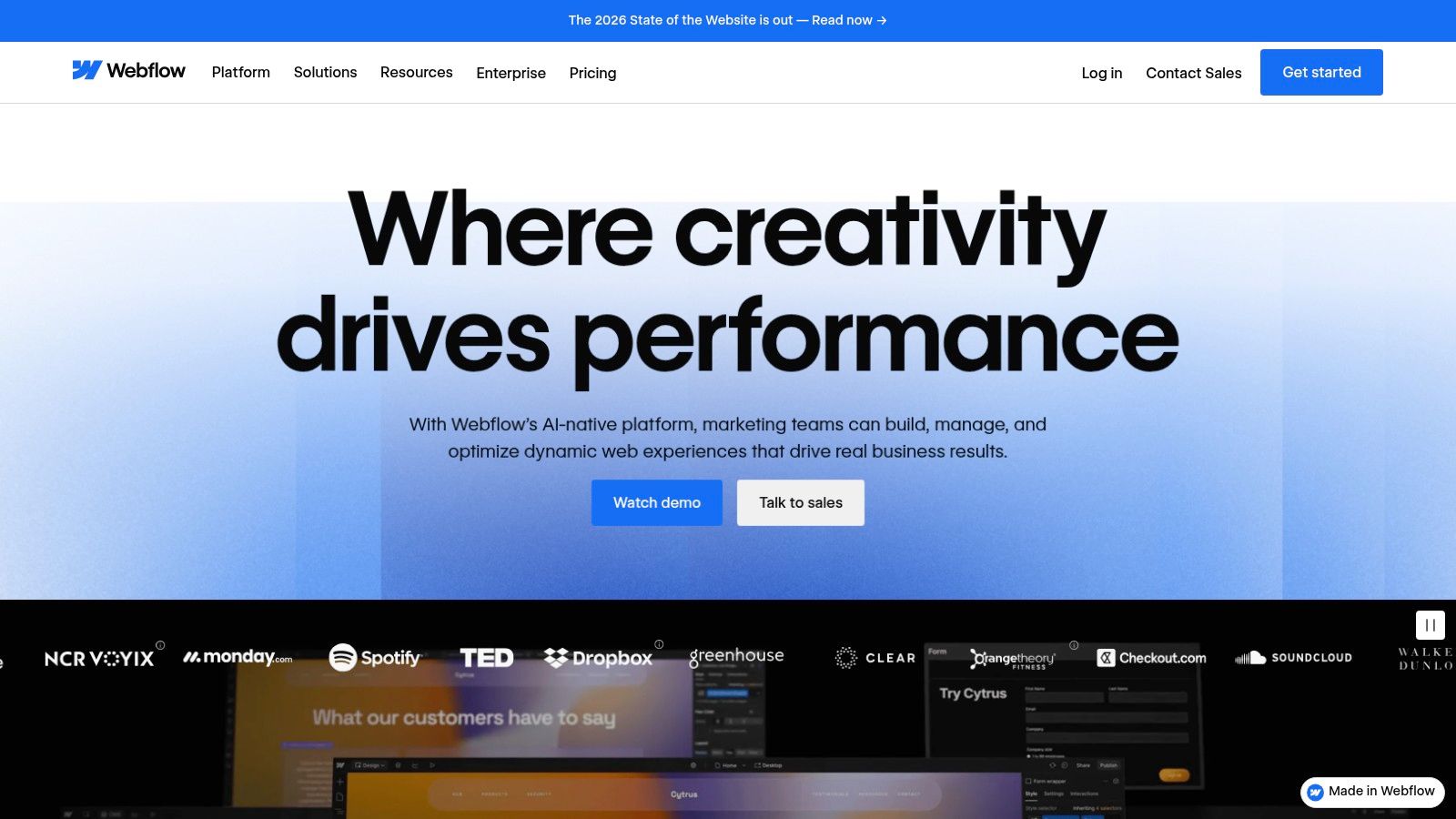
The platform’s standout feature for affiliates is its powerful Content Management System (CMS). Using CMS Collections, you can create structured databases for your affiliate products, reviews, or comparison tables. You can then design a single template and dynamically populate it with your content, making it incredibly efficient to scale a review site or product hub with hundreds of entries while maintaining a consistent design.
Implementation and Key Features
Webflow’s visual designer provides a level of control unmatched by simpler drag-and-drop editors, allowing for pixel-perfect, responsive designs. Its "university" offers some of the best free tutorials in the industry, helping new users overcome the initial learning curve. The introduction of AI features also helps accelerate content and design workflows.
- Design Control: Unparalleled visual control over every element, resulting in clean, semantic code.
- Powerful CMS: Use CMS Collections to manage and scale large amounts of structured affiliate content efficiently.
- Performance: Sites are built for speed and reliability, which is crucial for SEO and user experience.
- Pricing: A free starter plan lets you build and learn. Paid site plans start at $14/month (billed annually) for a custom domain.
Pros and Cons
Webflow offers professional-grade power but comes with a steeper learning curve than its competitors.
| Pros | Cons |
|---|---|
| Excellent performance and design control | Steeper learning curve than simple drag-and-drop builders |
| Strong CMS for structured affiliate content | Page/item caps on lower-tier plans can limit large-scale sites |
| Extensive educational resources | Can be more expensive than all-in-one beginner platforms |
Best For: Technically-inclined marketers, designers, and agencies who need complete creative control and a scalable CMS to build high-performance, custom affiliate review sites.
5. Shopify
Shopify is an ecommerce titan, but its powerful infrastructure also makes it one of the best website builders for affiliate marketing for those with a hybrid strategy. It's the ideal choice for marketers who plan to sell their own products alongside promoting others. This dual-capability allows you to build a brand, own your customer relationships, and diversify your income streams beyond traditional affiliate commissions.

While its core focus is on commerce, Shopify includes a robust built-in blog perfect for publishing product reviews and comparison articles. You can easily embed affiliate links within this content or use custom discount codes to track referrals. The platform's true power for affiliates, however, comes from its ability to also host your own affiliate program for your products.
Implementation and Key Features
The Shopify App Store is a game-changer, allowing you to add sophisticated affiliate and referral marketing capabilities to your own store. Apps like GoAffPro and Social Snowball integrate seamlessly, turning your customers into your own team of affiliates. This merchant-side functionality is a key differentiator from content-only platforms.
- Full Ecommerce Stack: Provides a complete solution for selling, including a store, secure checkout, shipping, and powerful analytics.
- Built-in Blogging: Create and manage affiliate content alongside your product pages.
- App Ecosystem: A massive app store with tools for running your own affiliate program, SEO, and analytics.
- Pricing: Plans start at $29/month after a free trial, with 24/7 support included.
Pros and Cons
Shopify's commerce-first approach presents a unique set of advantages and considerations for affiliate marketers.
| Pros | Cons |
|---|---|
| Best-in-class commerce capabilities and app store | Overkill and too costly for pure content-only affiliate sites |
| Extensive support resources and merchant tools | Transaction fees and app costs can accumulate quickly |
| Easy to add apps for running your own affiliate program | Less template design flexibility than drag-and-drop builders |
Best For: Entrepreneurs and affiliate marketers who want to sell their own physical or digital products in addition to promoting other brands' offerings.
6. Hostinger Website Builder (formerly Zyro)
Hostinger Website Builder emerges as one of the best website builders for affiliate marketing for those prioritizing affordability and all-in-one simplicity. Bundled directly with Hostinger's renowned hosting services, it offers an incredible value proposition: a builder, domain, SSL, and business email in a single, low-cost package. This makes it a powerful contender for affiliates on a tight budget who need a reliable, fast-loading site without a significant upfront investment.
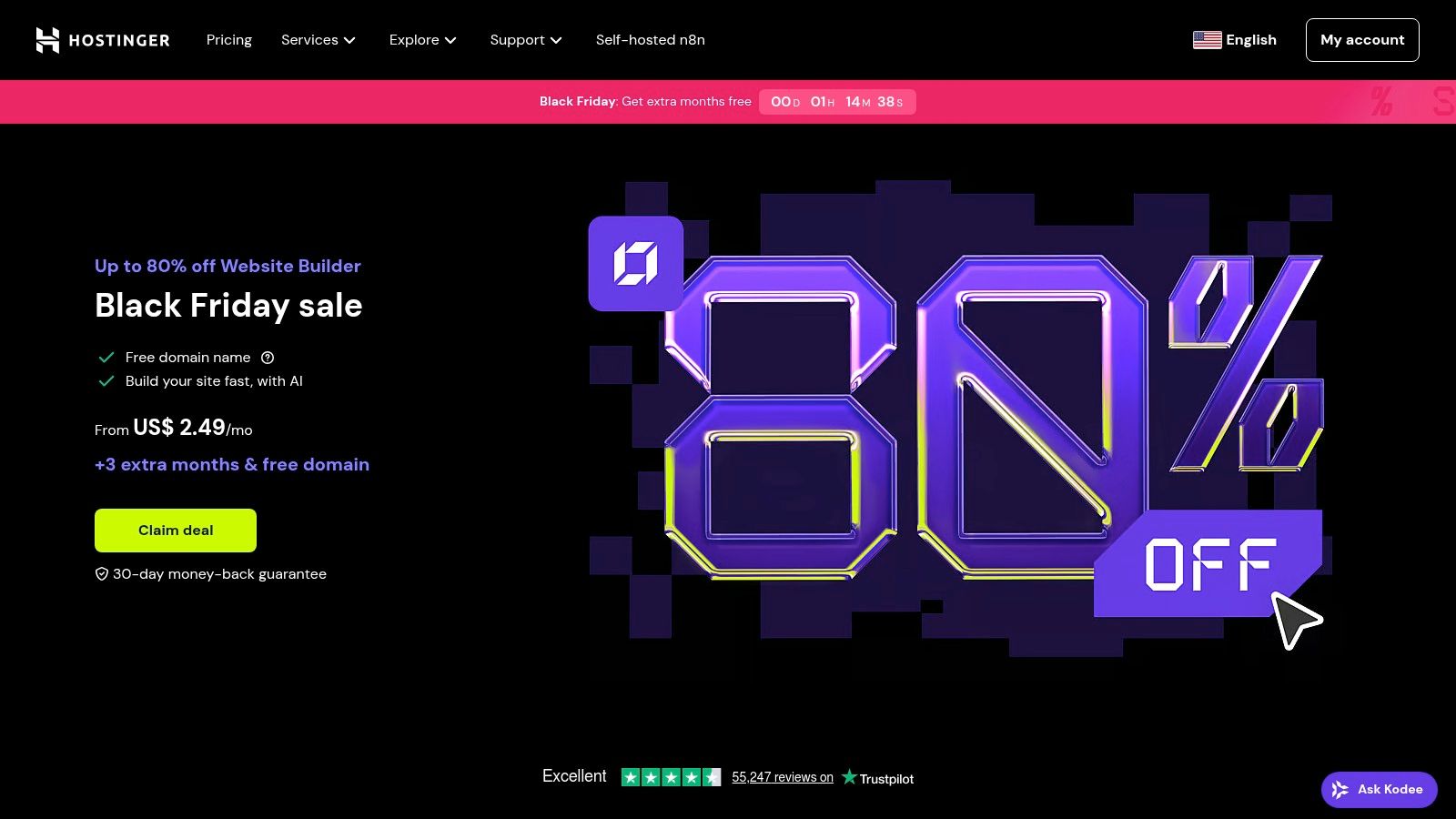
The platform's main appeal is its suite of AI-driven tools. The AI Writer can help generate blog posts and review content, while the AI SEO assistant provides actionable tips to improve search visibility. These features streamline the content creation process, allowing marketers to publish high-quality, optimized affiliate articles more efficiently. For a deeper dive into what Hostinger offers, including its hosting services and website builder, you can read a comprehensive Hostinger review.
Implementation and Key Features
Getting started with Hostinger Website Builder is fast and guided, making it ideal for beginners. You can either pick a template or use the AI to generate a starter site based on a few prompts. Adding affiliate links to text, images, or buttons is intuitive within its grid-based editor. The built-in analytics also help track visitor behavior, which is crucial for optimizing conversion rates.
- AI-Powered Tools: Includes an AI writer, SEO assistant, and blog title generator to speed up content creation.
- All-in-One Package: Plans bundle hosting, a free domain for one year, SSL, and email accounts.
- Performance: Built on Hostinger's infrastructure, sites benefit from solid speed and reliability.
- Pricing: Extremely competitive introductory pricing, often starting at just a few dollars per month.
Pros and Cons
Hostinger’s value is undeniable, but it's important to be aware of its limitations compared to more established builders.
| Pros | Cons |
|---|---|
| Very low entry price for US users | Fewer templates and apps than ecosystems like Wix or Shopify |
| All-in-one value (hosting + builder + domain) | Renewal prices can be significantly higher than introductory rates |
| Solid performance for small and medium sites | No permanent free plan is available for long-term testing |
Best For: Budget-conscious affiliate marketers and beginners who want an all-inclusive, easy-to-use platform with helpful AI tools to kickstart their content creation.
Visit Hostinger Website Builder
7. GoDaddy Website Builder
GoDaddy Website Builder leverages AI and a simplified interface to provide one of the fastest ways to launch a functional affiliate marketing site. While not as feature-rich as dedicated platforms, it stands out for its all-in-one approach, integrating marketing and scheduling tools directly into the dashboard. This makes it a strong contender among the best website builders for affiliate marketing for service providers, local business reviewers, or those who value speed and reliable support over deep customization.
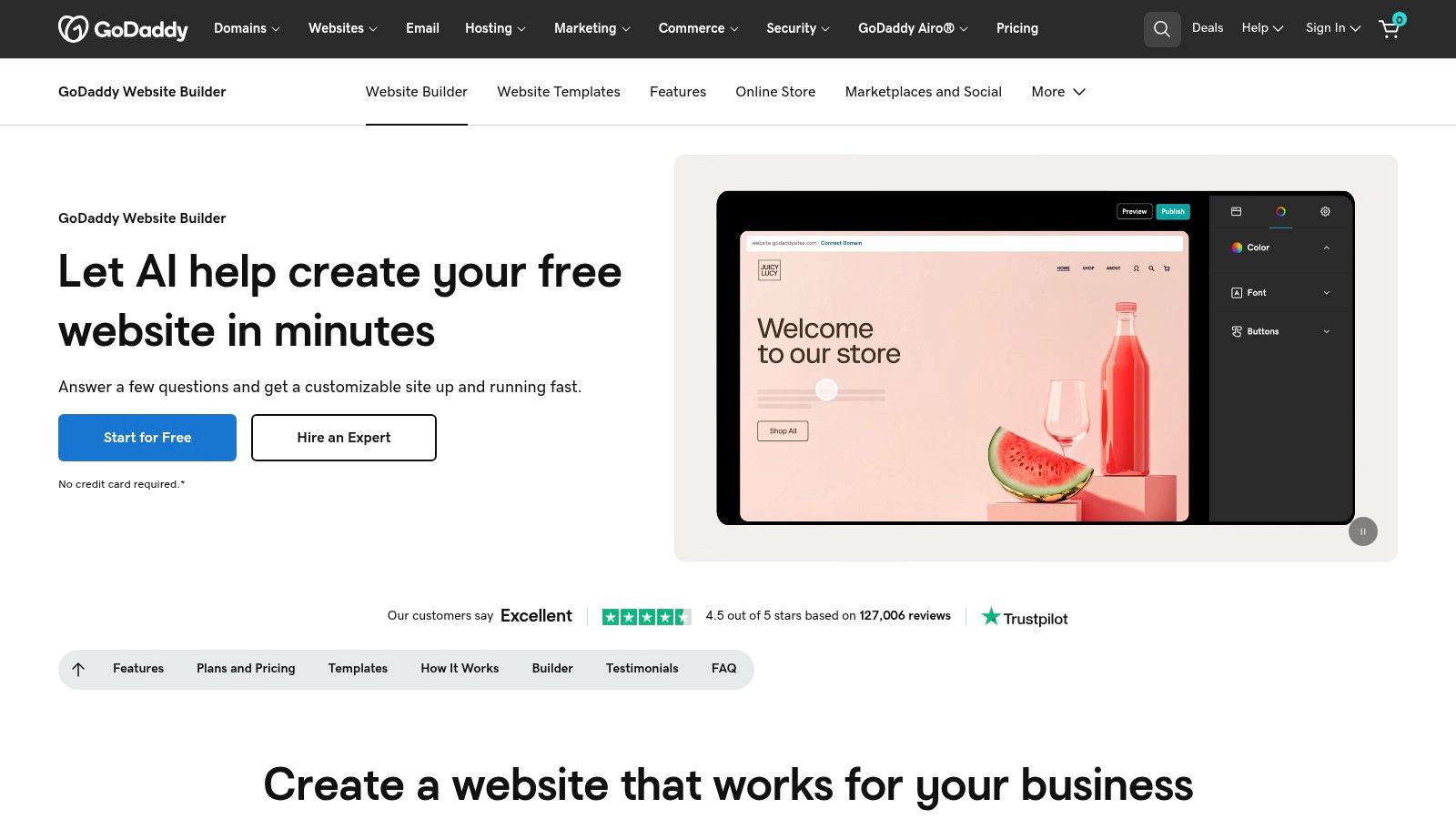
The platform is ideal for creating simple affiliate blogs, “best of” product lists, and targeted landing pages where getting online quickly is the main priority. The AI-powered setup (Airo) can generate a foundational site in minutes, letting you focus immediately on adding content and affiliate links to text, images, and buttons without a steep learning curve.
Implementation and Key Features
GoDaddy's primary advantage is its integrated marketing suite available on select tiers. Users can manage email marketing campaigns, social media posts, and basic SEO from a single location, which is a significant time-saver for beginners. The standout 24/7 phone and chat support provides an invaluable safety net for marketers who are not technically inclined and need immediate assistance.
- AI Setup: GoDaddy Airo assists with initial site generation and content ideas.
- Integrated Tools: Built-in email marketing and social media tools streamline promotion.
- Ease of Use: A section-based editor simplifies the design process for non-designers.
- Pricing: Offers a free plan and a free trial. Paid plans with a custom domain start at a competitive price point, often around $10/month.
Pros and Cons
GoDaddy prioritizes speed and simplicity, which comes with certain limitations compared to more complex builders.
| Pros | Cons |
|---|---|
| Fastest path to get a basic site live | Less design flexibility than premium builders |
| Strong 24/7 support resources | Smaller app and integration ecosystem |
| Reasonable entry pricing and trials | Basic SEO tools may not be sufficient for highly competitive niches |
Best For: Beginners and service-based affiliate marketers who need an ultra-fast setup, integrated marketing tools, and access to reliable 24/7 customer support.
8. Ghost(Pro)
Ghost(Pro) is a powerful, minimalist platform that stands out as one of the best website builders for affiliate marketing for creators who prioritize content, performance, and audience building. Unlike all-in-one builders, Ghost is a streamlined CMS focused on publishing, making it ideal for affiliate bloggers and newsletter writers who want an incredibly fast, SEO-friendly site without the bloat of traditional platforms. Its distraction-free editor is designed to keep you focused on creating high-quality reviews and articles.
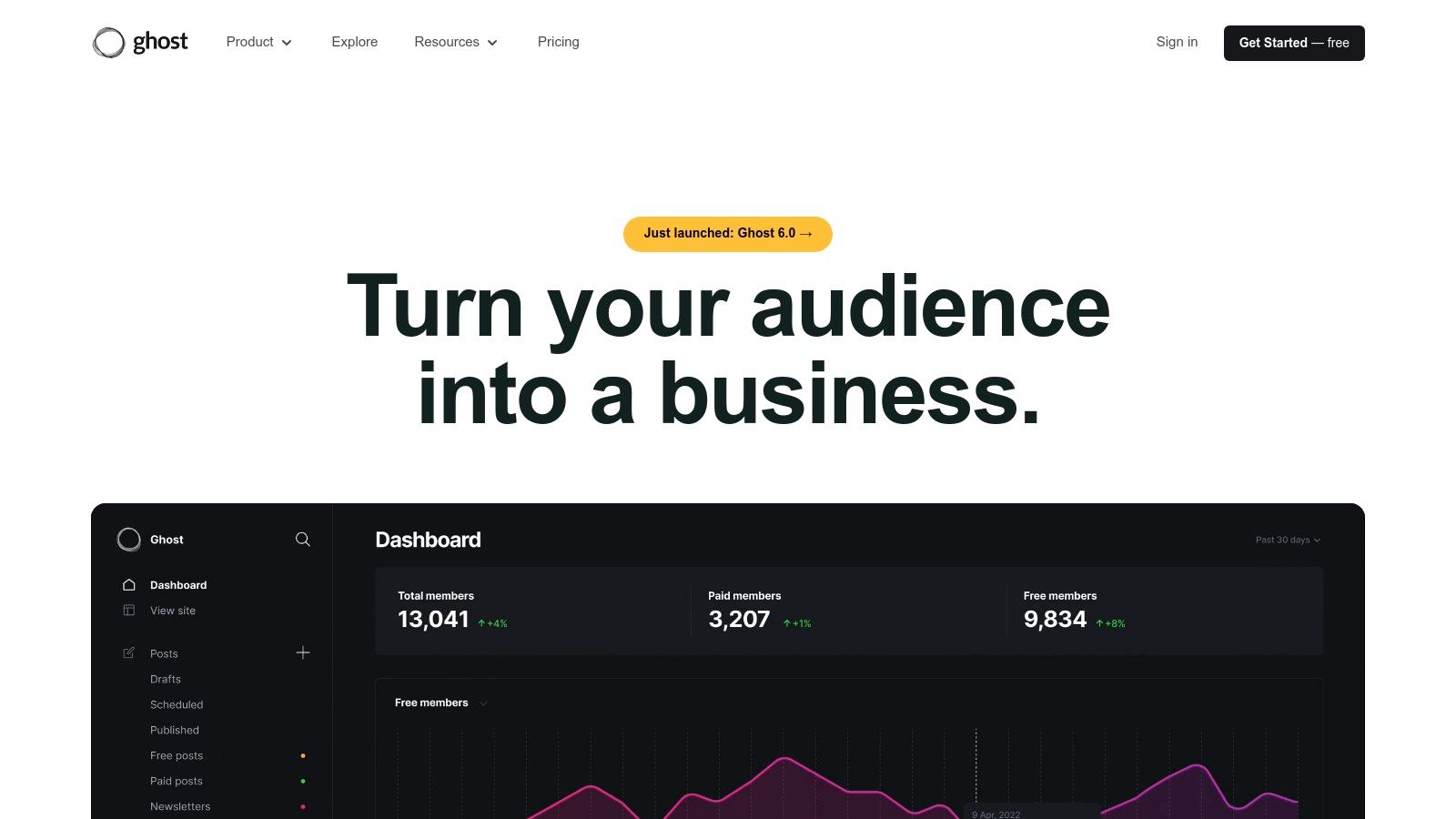
The platform's core advantage is its native membership and newsletter functionality. Affiliates can build a dedicated email list and even create premium, members-only content to supplement their affiliate income. This integrated approach allows you to own your audience directly, a critical asset for long-term success. Adding affiliate links is as simple as hyperlinking text, ensuring a clean and professional look for your content.
Implementation and Key Features
Ghost(Pro) is a fully managed hosting solution, meaning you don't have to worry about security, updates, or performance optimization. The platform is built on a modern tech stack that ensures lightning-fast page loads, which is a significant factor for both user experience and SEO rankings. For extended functionality, it integrates seamlessly with thousands of apps via Zapier.
- Built-in Memberships & Newsletters: Natively capture emails and offer paid subscriptions without third-party tools.
- Superior Performance: Extremely fast loading speeds and clean code for excellent SEO out of the box.
- Distraction-Free Editor: A clean, intuitive writing interface that helps you focus on content creation.
- Pricing: Ghost(Pro) plans start at $9/month (billed annually) for the "Creator" tier, with pricing scaling based on audience size.
Pros and Cons
Ghost's focus on publishing is both its greatest strength and a potential limitation depending on your needs.
| Pros | Cons |
|---|---|
| Excellent performance and SEO-friendly markup | Smaller theme and plugin ecosystem compared to WordPress |
| Strong built-in newsletter and monetization tools | Advanced customizations may require theme development skills |
| Distraction-free writing and publishing experience | Not designed for complex e-commerce or non-content sites |
Best For: Serious content creators, bloggers, and newsletter writers who want a high-performance platform to build and monetize a dedicated audience with affiliate content and paid subscriptions.
9. Systeme.io
Systeme.io has rapidly become one of the best website builders for affiliate marketing by offering an all-in-one platform specifically designed for funnel-based marketing. Unlike traditional website builders, it integrates a sales funnel builder, email marketing automation, and even a native affiliate program management module into a single, cohesive dashboard. This integrated approach is a game-changer for marketers wanting to sell their own digital products while also promoting others.
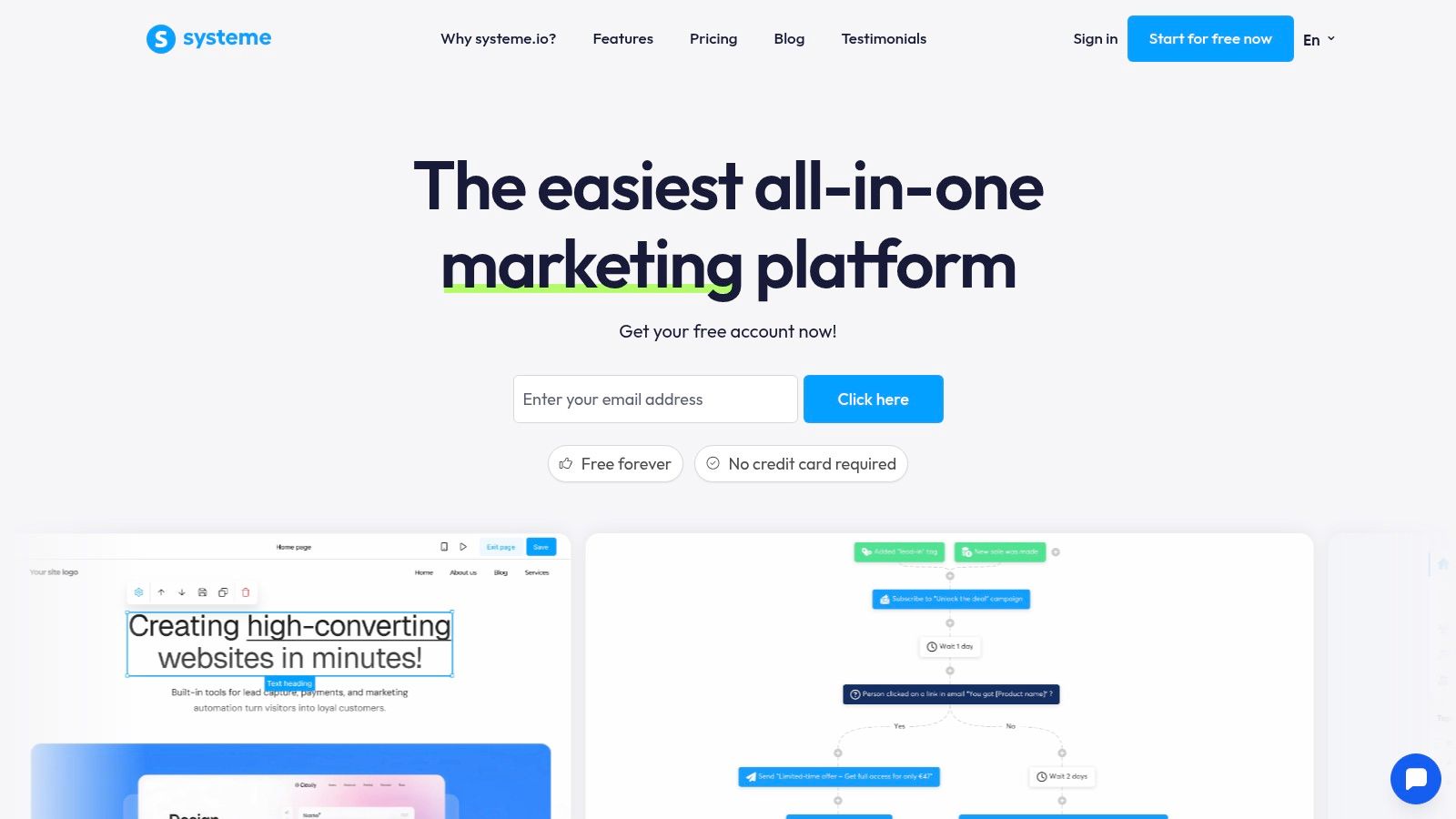
The platform's core strength is its focus on conversion. You can quickly build landing pages and multi-step funnels to capture leads, promote affiliate offers, or sell your own products. Since affiliate management is built-in, you can recruit your own affiliates to promote your offers, creating a powerful, self-sustaining marketing engine without needing third-party tools.
Implementation and Key Features
Setting up a marketing funnel in Systeme.io is streamlined, with templates designed for lead generation, sales, and webinars. The platform’s native email marketing allows you to build automated sequences that nurture leads and promote affiliate links directly. Crucially, it integrates with Stripe and PayPal with no additional platform transaction fees, making it highly cost-effective for selling courses or ebooks.
- All-in-One Platform: Combines a funnel builder, email marketing, and affiliate program management.
- Cost-Effective: A generous free-forever plan provides access to most core features.
- Native Affiliate Management: Easily create and manage your own affiliate program for your products.
- Pricing: The free plan is robust. Paid plans start at just $27/month, offering more contacts, funnels, and unlimited emails.
Pros and Cons
Systeme.io’s value proposition is exceptional, but its focus on funnels means its general website-building capabilities are more basic.
| Pros | Cons |
|---|---|
| Very low cost of entry with a generous free tier | Design flexibility is simpler than dedicated website builders |
| Native affiliate management removes need for extra apps | Blog/CMS capabilities are less sophisticated than WordPress |
| Unlimited emailing and storage on low tiers | The interface can feel less polished than more expensive competitors |
Best For: Marketers focused on building sales funnels, selling their own digital products, and managing their own affiliate army on a budget.
10. ClickFunnels
ClickFunnels shifts the focus from traditional website building to high-octane conversion funnels, making it one of the best website builders for affiliate marketing for direct-response marketers. Instead of building large content sites, it excels at creating streamlined pathways that guide visitors toward a specific action, such as signing up for a list or purchasing an affiliate offer. Its drag-and-drop editor is designed specifically for building multi-step funnels, including bridge pages, upsells, and downsells.
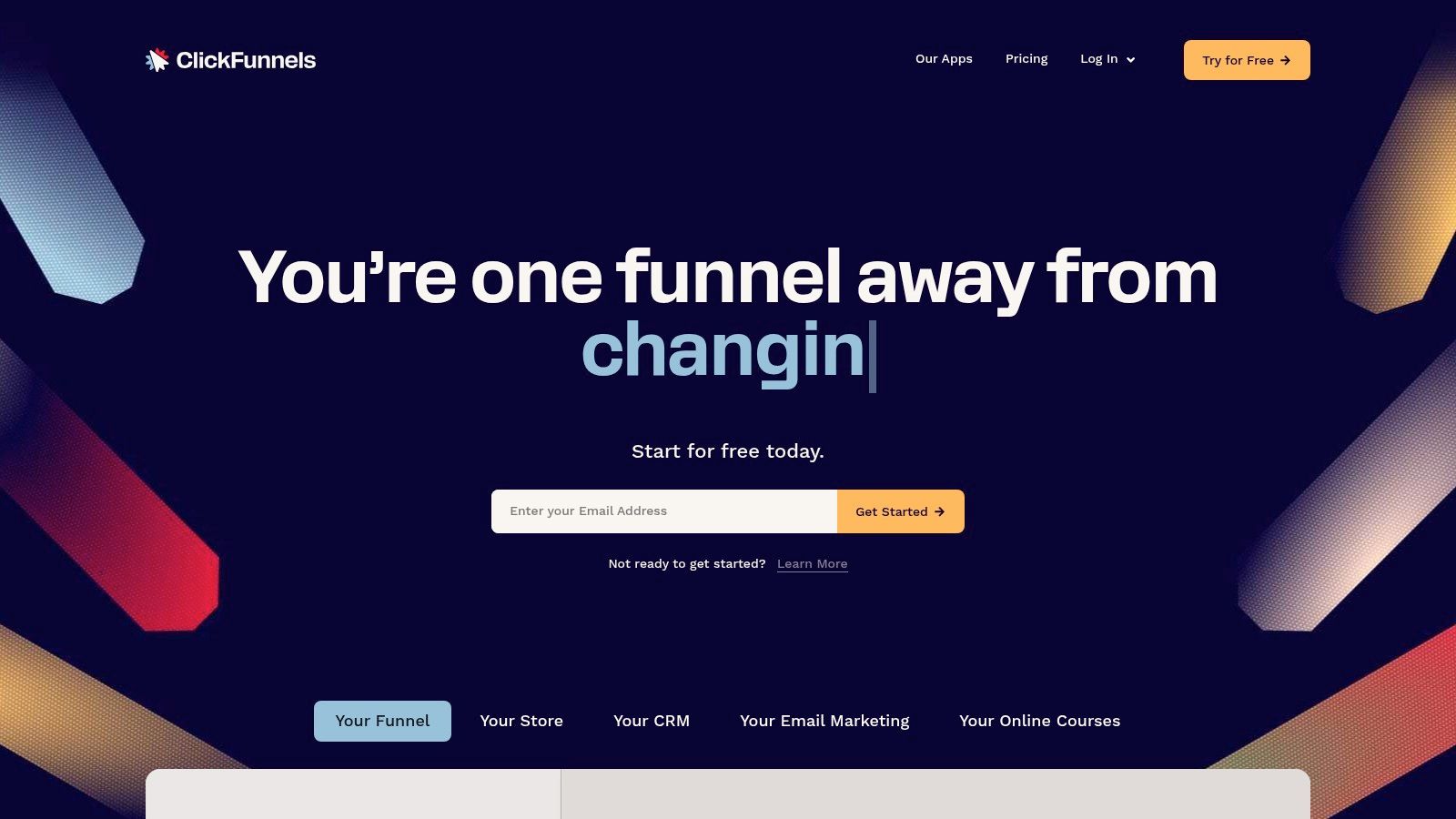
This platform is engineered for affiliates who prioritize list building and paid traffic over organic SEO. The templates are optimized for conversions out of the box, and the integrated automation tools allow you to create follow-up sequences that nurture leads and promote offers. This all-in-one approach is its main advantage, combining landing pages, email marketing, and analytics in a single dashboard.
Implementation and Key Features
Implementing a campaign is incredibly fast. You can choose a pre-built funnel template for a specific goal (like lead generation), customize the pages with the visual editor, and connect your autoresponder. The platform’s built-in A/B split testing is a critical feature, allowing affiliates to test different headlines, images, and calls to action to maximize their conversion rates.
- Conversion-Focused Builder: Tools designed for creating sales funnels, not just websites.
- High-Converting Templates: A library of funnels proven to work for various affiliate marketing scenarios.
- Integrated Toolset: Includes features for course creation, membership sites, and upsell/downsell flows.
- Pricing: Plans start at a higher price point, typically around $127/month, reflecting its specialized, all-in-one nature.
Pros and Cons
ClickFunnels is a powerhouse for a specific type of affiliate marketing, but it's not a universal solution.
| Pros | Cons |
|---|---|
| Optimized for conversions and lead generation | Higher cost compared to traditional website builders |
| Bundles many marketing tools into one platform | Not designed for creating large, content-heavy blogs or review sites |
| Strong community and extensive training resources | Can have a steeper learning curve for those new to funnel marketing |
Its unique focus on sales funnels makes it ideal for affiliates using paid ads who need effective affiliate marketing landing pages that convert traffic efficiently.
Best For: Affiliate marketers who use paid advertising (e.g., social media or search ads) and need to build high-converting landing pages and sales funnels quickly.
11. Elementor
Elementor is not a standalone website builder but a powerful visual page-builder plugin for WordPress. This makes it one of the best website builders for affiliate marketing for users who want the full power and scalability of WordPress without having to write code. Its drag-and-drop interface allows for complete design control, enabling marketers to create custom product review layouts, landing pages, and comparison tables that are optimized for conversions.
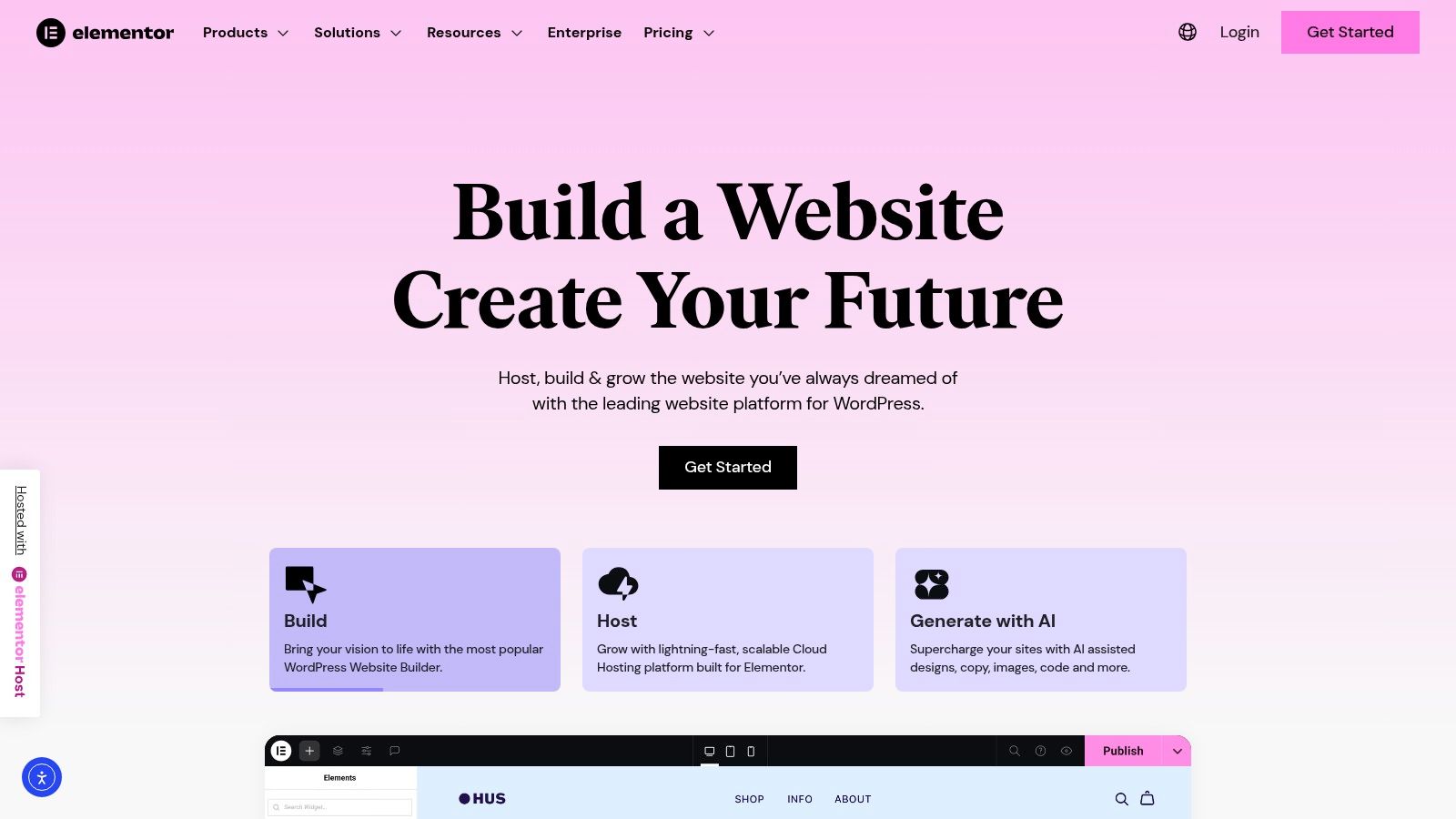
The platform’s real strength is combining the design freedom of a visual editor with the robust content management and SEO capabilities of WordPress. Affiliates can build dynamic content, use advanced forms to capture leads for email marketing, and seamlessly integrate specialized affiliate tools like link cloakers or table-building plugins. This gives you granular control over your site's look and functionality.
Implementation and Key Features
Getting started with Elementor means you first need a WordPress installation with your own hosting. Once the plugin is installed, you can use its Theme Builder to design every part of your site, from the header to the blog post template. The platform’s popup and form builders are particularly useful for creating opt-in offers to grow an email list, a crucial asset for any affiliate marketer.
- Design Control: Pro widgets and a Theme Builder offer unparalleled design flexibility within WordPress.
- Lead Generation Tools: Integrated popup and form builders help capture visitor emails.
- Plugin Compatibility: Works perfectly with essential WordPress plugins for SEO and affiliate link management.
- Pricing: A free version is available. Pro plans with advanced features start at $59/year for one website.
Pros and Cons
While Elementor offers incredible flexibility, it also comes with the responsibilities of a self-hosted WordPress site.
| Pros | Cons |
|---|---|
| Deep design control inside WordPress | You must manage hosting, updates, and performance optimization |
| Affordable annual licenses for multiple sites | Using many plugins can negatively impact site speed |
| Massive template and add-on ecosystem | Can have a steeper learning curve than all-in-one builders |
Best For: Affiliate marketers who want the power and scalability of WordPress but prefer a visual, code-free design experience.
12. Bluehost WonderSuite (for WordPress)
Bluehost WonderSuite offers a unique hybrid approach, combining the power of WordPress with an AI-guided setup process. This makes it one of the best website builders for affiliate marketing for those who want the flexibility of WordPress without its intimidating learning curve. It bundles hosting, a domain, and the WonderSuite builder, which walks you through creating a professional-looking affiliate blog or review site using AI-powered prompts and block patterns.
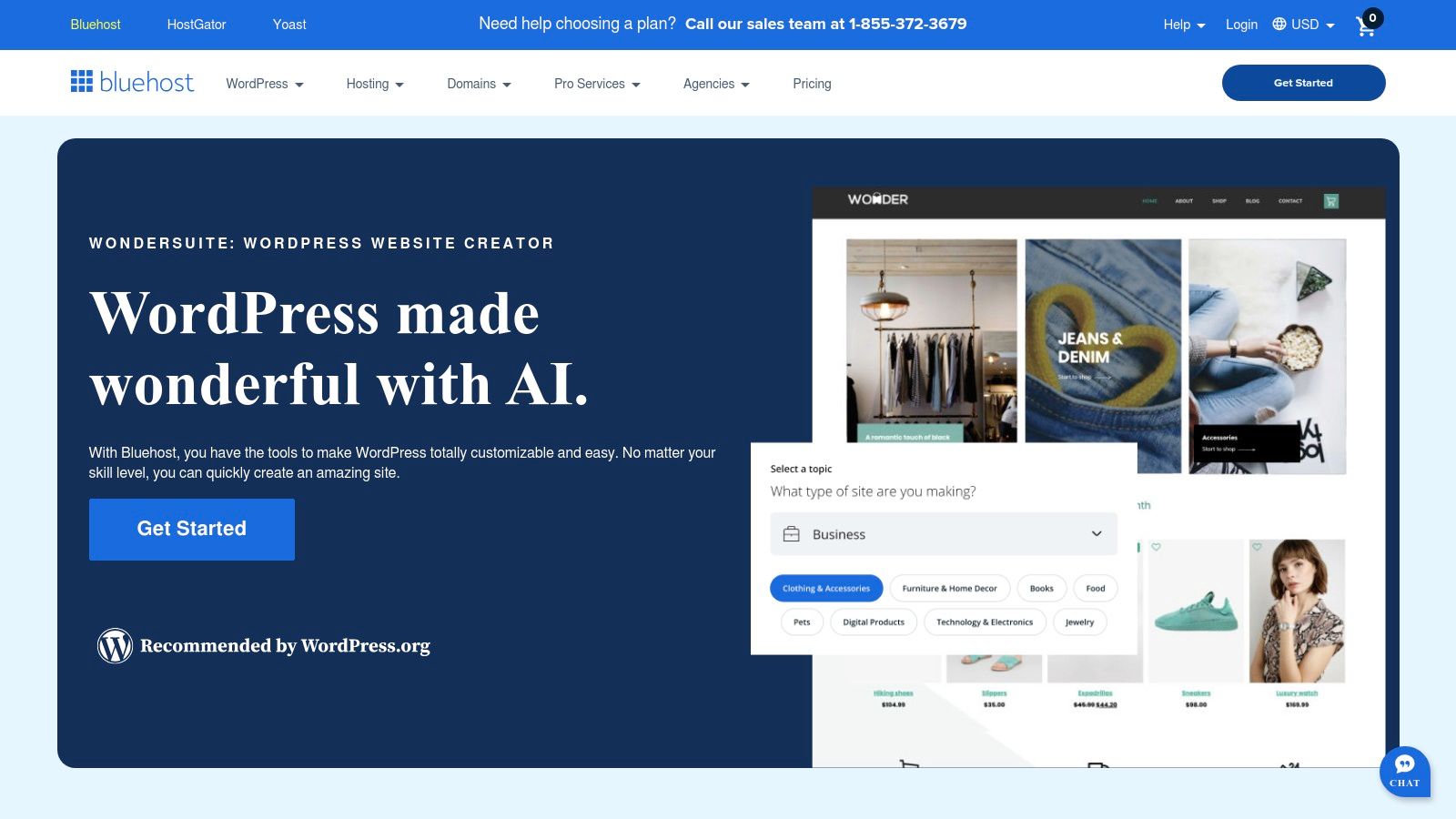
The platform is designed to get affiliate marketers up and running on WordPress quickly. The AI handles initial design choices and content structure, allowing you to focus immediately on writing reviews and integrating affiliate links. Since it’s built on WordPress, you retain full access to its massive plugin ecosystem for advanced SEO, analytics, and affiliate management tools, ensuring your site can scale as your business grows.
Implementation and Key Features
Bluehost’s main advantage is its all-in-one package with guided onboarding. The WonderStart and WonderTheme features simplify the initial site creation, while WonderBlocks provides a library of pre-built, customizable content sections perfect for product comparisons and call-to-action boxes. This structure provides a helpful framework for beginners while still allowing for deep customization later.
- AI-Guided Setup: WonderSuite’s AI tools streamline WordPress installation and theme customization.
- All-in-One Bundle: Includes hosting, a free domain for the first year, SSL, and CDN.
- WordPress Foundation: Full access to the WordPress plugin library for unlimited scalability.
- Pricing: Promotional pricing is highly competitive, often starting below $3/month for US customers, though this requires a multi-year commitment.
Pros and Cons
While WonderSuite simplifies WordPress, the model is tied to Bluehost's ecosystem and pricing structure.
| Pros | Cons |
|---|---|
| Eases the WordPress learning curve | Best pricing requires a long-term commitment (12-36 months) |
| Great bundle value for new sites | Advanced security and backup features often cost extra |
| Full power of WordPress plugins | Performance may not match dedicated WordPress-managed hosts |
This bundled solution is ideal for US-based marketers who are committed to using WordPress but need a helping hand to get started.
Best For: New affiliate marketers who want the long-term benefits of WordPress but desire a guided, user-friendly onboarding experience.
Top 12 Website Builders for Affiliate Marketing — Comparison
| Platform | Core features | UX / Quality (★) | Value proposition (💰) | Target audience (👥) | Unique selling points (✨ / 🏆) |
|---|---|---|---|---|---|
| Wix | Visual drag‑drop editor, blogging, App Market | ★★★★ beginner‑friendly, fast launch | 💰 Free plan; paid tiers + app costs | 👥 Beginners & content‑heavy affiliates | ✨ 900+ templates, large integrations |
| Squarespace | Design‑led templates, blogging, commerce & memberships | ★★★★ polished UX, strong templates | 💰 All‑in‑one hosting; no permanent free plan | 👥 Creators, bloggers, membership sellers | ✨ Polished design + built‑in commerce 🏆 |
| WordPress.com | Managed WordPress, world‑class CMS, AI site builder | ★★★★★ SEO‑focused, highly scalable | 💰 Tiered pricing; plugins on Business+ | 👥 SEO‑focused bloggers & scale‑ups | ✨ Huge plugin/theme ecosystem & SEO 🏆 |
| Webflow | Visual, code‑accurate designer; CMS collections | ★★★★ excellent performance; steeper curve | 💰 Great performance; page/item caps on low tiers | 👥 Designers, dev‑savvy creators, review hubs | ✨ Granular design control; clean code |
| Shopify | Full ecommerce stack, blog, app ecosystem | ★★★★ commerce‑first, robust tools | 💰 Best for selling products; app/transaction fees | 👥 Merchants selling products + affiliates | ✨ Best‑in‑class commerce + apps 🏆 |
| Hostinger Website Builder | AI writer/SEO, templates, bundled hosting/domain | ★★★ affordable, good small‑site performance | 💰 Very low entry price; intro vs renewal gap | 👥 Budget bloggers & small review sites | ✨ AI content tools + bundled value |
| GoDaddy Website Builder | AI setup (Airo), basic SEO, marketing tools | ★★★ fastest to launch; strong phone support | 💰 Low entry pricing; trials available | 👥 Beginners wanting speed & support | ✨ 24/7 phone & chat support |
| Ghost(Pro) | Newsletter + membership CMS, managed hosting | ★★★★★ lightning fast, publishing focus | 💰 Premium for newsletters & memberships | 👥 Writers, newsletter‑first affiliates | ✨ Built‑in memberships/newsletters 🏆 |
| Systeme.io | Funnels, landing pages, email, native affiliate module | ★★★★ simple & effective for funnels | 💰 Very low cost; generous free tier | 👥 Funnel builders & product affiliates | ✨ Native affiliate management (no extra apps) |
| ClickFunnels | Funnel/page builder, courses, split testing | ★★★★ conversion‑focused; higher price | 💰 Higher cost; all‑in‑one funnel stack | 👥 Conversion‑centric affiliates & course creators | ✨ High‑converting templates + training 🏆 |
| Elementor | Visual WordPress page builder, popups, AI tools | ★★★★ deep design control inside WP | 💰 Affordable pro licenses; self‑host costs apply | 👥 WordPress users wanting visual design | ✨ Pro widgets, theme/WooCommerce builder |
| Bluehost WonderSuite | AI‑guided WordPress build, CDN, domain & hosting | ★★★★ guided onboarding; 24/7 support | 💰 Strong bundle promos; multi‑year deals | 👥 US‑based WordPress beginners | ✨ AI‑guided WP setup + bundled hosting |
Your Next Step: From Plan to Profit
Navigating the landscape of website builders can feel overwhelming, but after reviewing twelve of the top contenders, a clear picture emerges. The journey from selecting a platform to generating affiliate income is a strategic process, not a lottery ticket. We've dissected everything from all-in-one solutions like Wix and Squarespace to the powerful, content-focused engines of WordPress.com and Ghost. We've also explored the specialized, conversion-driven worlds of ClickFunnels and Systeme.io.
The central lesson is this: there is no single "best" website builder for affiliate marketing. Instead, there is only the best tool for your specific affiliate marketing strategy. Your choice is the foundation upon which your entire business will be built, so it’s crucial to make a decision that aligns with your vision, skills, and resources.
How to Choose Your Perfect Platform
To distill this comprehensive guide into a simple, actionable decision, consider your primary business model. Your answer will immediately narrow down the options and point you toward the most effective tool for the job.
-
For the Content-Driven Blogger: If your strategy revolves around SEO, in-depth articles, product reviews, and building a loyal readership, your focus should be on content management and flexibility. WordPress.com (with a Business plan for plugin access) and Ghost(Pro) are unparalleled here. They are built for serious publishing, offering superior SEO capabilities and a writing experience that keeps you focused. The Bluehost WonderSuite is an excellent on-ramp to this world, simplifying the WordPress setup process.
-
For the Visually-Focused Niche Site Builder: If your affiliate site relies on stunning design, high-quality imagery, and a portfolio-like feel (e.g., travel, photography, or high-end product niches), your priority is aesthetics and ease of use. Squarespace and Webflow are your strongest contenders. Squarespace offers beautiful, turnkey templates, while Webflow provides unmatched design control for those willing to learn.
-
For the Sales Funnel & Digital Product Marketer: If your approach is less about broad content and more about direct-response marketing, lead generation, and selling your own digital products alongside affiliate offers, you need a conversion-optimized machine. ClickFunnels and Systeme.io are purpose-built for this. They integrate landing pages, email marketing, and payment processing into a single, cohesive system designed to guide visitors toward a specific action.
-
For the All-in-One Beginner: If you're just starting and want a simple, user-friendly platform that handles everything from design to hosting without a steep learning curve, look no further. Hostinger Website Builder and Wix provide intuitive drag-and-drop editors and a wealth of features that allow you to launch a professional-looking affiliate site quickly and affordably.
From Tool Selection to Traffic Generation
Remember, selecting from the best website builders for affiliate marketing is just the first step. The platform is the vehicle, but your content is the fuel that drives traffic and conversions. A powerful tool is useless without a strategy for creating value for your audience. To truly succeed in affiliate marketing, it's crucial to understand how to effectively generate and promote your articles, reviews, and comparisons. Learn more about creating engaging content for your audience to ensure your new website attracts the right visitors.
Ultimately, the builder you choose should feel like an extension of your workflow, not a barrier. It should empower you to execute your content strategy, track your performance, and scale your operations without getting bogged down by technical hurdles. Your goal is to spend less time fighting with your website and more time connecting with your audience and promoting valuable products. Choose wisely, commit to creating high-quality content, and you will be well on your way from a well-laid plan to a profitable reality.
Feeling ready to build but want a proven roadmap and expert guidance to ensure you don't waste time or money? The Daniel Proctor Affiliate Marketing Academy provides the step-by-step mentorship, tools, and accountability to turn your chosen website builder into a thriving, profitable business. Join us to fast-track your journey from beginner to successful affiliate marketer.
