

Let's be blunt: email marketing isn't just another strategy for affiliates. It's the absolute cornerstone of a real, sustainable business. It gives you a direct line to your audience, letting you promote offers on your own terms without praying to the algorithm gods. This is your asset, your key to consistent income and genuine trust.
Why Email Is Your Most Valuable Affiliate Asset

If your whole affiliate business is built on social media followers or SEO traffic, you're building on rented land. I've seen it happen countless times—a single algorithm update wipes out years of work overnight. Your traffic vanishes, and so does your income.
Email marketing for affiliates completely flips that script. An email list is something you truly own. No platform, no algorithm, no angry moderator can take it away from you. This direct access means you can talk to your people whenever you want, building a relationship that's way deeper than a simple click or follow.
The Power of an Owned Audience
Think about the difference for a second. A social media follower might see your post if the platform feels like showing it to them. But an email subscriber? They've literally given you permission to show up in their most personal digital space: their inbox.
That single act creates a level of attention and trust that social media just can't touch. You’re not just another post they scroll past. You're a trusted source showing up to deliver something valuable.
To put it in perspective, here's a quick comparison of why owning your audience is a game-changer for affiliates.
Owned vs Rented Audience Channels
| Attribute | Email List (Owned) | Social Media (Rented) |
|---|---|---|
| Control | You control who sees your message and when. | The platform's algorithm controls reach and visibility. |
| Relationship | Direct, personal communication builds deep trust. | Communication is public and often fleeting. |
| Longevity | It's a permanent asset that grows in value over time. | Your access can be restricted or removed at any time. |
| Conversion | Higher intent audience leads to better conversions. | Lower intent; users are often just browsing. |
| Competition | You have their undivided attention in the inbox. | You're competing with thousands of other posts in a feed. |
Simply put, you're playing a completely different game when you have an email list. It’s your business, on your terms.
An email list is the only marketing channel where you have complete control. You decide what to send, when to send it, and who sees it. For an affiliate marketer, this control is the foundation of a predictable and scalable income stream.
This isn't just a gut feeling; the data backs it up. A solid 22.8% of affiliates use email as their number one traffic source, and they see a conversion bump of 66.4% compared to those who don't. What's really telling is that the pros—the more experienced affiliates—are 47.8% more likely to make email their top priority. You can dig into more of the numbers in this affiliate email marketing research.
Building Trust Before the Pitch
The best affiliates I know don't treat email like a sales cannon. They use it as a relationship-building machine. Before they ever drop a link, they've spent weeks, sometimes months, providing insane value.
This could be things like:
- Exclusive Content: Sharing tips, tutorials, or insights they don't post anywhere else.
- Personal Stories: Opening up about their own wins and losses to connect on a human level.
- Answering Questions: Turning common audience problems into helpful, solution-focused emails.
By the time an affiliate offer comes up, it doesn't feel like a pitch. It feels like a genuine recommendation from a friend who gets it. You've already done the hard work of proving you have their best interests at heart, which makes them far more likely to trust your suggestions.
If you're just getting started, my personal recommendation is MailerLite. It has an amazing integration with Elementor, and its powerful Automations are completely FREE for your first 500 subscribers, which is perfect when you're in the early stages.
Choosing the Right Platform for Your Affiliate Business
Picking your Email Service Provider (ESP) is one of the most critical decisions you'll make in this game. Seriously. It’s the engine driving your entire operation, and it directly controls your ability to deliver emails, run automated campaigns, and ultimately, make money.
The wrong choice here can turn into a total nightmare. I’m talking about terrible deliverability, surprise account shutdowns, and hidden costs that chew up your profits before you even see them.
A lot of platforms look good on the surface, but they bury limitations in their terms of service, especially when it comes to affiliate links. Some are just flat-out hostile to affiliate marketers and will shut you down without a second thought. You need a partner that actually gets your business model and supports it.
That’s why finding an affiliate-friendly ESP isn't just a good idea—it's non-negotiable. You need a platform that openly welcomes affiliates and gives you the tools you need to succeed, not just a basic email sender. It’s all about balancing powerful features with a price that makes sense as you scale.
Why MailerLite Is a Top Choice for Affiliates
I've tried a bunch of them, but my top recommendation for affiliates—especially if you're just getting started—is MailerLite. The reason is simple: it gives you premium features on its free plan that others charge an arm and a leg for. This makes it an incredibly powerful and budget-friendly tool to build out your email strategy.
Here’s a quick peek at their interface. It's clean and easy to figure out.

The dashboard is super intuitive. You won’t get lost clicking through confusing menus, which means you can spend more time creating great campaigns and less time fighting with the software.
But here’s the real kicker: MailerLite provides full access to its Automations for FREE up to 500 subscribers. This is a massive win. You can build out sophisticated welcome sequences and nurture campaigns—the real heart of affiliate email marketing—without spending a dime. Most other platforms lock this crucial feature behind their paid plans.
It also plays really nicely with Elementor, the go-to page builder for WordPress. This seamless connection lets you drop beautifully designed signup forms right into your landing pages and blog posts, making list-building a breeze. If you're ready to jump in, you can find a helpful MailerLite discount to get started right here.
Setting Up Your Foundation for Success
Okay, so you've picked your ESP. Now comes the setup phase. Rushing this part is a rookie mistake that almost guarantees your emails land in the spam folder, killing your campaigns before they even get a chance.
Your very first move is to authenticate your domain. This means setting up a couple of records (like SPF and DKIM) with your domain provider. It might sound a bit techy, but your ESP will have a step-by-step guide to walk you through it. Think of it like a digital passport for your emails—it proves to services like Gmail and Outlook that you are who you say you are.
Authenticating your domain isn't a suggestion; it's a must-do for good email deliverability. Skipping it is like sending a letter with no return address. It’s immediately suspicious and will probably get thrown in the trash.
Once that’s done, it’s time to create your first signup form. This is the front door for your new subscribers, so keep it simple and focused.
Here are a few quick tips for that first form:
- Keep it minimal: Just ask for a name and email. Every extra field you add is another reason for someone to bail.
- Be clear on the "why": Remind them of the awesome lead magnet they’re about to get for signing up.
- Make it pop: Use contrasting colors and a clear call-to-action button so the form stands out on your site.
With your domain authenticated and your first form live, you've officially laid a solid foundation. This initial legwork ensures that when you start sending traffic, you’re ready to capture those leads and actually reach their inbox.
Creating Lead Magnets That Grow Your List
Nothing grabs attention like a resource that speaks directly to a pressing need. When your audience sees a solution to their immediate problem, they’ll hand over their email without a second thought.
- Specialized Checklists that guide subscribers step by step, no guessing required
- Resource Libraries bundling your top tools and templates into one neat download
- Video Workshops that pull back the curtain with insider techniques
- Swipe Files filled with real examples your readers can adapt on the spot
Planning High Value Offers
It all starts by homing in on one burning question your ideal subscriber has. That focus shows you respect their time—and it cranks up the perceived value.
- Camera Setup Guide walks photographers through each piece of gear and adjustment
- SEO Toolkit with curated keyword lists, audit checklists, and fast-win strategies
- Email Templates ready-to-send sequences for every type of campaign
When your magnet solves a specific problem, you attract leads who are genuinely eager for more.
Designing And Delivering Your Magnet
Simplicity wins. Build your download as a PDF or host it on a private video link. Then automate the delivery—no manual uploads required.
- Use a signup form in Elementor (https://elementor.com) and map it straight to your ESP
- Draft a welcome email with the download link pinned at the top
- Schedule a reminder for anyone who hasn’t opened your email within 48 hours
I recommend MailerLite (https://www.mailerlite.com) because of its nice integration with Elementor and its FREE use of Automations up to 500 subscribers. This makes it incredibly easy to sync your forms and workflows instantly.
Automation cuts manual tasks and sends your magnet the moment someone opts in.
Linking To Affiliate Landing Pages
Your lead magnet page is also an ideal gateway to your affiliate offers. A well-placed call-to-action at the end keeps the momentum going.
For proven tips on high-converting pages, check out our guide on crafting high-converting affiliate marketing landing pages.
For a deeper look at designing irresistible lead magnets, this resource has you covered.
Measuring Magnet Performance
Treat your lead magnet as an ongoing experiment. Track signup rates and iterate regularly—small gains add up over time.
Even a 2% boost in conversions translates into hundreds of extra leads down the line.
| Type | Time to Create | Signup Rate |
|---|---|---|
| Checklist | 1–2 hours | 15–20% |
| Toolkit | 4–6 hours | 10–15% |
| Video Workshop | 1–2 days | 8–12% |
Position Yourself As Trusted Expert
The real work begins after the download. A short follow-up sequence builds trust and primes your audience for affiliate pitches.
- Showcase a case study where someone doubled conversions with your guide
- Share a brief story about how you overcame the same challenge
- Include a screenshot or testimonial for added social proof
A lead magnet that delivers instant value plants the seed for affiliate success.
Next up, you’ll learn how to craft sequences that turn those subscribers into commission-earning clicks.
Best Practices For Lead Magnets
Keep it concise. Keep it actionable. Then promote it with headlines that jump off the page.
- Test different headlines to lift conversions by 5–10%
- Use benefit-driven copy that states the outcome clearly
- Embed social proof near the form to ease hesitation
- Optimize your layout for mobile readers
Your lead magnet is the springboard for every affiliate email campaign you send. Nail these best practices and watch your list—and your commissions—grow.
Start testing today to see real growth.
Keep iterating based on subscriber feedback.
Your results will guide every tweak.
A small change can lead to big wins.
MailerLite stays free until 500 subscribers, keeping costs low.
Dive in.
Good luck.
Designing Email Campaigns That Drive Commissions
Getting affiliate commissions from your email list isn't about blasting out links. It’s about building a few key email sequences that guide subscribers from just being curious to actually making a purchase, all without feeling like you're hard-selling them.
A strong first impression starts with your Welcome Sequence. This is your chance to introduce yourself, deliver the freebie they signed up for, and gently plant the seed for the affiliate products you'll recommend later.
Welcome Sequence Structure
A solid welcome sequence usually runs for about three to five emails. It kicks off by delivering the lead magnet and then smoothly transitions into content that’s genuinely helpful.
For instance, your first email is straightforward: deliver the checklist or resource library link and say thanks. Simple.
In the second email, you can share a few actionable tips, and while you're at it, casually mention a tool you use and love.
The third email can go a bit deeper with a case study or a mini-tutorial, showing the product in action with your affiliate links included.
Welcome emails get an incredible 82% higher open rate than your regular newsletters. That makes them the perfect place to subtly introduce an affiliate link right from the get-go.
Once you’ve got your lead magnets sorted, the next step is to write some high-converting lead generation emails that grab attention and get people to act.
This infographic breaks down the different types of lead magnets—checklists, resource libraries, and workshops—and shows how they fit into your welcome sequence.
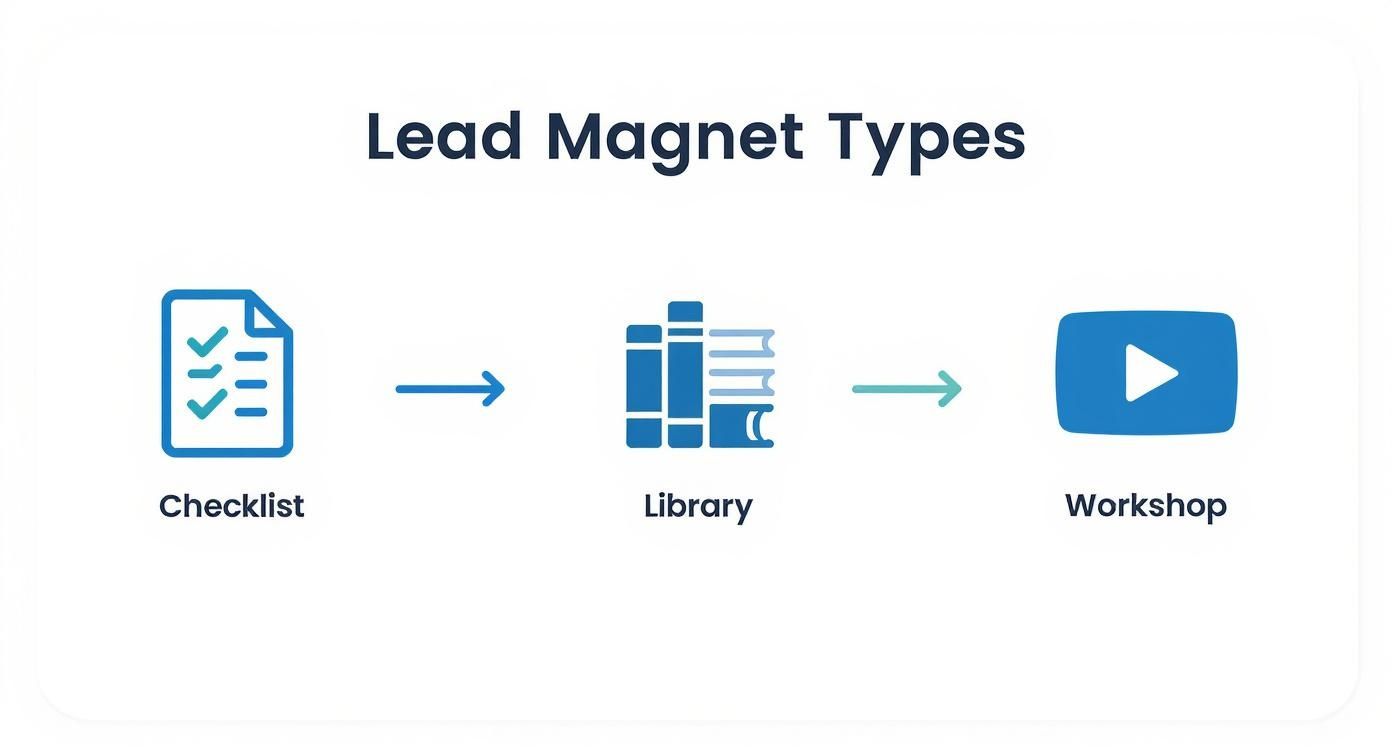
As you can see, simple checklists give people a quick win, resource libraries help build your authority, and workshops create a much deeper level of engagement.
Broadcast Campaigns Overview
Broadcasts are your one-off emails for time-sensitive stuff like a big product launch or a flash sale. They work best when you build a sense of urgency and have a super clear call-to-action.
I’ve found a simple subject line formula works wonders here:
- State the problem.
- Promise a solution with a deadline.
- Add a bonus in brackets.
Put it all together, and you get something like: “Struggling With SEO? Get 50% Off This Week Only [Free Guide Included]”.
When you share affiliate URLs, don't just drop the raw link. Send people to a review page or a bridge page on your own site first. This is much better for your email deliverability and lets you provide more context. If you want to dive deeper, you can learn more about https://danielproctor.com/how-to-write-product-reviews/ and get some tips on structuring those pages.
A broadcast doesn't have to be purely promotional, either. Including a short case study or a testimonial from another user can add a ton of value and make the pitch feel more genuine.
And please, always send a test email to yourself first. Check it on both desktop and mobile to catch any weird formatting issues before it goes out to everyone.
People often underestimate email's power, but the ROI is massive. For every dollar you spend, you can expect a return of $36 to $42. Plus, nearly 50% of consumers buy things directly from marketing emails.
For a launch, I like to spread it out over three to five emails: one to build hype, the launch day announcement, a reminder, a "last chance" email, and maybe a final one recapping the results.
Long-Term Nurture Sequences
Nurture sequences are the secret sauce for keeping your list warm long after the welcome emails are done. They build your authority and make your affiliate offers feel like helpful suggestions, not just random promotions.
A six-email nurture sequence could look something like this:
- A deep dive into a specific tutorial.
- A few pro tips you don't share publicly.
- A behind-the-scenes story of how you use a product.
- An exclusive discount or bonus content for your list.
- An FAQ email that addresses common objections.
- A final wrap-up email with a soft pitch.
This is where a tool like MailerLite really shines. You can set up all these automations for free for up to 500 subscribers, and it plays nicely with page builders like Elementor. This means you can create high-quality forms and automated workflows without spending a dime.
A pro tip here is to segment your list based on who clicks your affiliate links. This lets you send hyper-relevant offers later on, making your emails feel personal instead of generic.
Essential Affiliate Email Campaign Types
Each type of email campaign plays a specific role in your affiliate strategy. Here’s a quick breakdown of the three core campaigns you'll be using.
| Campaign Type | Primary Goal | Typical Length |
|---|---|---|
| Welcome Sequence | Build trust and deliver lead magnet | 3–5 emails |
| Broadcast Campaign | Promote time-sensitive offers | 3–5 emails |
| Nurture Sequence | Keep engagement high and upsell naturally | 6+ emails |
Think of these as building blocks. Each one serves a different purpose, but they all work together to move a subscriber closer to becoming a customer.
Tips for Testing and Scaling
You've got to test what works. Start by A/B testing your subject lines and calls-to-action on a small segment of your list. Even simple tests in a tool like MailerLite can boost your open rates by 10–15%.
Keep an eye on the important metrics: open rate, click-through rate, and conversion rate. And watch your unsubscribe rate—if it suddenly spikes, you’re probably coming on too strong.
As your list grows past 500 subscribers, you'll want to look at upgrading your plan or exploring more advanced segmentation. But the fundamentals never change: provide valuable content and weave in your affiliate recommendations naturally.
Optimizing and Scaling Your Email Strategy
Getting your first campaigns out the door is a huge step, but it's really just the beginning. The real money in affiliate email marketing is made through constant tweaking and improvement. Think of your initial strategy as a rough draft, not the final copy. To actually scale your income, you have to get good at listening to what your data is telling you.
This is where you stop guessing and start measuring. Every single email you send is a piece of feedback from your audience. They're telling you what they like, what they ignore, and what makes them hit the unsubscribe button. Paying attention to these signals is how you turn a trickle of commissions into a firehose.
Tracking the Metrics That Matter
To figure out what's working, you only need to keep an eye on a few key numbers. These metrics are the vital signs of your email campaigns.
- Open Rate: This is your subject line's report card. If your open rate is low, your subject line probably isn't grabbing enough attention in a crowded inbox. It's the first hurdle you have to clear.
- Click-Through Rate (CTR): This is the big one. It shows how many people actually clicked a link in your email. Your CTR tells you how compelling your email copy and call-to-action really are.
- Unsubscribe Rate: It always stings to lose a subscriber, but this number is your reality check. A sudden jump in unsubscribes could mean you're emailing too often, or maybe the offers just aren't hitting the mark for that audience.
Honestly, if you just focus on these three, you'll have a pretty clear picture of where to put your energy. They'll guide almost all of your optimization efforts.
The Power of Simple A/B Testing
One of the quickest ways to improve your numbers is with A/B testing, sometimes called split testing. It sounds technical, but it's simple: you create two slightly different versions of an email (an 'A' version and a 'B' version) and send them to a small slice of your list to see which one gets a better response.
The easiest place to start? Your subject lines. The impact here can be massive. For instance, you could test:
- A question vs. a statement.
- A subject line with an emoji vs. one without.
- A direct, benefit-focused subject line vs. one that sparks curiosity.
Most email platforms I've used, like MailerLite, have this feature built right in. You can set it up to automatically send the winning version to the rest of your subscribers, so it does the heavy lifting for you. Even a tiny lift in open rates from a better subject line adds up to a lot more clicks and commissions over time.
Scaling with Advanced Segmentation
Once you've got the basics down, the next level is segmentation. This just means breaking your main list into smaller, more targeted groups based on what they've shown interest in. Instead of blasting the same email to everyone, you start sending messages that are hyper-relevant to each little group.
Segmentation is the difference between shouting into a crowd and having a quiet, one-on-one conversation. It lets you put the perfect offer in front of the right person at the right time, and that's when your conversion rates really take off.
Let's say a subscriber clicks an affiliate link for a specific brand of camera in one of your emails. With segmentation, you can automatically tag them as "interested in photography gear." The next time a big sale on lenses or camera bags comes around, you can send an email only to that segment.
This approach feels so much more personal and genuinely helpful to the subscriber, which leads to way better engagement and more sales. You can create segments based on pretty much anything:
- Which links they've clicked in the past.
- Which lead magnet they originally signed up for.
- Their purchase history (if you have that data).
Also, don't forget that most people are reading emails on their phones these days. Making your emails mobile-friendly is non-negotiable for scaling. Responsive email design can boost unique mobile clicks by 15%. With the global email market expected to reach $36.3 billion by 2033, making sure your emails look good on a tiny screen is a must. You can dive deeper into email marketing statistics and see how to get ahead of these trends.
Common Affiliate Email Marketing Questions
As you get into the swing of affiliate email marketing, a few questions always seem to surface. I've been there. Getting a handle on these early on is key to building a strategy that actually works without burning you out.
Let's break down the most common ones I hear so you can move forward with confidence.
How Often Should I Email My Affiliate List?
There’s no magic number here, but a solid starting point is once a week. This keeps you on your audience's radar without completely overwhelming their inbox.
The real secret sauce is consistency. It's way better to send one fantastic email every single Tuesday than to blast out three emails one week and then disappear for a month. A predictable schedule builds trust and even a little bit of anticipation.
Keep a close eye on your open rates, but pay even closer attention to your unsubscribe rates. If you see a spike in people leaving right after you start emailing more often, that's a crystal-clear sign to dial it back. On the flip side, if engagement is solid and your list keeps growing, you might have room to send more, especially around a big launch or promotion.
How Do I Disclose Affiliate Links in Emails?
Being transparent isn't just a nice thing to do—it's a legal must. The Federal Trade Commission (FTC) requires you to be clear about your affiliate relationships. My take? Just be direct and honest about it.
A simple, straightforward statement at the top or bottom of your email is all you need. Don't try to bury it in tiny font or wrap it in confusing legal jargon.
Here's an example I've used: "Just so you know, this email might contain affiliate links. If you end up buying something through one of my links, I could earn a commission at no extra cost to you. I only ever recommend stuff I genuinely believe in!"
Most people really appreciate this honesty. Authenticity is the bedrock of good email marketing for affiliates. Trust will drive way more sales in the long run than trying to hide your partnerships ever could.
Can I Put Affiliate Links Directly in Emails?
This one is critical, and the answer is a classic "it depends." Whether you can drop a raw affiliate link into an email comes down to the rules of your Email Service Provider (ESP) and the specific affiliate program.
Some ESPs are more affiliate-friendly than others. My go-to recommendation is MailerLite. They just get what creators need. It plays incredibly well with tools like Elementor and, the best part, its FREE plan gives you full access to Automations for up to 500 subscribers. That's huge for setting up your campaigns right from the start.
However, many of the big affiliate programs, like Amazon Associates, flat-out forbid putting their links directly in emails. Break this rule, and you'll get kicked out of the program, no questions asked.
The safest—and frankly, smartest—approach is to use a "bridge page." Instead of sending people straight to the offer, you link them to a piece of content on your own website, like:
- A detailed product review
- A blog post comparing a few different products
- A case study showing how you used the product
This strategy does a few things: it protects your email deliverability, gives you way more control over the user journey, and lets you track clicks and conversions on your own domain. It’s an extra step, but it pays off big time.
At Daniel Proctor, we provide the mentorship and step-by-step blueprints to turn these strategies into a profitable reality. If you're ready to build an affiliate business with clarity and expert guidance, explore our training and resources at https://danielproctor.com.
