

So, you want to turn those quick, snappy YouTube Shorts into actual cash? It’s more than possible. The most common route is getting into the YouTube Partner Program (YPP), which means hitting specific subscriber and view counts. But you don’t have to wait for that. You can start earning from day one with things like affiliate marketing and brand sponsorships.
The real trick is to not put all your eggs in one basket. Blend the official YouTube money with your own income streams, and you’ll build something much more stable.
The Foundation of Shorts Monetization
Turning viral clips into a real income stream isn’t a pipe dream anymore. With the explosion of YouTube Shorts, creators have a massive opportunity to build an audience and make money at the same time. This guide is designed to cut through the noise and give you a straightforward, actionable plan to get there.
The first thing everyone thinks about is the YouTube Partner Program. This is where you get a cut of the ad revenue that plays between Shorts. But honestly, that’s just one piece of the puzzle. The creators who are really crushing it have a diversified strategy.
Core Monetization Strategies
Knowing your options from the jump is crucial. Your strategy will change as your channel grows, but it’ll likely be built on these pillars:
- YouTube Partner Program (YPP): This is the official way to get paid from ads. You’ll need to hit some specific goals for subscribers and views, which we’ll break down later.
- Affiliate Marketing: This is a big one. You promote products or services you genuinely like, and you get a commission when someone buys through your unique link. You can start this on day one, even with zero subscribers.
- Brand Sponsorships: Once you start getting traction, brands will pay you to feature their stuff in your Shorts. This can be super lucrative and gives your channel a professional boost.
- Selling Your Own Products: This is where the real money is. Think digital guides, courses, or even physical merch. You get the highest profit margins and build a direct line to your audience.
To help you visualize how these methods compare, here’s a quick breakdown.
Key Monetization Methods at a Glance
This table gives you a bird’s-eye view of the primary ways to earn from your Shorts, what you’ll need to get started, and what the potential payoff looks like.
| Monetization Method | Primary Requirement | Earning Potential |
|---|---|---|
| YouTube Partner Program | YPP eligibility (subs & views) | Moderate to High |
| Affiliate Marketing | An engaged audience (can start small) | Low to High |
| Brand Sponsorships | Established viewership & engagement | High |
| Selling Your Own Products | A product & an audience to sell to | Very High (potential) |
Think of this as your menu of options. You don’t have to pick just one; the most successful creators mix and match based on their niche and audience size.
The Scale of the Opportunity
The numbers behind Shorts are just staggering, which is exactly why this is a goldmine for creators. YouTube Shorts are pulling in over 200 billion daily views. That’s not a typo. They’re a massive slice of the platform’s total watch time.
Even better, the average engagement rate for Shorts is a solid 5.91%, which often beats out other short-form video apps. This means you have a huge, plugged-in audience ready for your content.
The smartest creators combine official YouTube revenue from the YPP with independent income streams like affiliate marketing or brand deals. This approach builds a resilient business that isn’t at the mercy of a single algorithm change.
To really get a handle on the earning potential of your short-form content, it’s worth checking out a comprehensive guide to monetizing YouTube Shorts. It lays the groundwork for the specific, step-by-step strategies we’re about to dive into.
Qualifying for the YouTube Partner Program
If you’re serious about making money from YouTube Shorts, your first big milestone is getting into the YouTube Partner Program (YPP). Think of it as your official license to earn. Once you’re in, you unlock the tools that let you generate revenue directly from your content.
The good news is that YouTube created a couple of different pathways to get there. They know that some creators build their audience with viral Shorts, while others focus on longer videos. Either way, there’s a route for you.
Two Tiers of YPP Eligibility
The program is broken down into two main levels, and each one unlocks different ways to earn. The first tier is all about giving smaller channels a head start with fan-funding tools—a solid way to build a community and see some early income.
The second tier is the big one. This is where you get a piece of the ad revenue from the Shorts feed.
The Fan Funding Tier
This first level has a lower bar for entry, which is perfect when you’re just starting to get some traction.
To qualify for this tier, you’ll need:
- 500 Subscribers
- 3 Public Uploads in the last 90 days
- Either 3,000 public watch hours on long-form videos in the past year OR 3 million public Shorts views in the last 90 days.
Getting to this stage doesn’t turn on ad revenue, but it does give you access to things like Super Thanks, Super Chats, and channel memberships. This is a crucial step because it lets your most loyal fans support you directly while you push for the next level.
The Full Monetization Tier
This is the goal for most creators. Hitting this tier means you start earning a cut of the ad revenue that plays between Shorts. The requirements are definitely a step up, but they’re totally doable with a smart, consistent content plan.
To get full YPP access and ad revenue, you’ll need:
- 1,000 Subscribers
- Either 4,000 public watch hours on long-form videos in the past year OR 10 million public Shorts views in the last 90 days.
A lot of people get this wrong: you don’t need both the watch hours and the Shorts views. You just have to hit one of those targets, along with the subscriber count, to apply.
The YPP is the foundation for everything. Once you’re in, you can start building a real business on the platform.
The program’s entire purpose is to help creators earn money, and the Shorts eligibility rules are designed to make that possible for short-form creators.
Your Strategic Path to 10 Million Views
Hitting 10 million Shorts views in 90 days sounds insane, but it’s less about luck and more about strategy. You don’t need every video to be a home run. Honestly, it usually comes down to one or two videos really taking off. A single Short that pulls in 3-5 million views can do most of the heavy lifting.
So, how do you make that happen? Focus on creating content that people feel compelled to share. You need a strong hook in the first three seconds to stop the scroll. Keep an eye on trends in your niche, but always put your own unique spin on them so you don’t just blend in.
Consistency is also a massive piece of the puzzle. Posting daily, or even a few times a day, tells the algorithm your channel is active and gives your audience more reasons to stick around. You can get more insights on Shorts monetization and how these numbers play out in the real world.
The goal is to build a content machine that consistently pumps out Shorts with viral potential. By understanding these YPP requirements, you can stop guessing and start building a clear plan to turn Shorts into a real revenue stream.
How Shorts Ad Revenue Actually Works
If you want to understand how you get paid for YouTube Shorts, you need to know that the system is completely different from traditional, long-form videos. Ads don’t play directly on your video. Instead, they pop up between Shorts as people scroll through the feed. This little detail forced YouTube to cook up a whole new way to share revenue.
They don’t figure out your earnings on a video-by-video basis. What they do is pool all the money from ads shown in the Shorts feed every month. That big pot of cash is the starting point for figuring out what every creator gets paid.
From there, it gets broken down in a few clear steps to determine what actually hits your bank account.
The Four-Step Payout Calculation
YouTube’s method for splitting up this ad money is pretty systematic. It’s designed to make sure creators, music publishers, and the platform itself all get a fair piece of the pie.
Here’s the play-by-play of how that money gets divided:
- Revenue Pooling: First, all the monthly revenue from ads that run between Shorts gets collected into one giant fund.
- The Creator Pool: A chunk of that fund is set aside for what YouTube calls the Creator Pool. How big this pool is depends on how much licensed music was used across all Shorts that month.
- Your Share of Views: YouTube then figures out your slice of the Creator Pool based on your channel’s percentage of total views. So, if your videos brought in 1% of all monetized Shorts views in a month, you get allocated 1% of the Creator Pool. Simple as that.
- The Final 45% Cut: From that allocated share, you keep 45%. YouTube takes the remaining 55%.
This model means your earnings are directly tied to how well you do compared to every other monetized creator on the platform.
The Impact of Licensed Music
Let’s be real, using popular music is a huge part of Shorts culture. But it directly hits your bottom line. When you use a track from YouTube’s library, the math changes a bit before you even see your share.
If your Short uses just one music track, half the revenue from its views goes straight to the music publishers, and the other half goes to the Creator Pool. If you use two tracks, a whopping two-thirds of the revenue goes to the publishers, leaving only one-third for the Creator Pool.
On the flip side, if you stick to original audio or royalty-free music, 100% of the revenue your views generate goes into the Creator Pool. This gives you the biggest possible slice to start from.
Key Takeaway: Using licensed music can seriously cut into your final payout. If you’re trying to maximize ad revenue, make it a priority to create Shorts with original audio or sounds you have the rights to. It’s a simple choice that can make a big difference.
This infographic breaks down the exact subscriber and view milestones you need to hit to unlock YouTube’s monetization features.
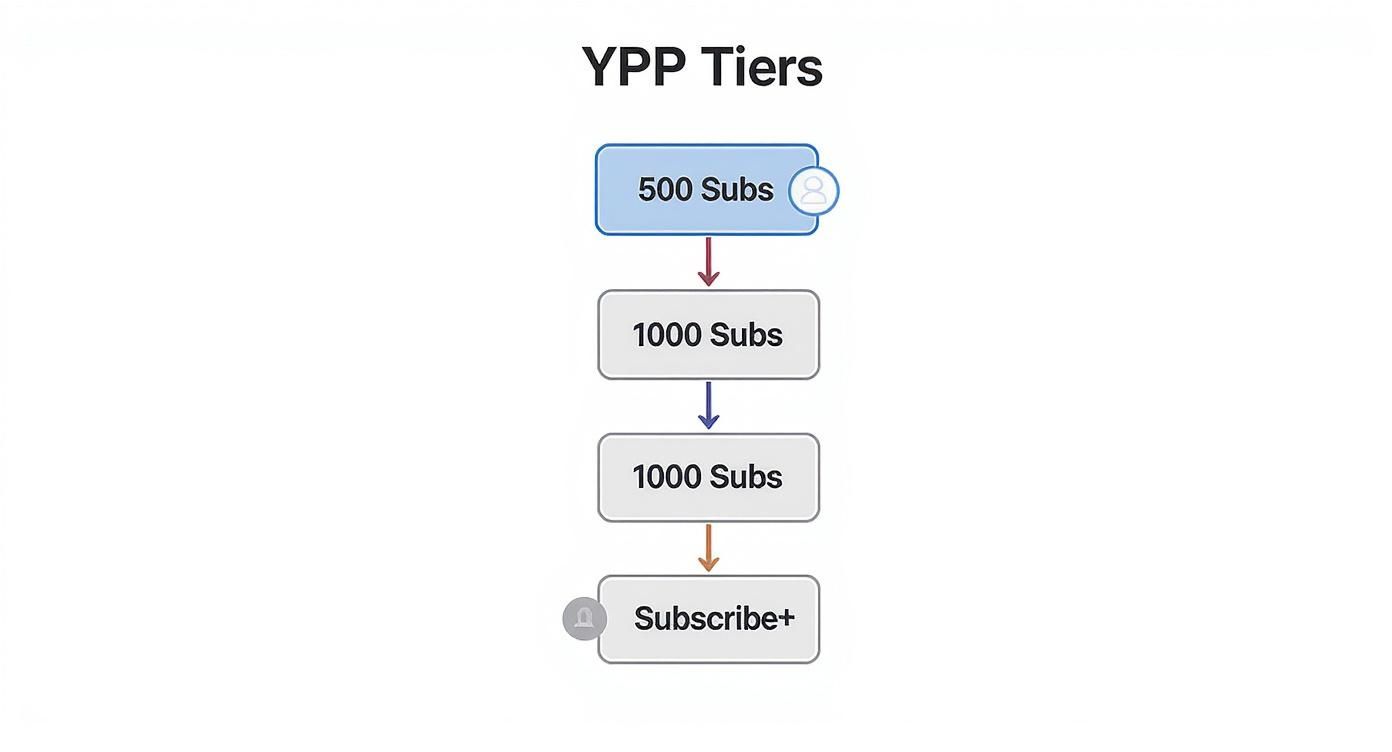
As you can see, the journey starts with fan-funding features at 500 subscribers and ramps up to full ad revenue sharing once you hit the 1,000-subscriber mark.
Ultimately, what you earn from YouTube Shorts can swing wildly depending on your niche, audience, and how much they engage. While many creators see somewhere between $0.01 and $0.05 per 1,000 views, that can add up fast. Top creators are banking thousands per month from ad revenue alone.
When you start combining that with things like brand deals and Super Thanks, your income potential really starts to climb. You can find more insights on how much YouTube Shorts can make on Bluehost. The system might seem complex, but it offers a clear path for turning viral content into a reliable income stream.
Building Income Streams Beyond Ad Revenue

Relying only on YouTube’s ad revenue is like building a house with just one pillar. It’s shaky. The smartest creators I know have learned that real financial stability comes from having multiple income streams.
Sure, the YouTube Partner Program is a solid foundation. But the real money, the kind that gives you freedom, comes from building revenue sources you actually control. Think of ad share as your baseline income—it’s a great start, but it can swing wildly with algorithm shifts or advertiser whims. These next steps are about taking back control.
Securing Lucrative Brand Sponsorships
One of the most powerful ways to earn from Shorts is through brand sponsorships. This is simply a brand paying you to feature their product or service in your content. For many creators, a single well-negotiated brand deal can eclipse months of ad revenue.
But brands don’t just magically show up. You need to look like a pro. The first step is creating a professional media kit. Think of it as your creator résumé—a slick, one-page document that spells out why a brand should work with you.
Here’s what it absolutely needs to include:
- Key Channel Analytics: Your subscriber count, average Shorts views, and basic audience demographics (age, gender, location).
- Engagement Metrics: Don’t just show views; highlight your like-to-view ratio and comments per video. This proves you have an active community, not just a bunch of passive scrollers.
- Past Collaborations: If you’ve worked with brands before, showcase their logos. This is instant social proof.
- Your Unique Value Prop: A quick sentence or two explaining what makes your audience tick and why they’re the perfect fit for the right sponsor.
Once your kit is polished, start reaching out. Don’t wait for brands to find you. Make a list of companies whose products you already use and genuinely love. The promotion will feel authentic because it is authentic.
Mastering Affiliate Marketing for Shorts
Affiliate marketing is probably the most accessible way to start making money beyond the YPP. The whole concept is beautifully simple: you recommend a product, and if someone buys it through your unique link, you get a commission. The best part? You can start doing this from day one, even with a tiny audience.
Success here boils down to one word: authenticity. Only promote products you genuinely use and believe in. Your audience’s trust is your greatest asset; don’t trade it for a quick buck. A good starting point is joining big affiliate programs like Amazon Associates or ShareASale, which give you access to a massive product catalog.
Pro Tip: Don’t just drop a link and pray. Weave the recommendation into your content naturally. For example, if you’re a fitness creator, you might mention the specific protein powder you use and then point people to a pinned comment where they can find your affiliate link.
To really get this dialed in, it helps to understand the fundamentals of affiliate marketing for content creators, as this can easily become a huge chunk of your overall income.
Selling Your Own Products and Services
This is the end game. It’s the ultimate monetization strategy because you control everything—the product, the price, and you keep 100% of the profits. It might sound like a massive leap, but it’s more doable than you think.
Digital products are a fantastic place to start because they have zero overhead and can be sold an infinite number of times.
- E-books or Guides: A personal finance creator could sell a simple “Beginner’s Budgeting Template.”
- Presets or Templates: A video editing channel? Sell your custom color-grading presets for popular software.
- Short Online Courses: A cooking channel could package up a mini-course on mastering basic knife skills.
Physical merchandise—think t-shirts, mugs, or hats—is great for building a stronger sense of community. You don’t even need to handle inventory yourself. Services like Printful or Teespring take care of all the printing and shipping for you. Just upload your designs and drop the store link in your bio and pinned comments.
The real magic here is how much it boosts your earnings per view. A single sale of your own product can be worth more than millions of ad-supported views.
Alternative Revenue Stream Comparison
So, where should you start? It really depends on your niche, your audience, and how much time you have. This table breaks down the options to help you decide where to focus your energy first.
| Revenue Stream | Effort Level | Income Potential | Best Niches |
|---|---|---|---|
| Sponsorships | High | Very High | Tech, Beauty, Fitness, Gaming |
| Affiliate Marketing | Medium | Moderate to High | Product Reviews, DIY, Fashion |
| Digital Products | High (Initial) | Very High | Education, Finance, Creative Arts |
| Merchandise | Low to Medium | Low to Moderate | Comedy, Entertainment, Lifestyle |
Honestly, the most effective approach is a blended one. You can start with affiliate marketing right away, build toward landing brand sponsorships as your channel grows, and maybe start outlining your own digital product as the long-term goal. That’s how you monetize YouTube Shorts like a true professional.
Content Strategies That Boost Your Earnings
Going viral feels great, but a real content strategy is what turns a fun hobby into an actual business. If you’re serious about monetizing YouTube Shorts, your videos need to do more than just get a laugh—they need to push viewers to do something. That something could be anything from watching another video (boosting your ad revenue) to clicking an affiliate link.
You have to start thinking like a marketer, but without sounding like one. Every single Short is an opportunity to grab a new subscriber, introduce your longer videos, or even make a direct sale. These strategies are all about crafting content that doesn’t just rack up views, but turns those views into income.
Identify High-Value Niches
Let’s be honest, not all niches are created equal when it comes to making money. Certain topics are goldmines for advertisers, and that means a bigger piece of the ad revenue pie for you. Niches like personal finance, tech, beauty, and fitness often have a much higher RPM (Revenue Per Mille) because the people watching are already in a buying mindset.
Picking a profitable niche takes a little homework. Just think about topics where people are constantly talking about products and services. A channel reviewing the latest phones, for example, is perfectly set up for both high-paying ads and juicy affiliate commissions.
To find these sweet spots, you need to get good at keyword research. People often think it’s just for long-form videos, but the same rules apply to Shorts. You’re searching for topics people are actively looking for that also have obvious ways to make money. Our guide on keyword research for beginners is a great place to start digging for those high-value ideas.
Master the First Three Seconds
The Shorts feed is brutal. You have a split second to grab someone’s attention before they swipe on to the next video. That means the first three seconds are absolutely everything. High retention is a huge signal to the YouTube algorithm, and it all starts with a killer hook.
Your opening needs to be instant and interesting. Kick things off with a bold claim, a weird visual, or a question that makes people curious. Ditch the slow intros and forget the fancy logo animations. Get straight to the good stuff.
Pro Tip: A ridiculously effective trick is to flash some text on the screen in the very first frame. If you’re making a recipe Short, something like “The 3-Ingredient Dessert You Need” instantly tells the viewer what they’re getting and stops their thumb mid-scroll.
Create Compelling Content Series
A one-hit-wonder Short is cool, but a series of connected Shorts is how you build a loyal audience that actually spends money. A series gives people a reason to come back for more, which juices your channel’s total views and watch time. It also gives you way more chances to promote a product or send traffic to a specific link.
Here are a few series ideas that are perfect for monetization:
- A “30-Day Challenge” Series: In the fitness niche? Create a daily Short as part of a workout challenge, and drop a link to your favorite protein powder in a pinned comment each day.
- A “Product Testing” Series: If you’re a tech or beauty creator, test a new gadget over several days, giving little updates in each Short. This builds suspense and makes your final review feel much more legit.
- A “Myth-Busting” Series: Pick a common belief in your niche and spend a few Shorts proving it wrong. It’s a fast way to position yourself as an expert.
Put a Unique Spin on Trends
Jumping on trends is a shortcut to getting a burst of views. We all know that. But just copying what everyone else is doing won’t build a brand that lasts. The real magic happens when you adapt a trend to fit your own style and niche. You get to tap into a huge, active audience while still showing them what makes your channel special.
For example, if a specific sound is trending, don’t just do the same dance everyone else is doing. How can you use that audio to share a quick tip or tell a story related to your topic? For creators looking to make their content pop, adding text to speech on YouTube Shorts can be a great way to stand out while using trending audio.
When you mix what’s popular with your own flavor, you get the best of both worlds: the immediate visibility of a trend and the long-term benefit of building your own brand. This is a core part of learning how to monetize YouTube Shorts, because it attracts an audience that’s there for you, not just for the latest meme.
Common Questions About Monetizing Shorts
When you’re trying to figure out how to monetize YouTube Shorts, a lot of questions pop up. The game is just different from long-form video, and the money side of things can feel like a black box. Let’s clear the air and tackle the questions I hear most often from creators.
How Many Views Do I Need on a Short to Make 100 Dollars?
There’s no magic number here, but we can definitely work with some real-world estimates. The money you earn for every 1,000 views, what we call RPM, usually lands somewhere between $0.01 and $0.05 for Shorts. That’s a huge range, and it’s all based on a few key things.
To pocket $100 from ad revenue alone, you’re probably looking at somewhere between 2 million and 10 million views.
So why the massive gap? It boils down to this:
- Audience Location: Viewers from places like the United States just have more ad money spent on them. It’s that simple.
- Your Niche: A Short about investing is almost always going to earn more per view than a funny cat video. Advertisers pay way more to get in front of audiences interested in high-value topics.
- Overall Engagement: Views are the main metric, but high engagement tells YouTube your content is solid, which can give you a little boost in the Creator Pool.
The big takeaway? Focus on making great content, consistently, in a niche that has some value. That’s the surest way to bump up your RPM and hit your goals faster. It might feel like a grind to earn a lot from views alone, and many creators wonder what it takes to hit those bigger milestones. If you’re curious about what goes into reaching a larger financial goal, you can learn more about what it means to make six figures in our related article.
Can I Monetize Shorts That Use Popular Music?
Yes, you can—but it comes with a pretty big financial hit. Hopping on a trend by using a popular song from YouTube’s library is a great way to get seen, but it will directly slice into your earnings for that Short.
Here’s how it works: when you use a licensed music track, the ad money from your video gets split between you and the music rights holders before you even see your 45% cut.
If you use one track, half the revenue goes to the music publishers before it even hits the Creator Pool. Use two tracks, and two-thirds of that revenue is gone. Your final payout will be a lot smaller than if you’d used your own audio.
For creators who are serious about maximizing ad revenue, the strategy is clear: create your own original audio or stick to royalty-free music. It’s a simple choice that makes a huge difference to your bank account.
Should I Focus on Shorts or Long-Form Videos?
Honestly, the smartest creators don’t pick one over the other. They use both as part of a single, connected strategy. Each format does a different job, and you need both to build a truly profitable channel.
- Long-form videos have a much higher RPM and more ad types, which means they make you way more money per view.
- Shorts are an incredible tool for quick growth and getting discovered by people who would never have found your longer stuff.
The winning move is to use Shorts as your hook. They bring in a huge, engaged audience with quick, bite-sized content. Then, you funnel that audience over to your long-form videos, where the real monetization happens. Shorts build the audience; long-form builds the bank.
Can I Make Money from Shorts Without the YPP?
Absolutely. You need to be in the YouTube Partner Program (YPP) to get a slice of ad revenue, but you can—and should—start monetizing your content from day one. Just waiting around for the YPP is a slow and often painful way to go.
Plenty of creators build solid income streams long before they even qualify for the YPP. You can start by focusing on:
- Getting brand sponsorships for product features.
- Dropping affiliate links in your pinned comments and channel bio.
- Selling your own merch or digital products.
- Taking fan donations through sites like Patreon or Ko-fi.
These methods put you in the driver’s seat. You’re building a real business from the start while you work your way toward unlocking that official ad money.
At Daniel Proctor, we provide the mentorship and step-by-step training you need to build a profitable online business with affiliate marketing. Check out our free masterclass to get started.
