


For anyone just dipping their toes into the world of SEO, keyword research is where it all begins. It’s the process of figuring out the exact words and phrases your potential customers are typing into Google. Think of it as learning your audience’s language so you can join the conversation they’re already having.
Get this right, and you’ll attract the perfect visitors to your website—people who are actively looking for what you have to offer.
What Is Keyword Research and Why It Matters

Imagine you opened a fantastic new coffee shop, but you didn’t put up a sign or tell anyone where it was. That’s pretty much what building a website without keyword research is like. At its core, keyword research is the foundation of any solid SEO plan. It’s how you connect with people who are looking for the exact solutions you provide.
Instead of just guessing what your audience wants, you get to use real data to uncover their needs, questions, and pain points. But it’s not just about finding popular search terms. It’s about understanding the intent behind those searches. Is someone looking to buy now, learn something new, or just find a specific website?
Nailing this process helps you achieve a few key things that are absolutely critical for growth.
The Real Impact on Your Website’s Success
Good keyword research does a lot more than just help you rank higher on Google. It directly impacts your ability to pull in the right kind of traffic—visitors who are genuinely interested in your products, services, or content.
Here’s why it’s a non-negotiable part of the process:
- Attract Qualified Traffic: You bring in an audience that’s already looking for what you do. That means they’re far more likely to become customers or loyal subscribers.
- Understand Your Audience Better: Keywords are a direct window into the minds of your target customers. They show you exactly what people are struggling with and what they want.
- Build Topical Authority: When you consistently create content around a specific set of related keywords, you start signaling to Google that you’re an expert in your niche.
- Gain a Competitive Edge: Peeking at the keywords your competitors are ranking for can reveal gaps in their strategy that you can swoop in and fill.
Keyword research transforms your content strategy from a shot in the dark to a calculated plan. It ensures every article, page, and video you create has a built-in audience waiting to discover it.
Let’s be clear: organic search is still a massive driver of online business. In fact, 53% of all website traffic comes from people finding sites through search engines. The catch? The competition is fierce. Nearly 70% of all clicks go to the top five organic results, which makes a data-driven approach absolutely essential.
Keyword research is a cornerstone of a much bigger marketing puzzle. To really see why it’s so important, it helps to understand the fundamentals of What is Search Engine Optimization (SEO). Getting this groundwork right sets you up for long-term success.
Before you can find killer keywords, you need to speak the language. Don’t worry, it’s not as complicated as it sounds. Think of it like learning the basic stats on the back of a baseball card—once you get what “batting average” means, you can quickly size up any player.
It’s the same deal here. Once you nail a few key ideas, you can look at any keyword tool and know exactly what the data is telling you. This foundation is everything when it comes to picking keywords that are actually worth your time.
Search Volume and Keyword Difficulty
The first two metrics you’ll see everywhere are Search Volume and Keyword Difficulty. They go hand-in-hand to tell you how many people are looking for something and how tough it’ll be to show up in their search results.
- Search Volume: This is the average number of times people punch a specific keyword into Google each month. A huge number (like 10,000+ searches a month) looks tempting because it means tons of interest, but it almost always comes with brutal competition.
- Keyword Difficulty (KD): This is usually a score from 0-100 that gives you a rough idea of how hard it is to crack the first page of Google. A low score (think 0-15) is a green light, especially for a newer website.
I like to think of it like picking a fishing spot. A massive, famous lake (high search volume) is packed with other anglers (high keyword difficulty). But a smaller, hidden pond (low search volume) has just a few people fishing (low keyword difficulty), which means you have a much better shot at actually catching something. As a beginner, your job is to find those quiet, promising ponds.
Short-Tail vs. Long-Tail Keywords
Not all keywords are built the same. They generally fall into two buckets based on their length, and knowing the difference is your first strategic advantage.
A short-tail keyword is short and sweet, usually just one or two words like “coffee.” It gets a massive amount of searches, but the competition is insane. Plus, you have no idea what the person actually wants. Are they looking for a café? Beans to buy? The history of coffee? Who knows.
Then you have the long-tail keyword. This is a longer, much more specific phrase like “best espresso machine for small kitchen.” The search volume is way lower, but so is the competition. And the best part? You know exactly what that person is looking for. That clarity is your secret weapon.
The real money for beginners is in the long-tail. Everyone chases the big, flashy keywords, but they’re only a tiny slice of all searches. By going after specific, lower-volume terms, you attract people who are much closer to making a decision.
The data backs this up completely. A staggering 94.74% of all keywords globally get 10 or fewer searches per month. This little-known fact, highlighted in search trends by Digital Silk, reveals a paradox: chasing only the most popular terms is a game you’ll probably lose. The real traffic is spread out across millions of these super-specific long-tail searches.
The Power of Search Intent
This is easily the most important concept you need to burn into your brain: search intent. It’s the “why” behind what someone types into Google. Get this wrong, and you’ll never rank, no matter how awesome your content is.
You have to create content that matches what the searcher is actually trying to do. It’s pretty simple once you see the four main types.
The table below breaks down the four types of search intent. Think of it as your cheat sheet for figuring out what people want and what kind of content you should create to give it to them.
Decoding Keyword Types and User Intent
| Search Intent Type | What It Means | Example Keyword | Best Content Match |
|---|---|---|---|
| Informational | They want to learn something or find an answer. | “how to make cold brew coffee” | Blog post, how-to guide, video tutorial |
| Navigational | They’re trying to get to a specific website. | “Starbucks login” or “Daniel Proctor blog” | Your homepage or a specific landing page |
| Commercial | They’re researching and comparing options before buying. | “best coffee grinders 2024” | Review article, comparison list, buyer’s guide |
| Transactional | They are ready to pull out their wallet and buy. | “buy Keurig K-Mini coffee maker” | Product page, sales page, category page |
See how that works? Matching your content to the user’s goal is non-negotiable. If someone searches for “best coffee grinders,” they expect a review or a comparison—not a sales page trying to push a single product on them. Give Google what it knows its users want, and you’ll be rewarded.
A Simple Step-by-Step Keyword Research Process
Alright, now that you’ve got the core concepts down, it’s time to roll up our sleeves and get to work. Theory is one thing, but having a repeatable process is what actually gets results.
This section breaks down keyword research into five simple, manageable steps. We’ll go from a fuzzy idea to a concrete content plan you can actually use.
To make this real, let’s walk through an example. Imagine you just launched a new online store called “Leafy Friends,” and you specialize in houseplants for total beginners. Your goal is to get found by people who are just starting their plant parent journey.
Step 1: Brainstorm Your Seed Keywords
Everything kicks off with a simple brainstorm. Put the tools and data aside for a minute. Your only job right now is to get inside your customer’s head. What broad topics and ideas are they thinking about? These are your seed keywords.
For our “Leafy Friends” plant shop, the list might look something like this:
- houseplants
- indoor plants
- low-light plants
- pet-friendly plants
- beginner plants
These seeds are the starting point for everything. Think of them as the main pillars of your business. We’ll use these to uncover hundreds, maybe even thousands, of more specific keyword ideas.
Step 2: Expand Your List with Keyword Tools
With your seed keywords ready, it’s time to find out what real people are actually typing into Google. This is where keyword research tools come in. You don’t need a super expensive tool to get started; plenty of free and “freemium” options will get the job done. The top tools for this include Ahrefs’ Free Keyword Generator and Ubersuggest. Even just the Google search bar’s autocomplete feature is a great starting point. The goal here is to blow up your initial list into a massive collection of related phrases and questions.
For “Leafy Friends,” plugging in “beginner plants” might spit out ideas like:
- best beginner houseplants that are hard to kill
- easy indoor plants for beginners
- low-maintenance plants for apartment living
- what is the easiest houseplant to take care of
Do this for every single seed keyword. By the end of this step, you should have a spreadsheet with hundreds of potential keywords. Don’t judge or filter them just yet—the name of the game is collection.
Step 3: Analyze and Find the Golden Nuggets
Okay, so now you have a giant, messy list. Most of it is probably junk. Your next move is to sift through all that noise to find the “golden nuggets”—keywords that hit the sweet spot of decent search volume and low competition. This is where we start looking at the metrics.
You’ll want to focus on long-tail keywords (phrases of 3+ words) because they almost always have lower competition and much clearer search intent. Pay close attention to keywords with a low Keyword Difficulty (KD) score. As a new website, these are your best shot at ranking.
Our “Leafy Friends” owner might see that a broad term like “houseplants” has a KD of 85 (basically impossible), but a long-tail phrase like “best pet-friendly plants that clean air” has a KD of just 12 (much, much easier). That second one? That’s a perfect golden nugget.
This visual guide breaks down how you should be thinking about each keyword’s potential.
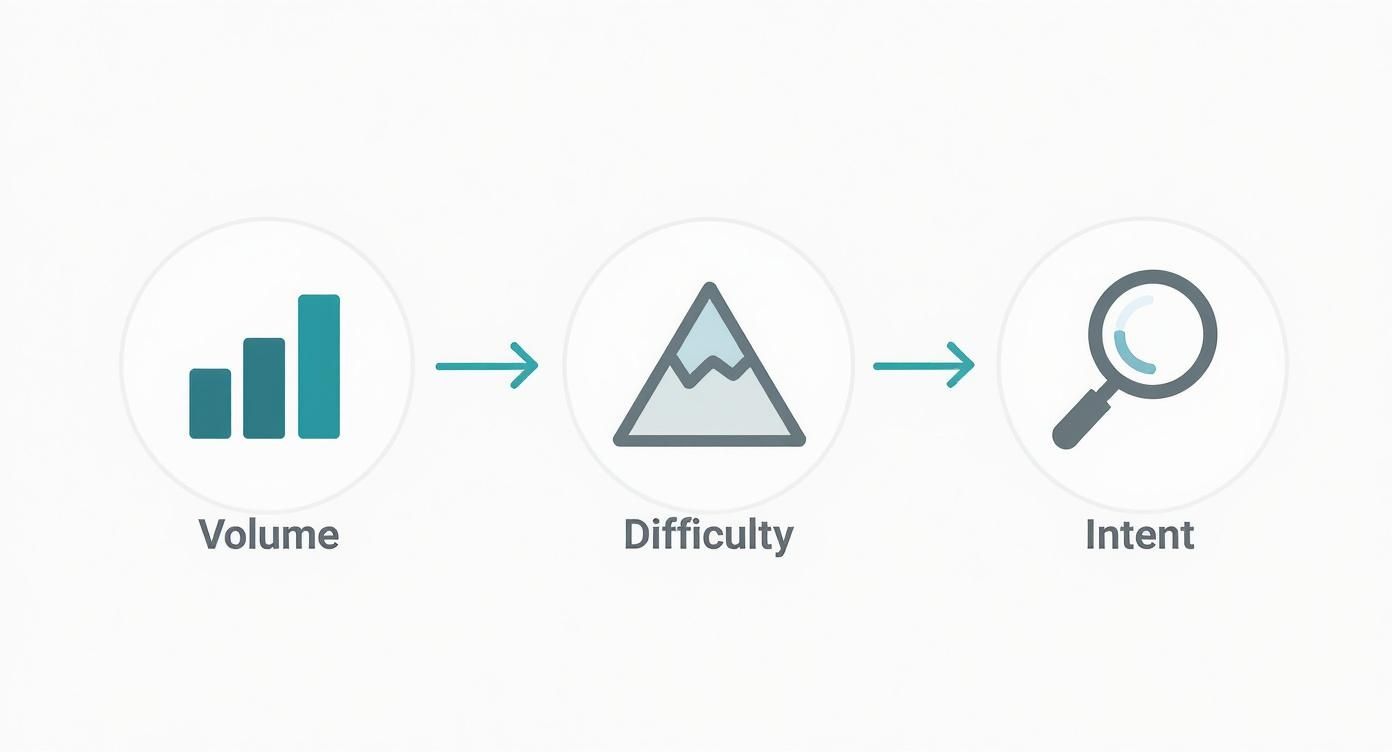
The process shown here—looking at volume, difficulty, and intent—is the framework you’ll use to find keywords that are both valuable and attainable.
The goal isn’t to find the keyword with the highest search volume. For beginners, the goal is to find the most relevant keyword you have a realistic chance of ranking for.
Go ahead and filter your spreadsheet to prioritize keywords with lower difficulty scores. This will give you a shortlist of your most promising targets.
Step 4: Investigate Search Intent on Google
Metrics from a tool are a great starting point, but they don’t tell you the whole story. Before you commit to a keyword, you have to check the search intent by actually looking at the Google results. This is a critical step that so many beginners skip.
Type your target keyword into Google and study the top-ranking pages. Ask yourself:
- What type of content is ranking? Is it blog posts, product pages, videos, or something else?
- What is the format? Are they “how-to” guides, listicles (“Top 10…”), or product reviews?
- What’s the angle? Is the content for beginners, experts, or people on a tight budget?
If you want to rank for “easy indoor plants” and every single top result is a list-style blog post, then you should probably create a list-style blog post. Trying to force a product category page to rank for that search term will be an uphill battle because it doesn’t match what Google knows its users want to see.
Step 5: Group Keywords into Topic Clusters
The final step is to bring some order to the chaos. You’ll want to organize your chosen keywords into logical groups, which we call topic clusters. This is a modern SEO strategy where you create one main “pillar” page on a broad topic and then support it with several “cluster” pages that dive deeper into related subtopics.
For our “Leafy Friends” shop, the plan might start to look like this:
- Pillar Page: “The Ultimate Guide to Houseplants for Beginners”
- Cluster Content 1: “10 Pet-Friendly Plants for Your Home” (targeting “pet-friendly plants”)
- Cluster Content 2: “The Best Low-Light Plants for Dark Apartments” (targeting “low-light plants”)
- Cluster Content 3: “How to Water Your Indoor Plants Correctly” (targeting “how to water houseplants”)
By following this repeatable process, you can turn a simple idea like “houseplants” into a structured content plan. You’ll know exactly what to write about, who you’re writing for, and why you have a real shot at ranking and pulling in the right kind of traffic.
The Top Keyword Research Tools for Any Budget
Walking into the world of keyword research tools can feel a bit like stepping into a giant hardware store for the first time. There are so many options, but which one is actually right for the job you need to do?
The good news is you don’t need the most expensive, feature-packed tool right out of the gate. Honestly, the best tool is the one that fits your budget and helps you find those golden-nugget keywords without a massive learning curve.
Let’s break down the top tools into three simple categories: the free essentials, the “try before you buy” options, and the pro-level powerhouses. I’ll walk you through the top choices in each so you can make a smart decision.
Powerful Free Tools to Start Your Journey
When you’re just starting, free is the best price. And luckily, some of the most powerful data comes straight from Google itself, giving you a solid foundation without costing you a dime.
- Google Keyword Planner: This is the OG keyword tool. It was built for advertisers, but it’s incredibly useful for SEO. You’ll get search volume in broad ranges (like 1K-10K) unless you’re running an active ad campaign, but it’s an absolute goldmine for uncovering new keyword ideas directly from the source.
- Google Trends: This one is fantastic for understanding the bigger picture. You can see a topic’s popularity over time, check for seasonal spikes, and figure out if a keyword is a fleeting fad or a stable trend. This is crucial for planning your content calendar.
- Ahrefs Free Keyword Generator: A great little tool that gives you a taste of what a premium platform can do. Just pop in a seed term, and it spits out the top keyword ideas along with their search volume and a keyword difficulty score.
These tools are perfect for brainstorming and getting a basic feel for what your audience is actually searching for.
Freemium Tools That Grow with You
The next step up is the “freemium” category. These tools give you a limited number of free searches each day but pack in more advanced features than the completely free options. They’re an excellent way to test-drive professional-level data before you decide to subscribe.
A real standout here is Ubersuggest by Neil Patel. It presents data in a super user-friendly, visual way that’s perfect for beginners. You can analyze keywords, see who’s ranking at the top, and get content ideas—all within a generous daily free limit.
Think of freemium tools as a test drive. You get to experience the handling and features of a high-performance car before deciding if you’re ready to buy it. They bridge the gap between basic brainstorming and deep analysis.
This approach lets you learn the ropes with more sophisticated metrics without any financial risk.
Industry-Standard Paid Platforms
When you’re ready to get serious about SEO and need deep competitive insights, it’s time to invest in a paid tool. These platforms are the industry standard for a reason; they offer incredibly comprehensive data that can give you a massive edge.
A few of the top choices include:
- Ahrefs: Widely regarded as having one of the best backlink indexes and incredibly accurate keyword data. Its “Keywords Explorer” is a powerhouse, offering deep insights into keyword difficulty, traffic potential, and SERP analysis.
- Semrush: This is more of an all-in-one marketing toolkit. It has robust keyword research features, but also tools for advertising, social media, and competitive analysis. It’s a great option if you want a single platform to handle multiple marketing needs.
To give you an idea of what you’re looking at, this screenshot shows Ahrefs’ Keywords Explorer in action. It highlights key metrics like Keyword Difficulty (KD), Volume, and Traffic Potential (TP) for the term “affiliate marketing.”
Notice how “Traffic Potential” shows the total estimated traffic the #1 ranking page gets, which is often way higher than the search volume for just a single keyword.
For creators focusing specifically on video, it’s also worth checking out the 12 best YouTube keyword research tools to find options tailored for that platform. And if you’re looking to really nail your on-page SEO, our in-depth Surfer SEO review explores a tool that blends keyword research right into your writing process.
Comparing Top Keyword Research Tools
To make things even clearer, here’s a quick side-by-side look at the top tools we’ve talked about. This should help you pinpoint which one is the best fit for you right now.
| Tool Name | Best For | Pricing Model | Key Beginner Feature |
|---|---|---|---|
| Google Keyword Planner | Initial idea generation & brainstorming | Free | Direct keyword suggestions from Google’s own data. |
| Ubersuggest | Beginners who want more data without paying | Freemium | Very visual and easy-to-understand data dashboards. |
| Ahrefs | Serious bloggers & businesses needing deep data | Paid (Premium) | “Traffic Potential” metric shows the bigger opportunity. |
| Semrush | Marketers looking for an all-in-one SEO toolkit | Paid (Premium) | Combines keyword research with competitor analysis. |
Ultimately, any of these tools can get the job done. The key is to pick one, learn its ins and outs, and start putting that data to work for your content.
How to Analyze and Choose the Right Keywords
So, you’ve run the tools, pulled the data, and now you’re staring at a spreadsheet with hundreds—maybe even thousands—of potential keywords. This is where a lot of people get stuck. Getting a list is the easy part; the real skill is picking the winners that are actually going to move the needle for your business.
This isn’t just about grabbing the terms with the highest search volume or the lowest difficulty score. It’s about learning to read between the lines of the data and picking keywords that actually line up with your goals. Think of it as part data analysis, part strategic thinking.
Look Beyond the Basic Metrics
Search volume and keyword difficulty are great starting points, but they don’t tell you the whole story. To make smart choices, you’ve got to dig a little deeper. A keyword might look easy to rank for, but if it has zero relevance to what you offer, the traffic it brings is completely worthless.
Think of it this way: a keyword with 5,000 monthly searches and low competition seems like a home run. But if it doesn’t attract potential customers, it’s just a vanity metric. On the flip side, a keyword with only 50 monthly searches could be a goldmine if every single one of those searchers is ready to buy exactly what you sell.
This is where the idea of business relevance comes in. For every single keyword you’re considering, ask yourself this simple question: “If someone found my site using this phrase, would they be happy with what they discovered?” If the answer isn’t a definite “yes,” it’s probably best to move on.
Your goal isn’t just to get more traffic; it’s to get the right traffic. Prioritizing business relevance ensures that your SEO efforts actually contribute to your bottom line, not just your analytics report.
Perform a Quick SERP Analysis
One of the most powerful—and most overlooked—steps is to just manually check the SERP (the Search Engine Results Page). Before you commit to a keyword, take 30 seconds to Google it and see what’s already ranking on page one. This shows you exactly what kind of content Google thinks its users want for that search.
As you scan the first page, look for these patterns:
- Content Type: Are the top results mostly blog posts, product pages, videos, or forum threads? Your content needs to match whatever type is dominating.
- Content Format: Are they listicles (“Top 10…”), how-to guides, or in-depth reviews? This format gives you a blueprint for your own content.
- Content Angle: Is the content aimed at beginners, experts, or people looking for a deal? This helps you dial in your messaging for the right audience.
This quick check can save you from wasting hours creating content that doesn’t match what people are looking for. For example, if you create a product page for a keyword where Google is only showing informational blog posts, your chances of ranking are pretty much zero. It’s a simple check that can save you a ton of frustration. You can often manage this on-page analysis with plugins, as we cover in our comparison of Rank Math vs Yoast SEO.
Consider Modern Search Trends
Finally, remember that the way people search is always changing. The explosion of mobile and voice search, along with AI’s growing influence, has made keyword research way more dynamic. By 2025, over 60% of U.S. searches will happen on mobile, making it a non-negotiable.
And get this: 20.5% of people worldwide now use voice search, but very few marketers are actually optimizing for it. That’s a huge opportunity. These more conversational, natural-language queries prove the value of long-tail keywords, which already account for 70% of all search traffic. You can get more details on these trends and how they’re shaking up SEO in this deep dive into Google Search statistics.
Putting It All Together Your First Content Plan

Okay, so you’ve got this big list of keywords. Now what? That spreadsheet isn’t just data—it’s the blueprint for your entire content strategy.
This is where the magic happens. We’re going to turn all that raw data into a real, actionable plan that tells you exactly what to create. This is how you take hours of research and spin it into actual website traffic and growth.
Instead of just guessing what to write about, you’ll use your keywords to build a powerful, organized structure for your site. This way, every single page has a clear purpose and a built-in audience just waiting to find it.
From Keywords to Topic Clusters
One of the most effective ways to organize your content today is using a method called topic clusters. It sounds complicated, but the idea is simple.
You create one big, central “pillar” page on a broad topic. Then, you support it with several smaller “cluster” pages that dive deeper into more specific, related subtopics. Think of it like a wheel: the pillar is the hub, and the clusters are the spokes.
Let’s say your pillar page is a huge guide on “Affiliate Marketing for Beginners.” Your cluster content would then be smaller articles targeting the specific long-tail keywords you found earlier, like:
- “How to choose a profitable affiliate niche”
- “Best affiliate programs for new bloggers”
- “Writing product reviews that convert”
This structure does something really important: it screams to Google that you have deep expertise on a subject. Each cluster post links back to the main pillar page, creating this interconnected web of content that builds your site’s authority over time. And with more authority, it gets easier to rank for those really competitive terms.
Grouping keywords into topic clusters isn’t just about targeting individual search queries. You’re building a complete resource that answers multiple questions for a user. That’s exactly what search engines want to see, and it’s what they reward with higher rankings.
Mapping Keywords to Content Types
Next up, you need to decide what kind of content each keyword should become. Your keyword research has already given you some big clues about search intent, so now it’s just a matter of matching it to the right format.
Your content plan should make this crystal clear.
- Informational Keywords: These are perfect for blog posts, how-to guides, and tutorials. A keyword like “how to start a blog” is practically begging for an in-depth, educational article.
- Commercial Keywords: These are your best bet for review articles or comparison pages. Someone searching for “best email marketing software” wants a “Top 10” list, not a philosophical essay.
- Transactional Keywords: These should point directly to your service or product pages. If someone types in “buy affiliate marketing course,” they’re ready to pull out their credit card.
Organizing your plan this way ensures every piece of content perfectly aligns with what the user actually wants to do. As you start building out your articles and pages, don’t forget that off-page factors play a huge role, too. To get a better handle on that, you can find some great insights in our detailed guide on how do you get backlinks to your website.
Got Questions About Keyword Research? Let’s Clear a Few Things Up.
As you start digging into SEO, you’re bound to have some questions. It happens to everyone. Let’s tackle some of the most common ones I hear from beginners. Think of this as a quick chat to get you past those first few hurdles.
How Many Keywords Should I Target on a Single Page?
This one trips a lot of people up. The simple answer? Focus on one primary topic for each page.
That means you’ll have one main “parent” keyword, but you’ll also naturally include a handful of closely related secondary keywords. Don’t overthink it. Google is ridiculously smart these days—it understands synonyms and related ideas without you having to spell it out.
Instead of trying to cram a bunch of different keywords onto a page, your real job is to create the single most helpful piece of content on that one topic. When you do that, you’ll find all the right keyword variations just naturally fall into place.
What Is a Good Keyword Difficulty Score to Target?
Honestly, a “good” score completely depends on where your website is at right now. If you’ve just launched a brand-new site with zero backlinks, going after keywords with a difficulty score under 15 or 20 (using top tools like Ahrefs or Semrush) is a great place to start.
The smartest move for any beginner is to go after the low-hanging fruit. Start with low-difficulty keywords. It’s how you get those crucial early wins, build some momentum, and start earning a bit of authority.
As your site grows and you start picking up more backlinks, you can begin to set your sights on more competitive terms with higher scores. It’s a game of leveling up—as your site gets stronger, so do the keywords you can realistically target.
How Often Should I Perform Keyword Research?
Keyword research isn’t a “one-and-done” task you can check off a list. It’s an ongoing part of the game. You should be doing fresh research every single time you plan a new piece of content. That’s non-negotiable if you want to stay relevant.
Beyond that, it’s a good idea to give your existing content a refresh every 6 to 12 months. People’s search habits change, new keywords pop up, and you can bet your competitors are always tweaking their strategies. A regular audit keeps your content from going stale and ensures it keeps pulling in traffic for the long haul.
Ready to turn your keyword research into a profitable affiliate marketing business? At Daniel Proctor, we provide the mentorship and step-by-step systems to help you succeed. Learn the exact strategies for choosing niches, mastering SEO, and generating passive income. Start your journey with our free masterclass today!
